Posted in Posts and podcasts

St. Patrick – Baal’s Fire – 1852

Hymn of St. Patrick

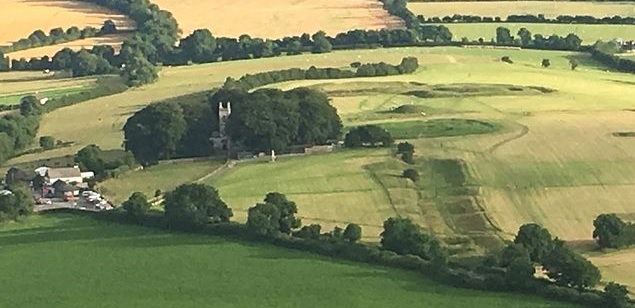
Hill of Tara
Photo: Alison Cassidy
Wikimedia Commons

The Catholic Layman Vol. 1, No. 2 (Feb. 1852), pp. 16-18
(abridged)

In the year 433 St. Patrick preached at Tara before Leogaire (or Laoghaire), then the supreme monarch of Ireland, on the celebrated hill of Tara, in the county of Meath, the chief residence of the Irish kings from the first establishment of a monarchical government in this country. The national convention or parliament was then assembled in that place, for the celebration of the great national festival of Tara, called “Baal’s fire.” The force with which St. Patrick urged upon them the truths of the Gospel, was such that, according to some accounts, the king himself became a convert to Christianity, and great multitudes of his subjects, including Dubtach, the arch-poet of the kingdom, and Conall, the King’s brother, soon followed his example. Whatever may have been the immediate effect, the preaching of St. Patrick before King Leogaire at Tara, is one of those facts on which all authorities concur.

On Easter Eve, St. Patrick arrived in the evening at a place called Ferta-fer-feic, now Slane. Having got a tent pitched there, he made preparations for celebrating the festival of Easter, and accordingly lighted the paschal fire about night-fall. It happened that at this very time the King Leogaire and the assembled princes were celebrating a religious festival, of which fire-worship formed a part. There was a standing law that at the time of this festival, no fire should be kindled for a considerable distance all around, until after a great fire should be lighted in the royal palace of Temoria, on Tara. St. Patrick’s paschal fire was, however, lighted before that of the palace, and being seen from the heights of Tara, excited great astonishment. On the king’s inquiring what could be the cause of it, and who could have thus dared to infringe the law, the Magi told him that it was necessary to have that fire extinguished immediately, whereas, if allowed to remain, it would get the better of their fires, and bring about the downfall of his kingdom. Leogaire, enraged and troubled on getting this information, set out for Slane, with a considerable number of followers, and one or two of the principal Magi, for the purpose of exterminating those violators of the law. It was immediately before, and in anticipation of the imminent peril in which he was placed when approaching the stronghold of his Pagan enemies, that a remarkable hymn was composed by St. Patrick, and is said to have been sung by him and his followers as a defence against the plots that beset his path. It is familiarly known by the name of “St. Patrick’s Armour” (Lorica Patricii) and is obviously a prayer for protection from the incantations of his Druidical opponents, who were determined on his destruction. And this is a religious armour to protect the body and soul against demons, and man, and vices.
The hymn is recorded in the celebrated M.S. Liber Hymnorum, preserved in the library of Trinity College Dublin. It is written in that ancient dialect of the Irish in which the Brehon laws, and the oldest tracts in the language are written.
Posted in Posts and podcasts

The Hooker and the Hurricane – 1877

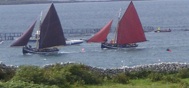
Galway Hookers Wikipedia.org
Galway Hookers
Wikipedia.org
https://widgetworld3.wordpress.com/podcasts/
FREEMAN’S JOURNAL 10TH MARCH 1877
THREE IRISH FISHERMEN ADRIFT IN MID OCEAN.

The Old Dominion, of the Old Dominion Steamship Company, arrived at New York recently, having on board seventeen men, fourteen of whom were Italians and three, natives of Ireland, who have strange stones, to tell of the recent storms at sea. The. Irishmen have a strange story to relate. One, of the three, Michael Moran, a well-built and hearty-looking man, made the following statement :

‘We are fishermen of a little village named Claddagh, near Galway, and but a short distance from where Father Burke resides. We are in the habit of going out to catch fish, which we sell in Galway. In this way we support our families. That young man there (pointing to one of his companions) is Michael Smith, who has been married but a few months. The older man is my fathor, Patrick Moran. Se is eighty-six years old. I am the father of a family of five. We are all most anxious to return to Ireland.

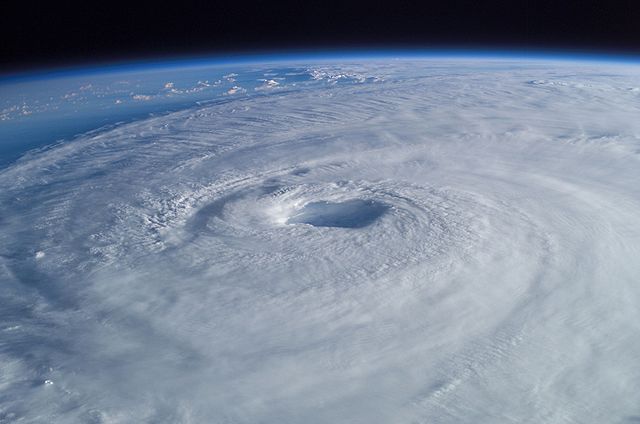
Hurricane Isabel - 2003 Photo: Astronaut Ed Lu via Mike Trenchard, Earth Sciences & Image Analysis Laboratory , Johnson Space Center.
Hurricane Isabel – 2003
Photo: Astronaut Ed Lu via Mike Trenchard, Earth Sciences & Image Analysis Laboratory , Johnson Space Center.
I was the captain of a fishing smack, or hooker, named the St. Patrick. Thinking that we might make a good haul of herring, with Michael Smith, Patrick Moran and my uncle, John Moran, I set sail in our nine ton hooker on Monday, the 4th of November, and made for Sline Head about sixty miles from Galway, where we thought the fishing would be good. We had no extra good fortune, and at night foggy weather overtook us.

The wind sprang up, blowing a perfect hurricane. My post was at the helm, where my hands became frozen. On Tuesday night the boat was half filled with water. It is our custom to light turf on setting out and keep the fire going. The water put it out. Although we had potatoes and fresh fish, we had no means to cook them. We were four days and four nights without eating. In order to break the speed with which we were driven we lowered a basket filled with stones and endeavoured to heave to, but the cable broke on Friday morning. We could not, previous to this, reach any sounding. About this time my uncle, John Moran, aged ninety- six, while we were asleep towards morning, must have been drowned by the lurching of the ship throwing him into the water. At any rate, we could discover no trace of him.
When one hundred and fifty miles out we were picked up by a Swedish bark, the Gorgian, Captain P. Olsen, bound for Hampton Roads. The ice drove the vessel into Norfolk, where we arrived on the 6th instant.

I am not a stranger to America, having been here about thirteen years ago. I have served on the Shenandoah. My father was also here twenty -five years ago, being engaged in shad fishing at Fort Lee. We are totally destitute of clothing, and have no means. We intend to see the British Consul to-morrow. We have acquaintances here, but we do not know where they live.’

Posted in Posts and podcasts

Who shall possess Tara? 1922

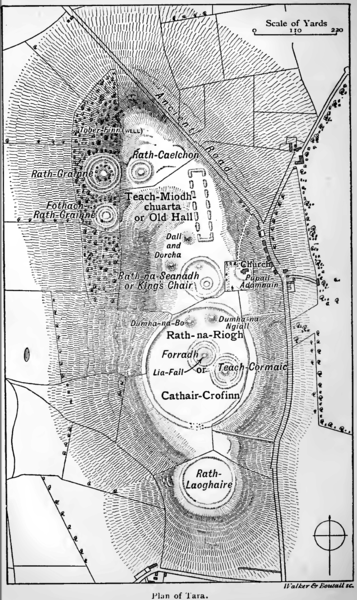
Plan of Tara Wakeman's handbook of Irish antiquities (1903). p. 166
Plan of Tara
Wakeman’s handbook of Irish antiquities (1903). p. 166

Freemans journal 23rd February 1922
Who shall Possess Tara?
THE HILL FOR SALE.

Tara Hill is in the market. Major Moore Brabazon, a member of the Meath family, is about to submit his Meath estate to the hazard of the auctioneer’s mallet. To the modern Greek, Thermopylae is immortalised ground; and so is Tara’s hill. The vital question is whether this precious heritage is to pass from one owner to another, or whether it is to become the permanent property of the Irish nation.
Tara has been strangely neglected; but specially secured as the property of the nation it would be more readily visited and more highly appreciated. Other ancient races, especially the Greeks, have revived their old games and sports. The ancient festivals of Beltaine and Samhain might be revived again in all their past glories on Tara’s Hill.
The Hill has no territorial beauty or distinction, only a low ridge of moderate dimensions; but these 330 acres of Royal Meath are very precious when we consider their historic value. Tara of ancient Druids and early kings, still haunted with the glory and glamor of ancient Ireland, hallowed by the hosts of pagan and Christian associations! The green grass of this holy and historic hill still sparkles with the’ dewy gems of legend, myth and romance during the fourteen centuries of its history.

Some outstanding features and events may be briefly noted. In the traditional period, away back in the twilight of the past, appears Ollamh Fodla, who founded the first Feis of Tara; here was- attempted the first tentative effort to found a primitive Parliament, and draw into concord and social intercourse the scattered element of Irish life. The meeting of Convocation took place every three years to preserve and improve the laws and customs, and also to verify history. It was a period of road-making; all roads led to Tara, and more than any other evidences indicate the influence and importance of Tara. The pagan epoch is demonstrated by the celebrated idol, Crum Cruach, and twelve minor idols.


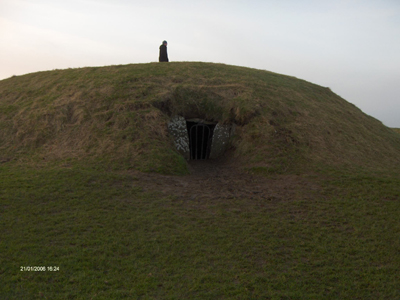
Mound of the Hostages, Tara. Photo: biekje Wikipedia.org
Mound of the Hostages, Tara.
Photo: biekje
Wikipedia.org

On Tara Hill, on Easter Day in the year 433, St. Patrick silenced the Druids of King Laoghaire in the presence of the king. It was a notable event in the history of the Christian Church of Ireland, when the heroic missionary set ablaze the Paschal fire on the Hill of Slane. It marked the doom of paganism. St. Patrick’s first move was to utterly destroy and overthrow the shrines and temples of the national idol at Mo Slecht.
In 890 Malachy the Great reigned in Tara, and in the year before his accession defeated the Norsemen in a great battle at Tara, where vast numbers were slain. Many of the revolutionaries of 1798 were buried in the sacred soil of Tara. In 1843 Daniel O’Connell addressed a monster meeting, on Tara Hill in support of the Repeal agitation. The glamor of a famous love story adds romance to the glories of battles and the splendid hospitalities of royal kings. On the northwest, in a grove of trees, stands Rath Grania. Here at Tober Finn (the crystal spring) , the lovers, Diarmuid and Grania, the daughter of Cormac Mac Art planned their elopement. When the Irish Literary Theatre was founded in 1899 the Tara romance of Diarmuid and Grania was dramatised by George Moore and W. B. Yeats. The play was produced on October 21, 1901. The scenes were the Banqueting Hall of Tara and the house of Diarmuid.
There is another charming episode. Where the road leads up the hill there is a well, and here sat Carned, the beautiful grinder of corn, grinding at her quern all day long. King Cormac, as he passed up and down the slope, gazed up on the beautiful grinder, and finally he carried her off. There was no other grinder, and the people were threatened with starvation. Ua Cuind a noble prince, had compassion upon them, and he brought a millwright over the great wave, and in this way the first mill in Erin was erected.
The stone named Lia Fail, known as the Coronation Stone or the Stone of Destiny, was through centuries one of the greatest treasures of Tara. It is said that it was carried away on the pretence to crown a king in Scotland.
The stone is generally believed to lie under the Coronation chair in Westminster Abbey. In the seventeenth, century Isaac Butler visited Tara and noted some details. He comments on the glorious views over twelve counties.
‘On the north side of the hill at the bottoms’ he says, ‘the Earl of Meath has a large modern seat arid a fine avenue.’
The residence is now known as Tara’s Hall.
The ancient Church of Tara dedicated to St. Patrick, is the most precious of all its monuments. It was built on an ancient pagan fort known as Adamnan’s Tent or Pavilion. The church is unroofed, but its grey tower is a conspicuous object over many miles. The ancient cross of St. Adamnan still exists. When Isaac Butler visited Tara there were two tolerable inns at Tara. Now there are none. Let us hope that fairy music of the past will enchant some patriot to a generous and noble deed.