Posted in Posts and podcasts

Seamount College, Kinvara – 1954

Connacht Tribune 21st August, 1954 p20 (abridged)
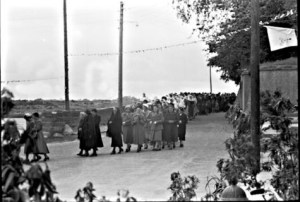
Seamount
Corpus Christi procession passing Seamount gate (on right) c. 1950 Photo: Cresswell archives

About one hundred years ago Dr. Hynes of Kinvara purchased from Lord Inchiquin a shooting lodge overlooking Galway Bay between Kinvara and Dungora Castle. Here Dr. Hynes built a residence for himself and his family and, dying, bequeathed it to his daughter, Elizabeth, who had married his successor as M.O. of Kinvara, Dr. Nally.
During Easter Week 1916 this residence was occupied by Kinvara Company of the I.R.A. and during the War of Independence it was the secret meeting place of the wanted men. Again, during the Civil War, on account of its fine accommodation and commanding position, it was occupied in turn by both of the warring forces. At that time too, Mrs Nally, now a widow, set in motion the chain of circumstances which has brought it to its present proud position by presenting it to the Sisters of the Convents of Mercy of Gort and Kinvara. The Sisters had long wished to establish a secondary school for girls. Now they had the building with which to make a start but their resources were meagre.
By 1926 a room in one of the stables had been converted into a classroom and some members of the Gort Community took up residence in Seamount House. The work was inaugurated with fifteen boarders and thirteen day-pupils. By 1928 the rest of the stable had been converted into two more classrooms and a large corridor was added to the building. As the fame of the College grew so did the numbers of boarders and day pupils, and so too, did the need for extra accommodation.
In 1938 a fine three storey building was erected which contained dormitories, class-rooms, dressing rooms, and a magnificent recreation hall with a permanent stage. Despite these extensions the sisters were unable to cope with the ever-growing volume of demands for admission and again they had to face the question of expansion of the College buildings. The old buildings were adequate for the 140 pupils in residence there in 1952 but many, many applications had to be refused. So in 1952 Mr. Ralph Ryan, M.E. Galway, prepared plans for the great extension and the work was put in the hands of Messrs. kBurke and Clancy, Galway.
And so, in thirty years, the nuns of Seamount have written a success story of which any large corporation might be proud.
Posted in Posts and podcasts

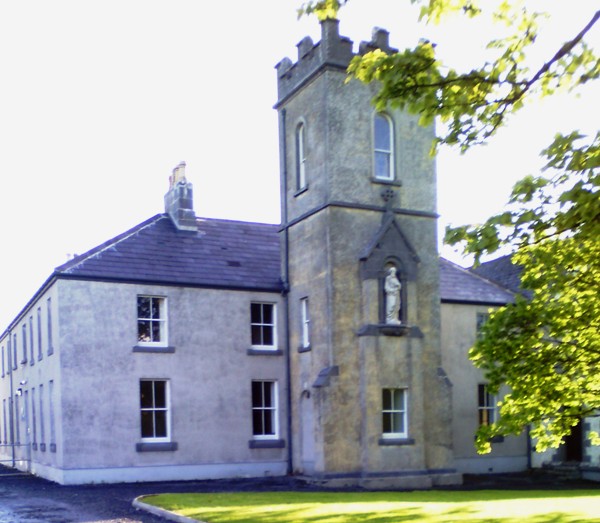
Kinvara Convent – 1876

Freemans Journal 10th April, 1876 p.8

Photo: EO'D
Photo: EO’D

NOTICE TO CONTRACTORS
This Sisters of Mercy at Gort will receive tenders on or before 29th April, for the Erection of Convent, Chapel, and School Buildings at Kinvarra, county Galway, in accordance with plans and specifications prepared by M.A. Hennessy, Esq. Architect, M. Inst., C.E.I., A.R.I.A.I.
Copies of plans &x, may be seen at the Convent, Gort, and at the office of the Architect, 10 Glentworth Street, Limerick.
The lowest or any Tender need not be accepted, and contractors are to tender at their cost.

Posted in Posts and podcasts

A Remarkable Trial – Galway – 1850

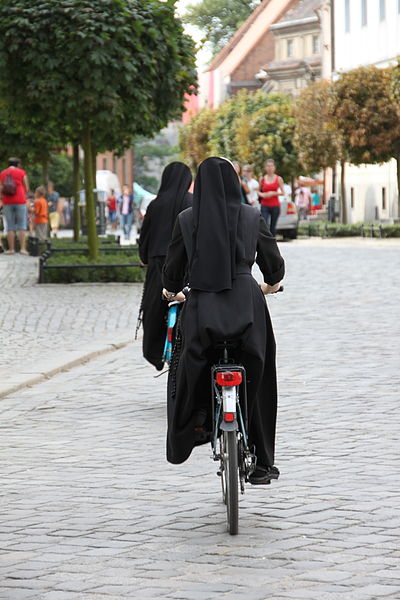
Nuns on bicycle pass in front of the Cathedral of Wroclaw, Poland Photo: Yarl Wikimedia Commons
Nuns on bicycle pass in front of the Cathedral of Wroclaw, Poland
Photo: Yarl
Wikimedia Commons

South Australian Register 21st November 1850

ACTION AGAINST THE SISTERS OF MERCY  (abridged)

The following is a compendium report of a recent remarkable trial in the Galway Record’s Court, Ireland.  Such was the public anxiety to hear this very novel trial, that at an early hour the Court was densely crowded. Mr Fitzgibbon, Q.C., stated the case.  This was an action brought by the administrator of Mrs Eliza McDonnell, to recover the sum of £500 given by her to the Sisters of Mercy, in the town of Galwav.  The circumstances were these :—

In March, 1846, Miss Harriet McDonnell, the daughter of Mrs McDonnell, was desirous of becoming a Nun of the Order of the Sisters of Mercy. Her sister, Mrs Ireland, at the request of Mrs McDonnell, called at the Convent of Mercy, to enquire as to the terms of the convent, and to settle with the nuns.  The Mother Abbess, stated that it was absolutely necessary that Miss McDonnell should spend six months as a postulant in the convent previous to her reception as a novice.  After the ceremony of her reception had taken place, she should pass two years in the convent as a novice before she could be professed.  She added that they could not, on any account, shorten the time of her profession, and that it could not be done without a dispensation from the Pope. They agreed to take the sum of £500 from Mrs McDonnell for the daughter, and that it should be left in the hands of her brother-in-law, Mr Ireland, until after her profession.  In the meantime they should receive the interest for her support.

In the month of May, 1846, the Rev. Peter Daly called on Mr Ireland, and told him that it would be of great service to the nuns if the family would give them the money at once, as they were going to invest some money on very favourable terms.  Mrs McDonnell agreed to give them the money, on their undertaking to return it in case either her daughter should wish to leave the convent before the regular time of her profession, as stated by themselves, or, in case of her death, before then.  They agreed to give the strongest guarantee to that effect, and Mrs White entered into the following agreement : —

Mrs Eliza M’Donnell— Madam, you have handed the Rev. Peter Daly, on behalf of the Sisters of Mercy, £500 sterling, the sum agreed to be received from your daughter, Harriet McDonnell, on her being professed a nun in her community, which sum we engage to return you free of interest, should either the nuns or your daughter change their minds before the period of her said profession arrives, or in the event of her decease before then.

In the month of August, 1847, Miss McDonnell took a malignant fever.  After all hopes of recovery were over, the nuns had her professed a nun.  They now contend that, as she was professed on her dying bed, they have complied with the terms of the agreement – they rely on the ambiguity of the word profession, although it was clearly provided in the agreement, that in case of her death the money should be returned.

Counsel for the case contended that it would be absurd to put any other construction upon the words, ‘period of profession’ – as it was always in the power of the nuns, by that construction, to make the money their own, and to render their guarantee a mere mockery, by professing her dying.  They were permitted by the Bishop to profess her dying, merely as consolation; and, if she survived, she should be professed again.

The Bishop of Galway directed them to return the money but they preferred taking their chance in a court of law, thinking to evade the agreement by some ambiguity on the face of it.  They were unsuccessful.

The Jury returned a verdict for the plaintiff, with £500 damages and 6d. costs.