Posted in Posts and podcasts

What an American Journalist saw – 1919

Excerpt from The Workhouse or Gaol in Galway. What an American Journalist saw by James M. Tuohy (Staff Correspondent of the ‘New York World’). Freemans Journal (Sydney) 9th October, 1919 p.14

It is not surprising to find that Galway is a strong Sinn Fein centre, and during the Easter rebellion of 1916 there was a futile rising there. A score of men were taken from Galway City and deported to English gaols and internment camps, including Dr. Walsh, bursar of the Galway branch of the National University, where he
also holds two important medical professorships. His experience may be taken as a fair sample of the treatment accorded to men against whom no charge was ever preferred, no evidence offered, and to whom no trialwas ever accorded.

In Galway I listened to the stories of a number of men of culture and refinement, professional men and others, who had been arrested not once but twice and even three times, had spent long periods in gaol or internment camps without ever being brought to trial. Space does not permit me to give the details of these statements, of which no one who heard them could fail to be convinced of the truthfulness. They have no desire to advertise the ill-treatment and injustice to which they have been subjected, but their indignation was roused by Mr. MacPherson’s impudent misrepresentations.


As I have said, D.O.R.A. (Defence of the Realm Act) is all powerful in Galway and throughout the west of Ireland. Hardly a night passes that a police raid is not made on some house either in the town or the surrounding country ; searches are made and men arrested without charge, some being taken off into confinement, no one knows whither. These raids are preferably made in the dead of night, the police being accompanied by lorries full of soldiers, fully armed. The victims are handcuffed, placed in the lorries and taken perhaps to the large military barracks at Renmore, across the river. The next that is heard of them usually is that they have been sentenced by court martial for being in possession of ‘seditious’ literature or some similar crime.


Then there is the ‘Customary display of force by the army of occupation — squads of soldiers marching hither and thither with their trench helmets on to overawe people. But the people seem to be unconscious of these provocative demonstrations which, strike the newcomer with amazement. Apparently familiarity breeds contempt.

Note; Mr Lloyd George sent Mr Ian MacPherson to Ireland with ‘the Coercion Act in one hand and the Defence of the Realm Act in the other.’
Posted in Posts and podcasts

Kinvara politics – 1917

The Register 18th June, 1917

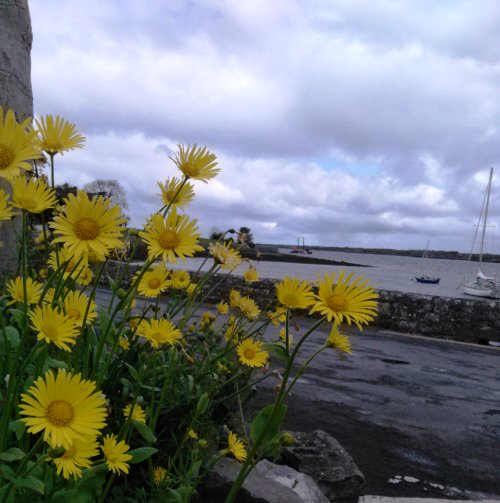
Kinvara Photo: EO'D
Kinvara
Photo: EO’D

Kinvara – Politics, as they go, are still matters of conversational interest here. The Sinn Fein movement is mentioned by some with sympathy for motive and contempt for methods and organisation. The rising came as a surprise, if not a shock, to some persons, but there were, or are, scattered sympathisers or objectors to the more drastic of the methods of repression among the middle as well as the working classes. For among those who paid the inevitable penalty of revolt in time or war were some leaders of ripe scholarship and, in other respects, stainless lives; “Poets of the Insurrection” as they were called, whose mistakes of judgment, policy and method are lightly regarded by those of emotional temperament to whom disinterestedness primarily appeals. Discontent now turns on the recent check to Home Rule as expressed in the Government of Ireland Act 1914. There is a feeling that the political system – Union Government – is still the source of any economic maladjustment and that the country will at once flower under the working of autonomy.
the Hon. P.McM.Glynn K.C. Minister for Home and Territories.

Posted in Posts and podcasts

Rising – 1917

Watchman 1st November, 1917 p.7

Liam Mellows Wikimedia Commons
Liam Mellows
Wikimedia Commons

A cable from New York, dated Sunday last, states that the Secret Service has frustrated a second Sinn Fein rebellion which was planned to occur next Easter, on the anniversary of last year’s bloody Dublin riots. German gold was scheduled to play a part. The preliminaries were mapped out, and ready to be put in operation, when the Secret Service men stepped in and arrested “General” Liam Merlewes (sic.) one of the leaders of the 1916 outbreak. Baron von Reculinghausen (sic.) was apparently Count von Bernstorff’s designee to watch Germany’s interests in Ireland after Bernstorff was ousted from the United States.

The Canadian authorities, acting upon the information received from the Secret Service, arrested Dr. Patrick McCarton, upon his arrival at Halifax. He was travelling on a fraudulent seaman’s passport. McCarton enjoyed the title “Ambassador of the Irish Republic to the United States.” It is commonly reported that German agents are busy in Ireland, attempting to stir up a second outbreak. A German cargo, which submarines carried, comprising machine guns and ammunition, was landed in lonely inlets in the Irish Sea.

It is understood that the United States possesses the official Sinn Fein report of the 1916 riots and other valuable data in connection therewith. Merlewes (Mellows), prior to the Easter Monday rebellion, spent three months in an English prison. Later he proceeded to Galway, and organised 700 volunteers for the United States, following the failure of the revolt.

McCarton arrived in the United States early in 1917, a fugitive from justice. Both decided to return to Ireland. McCarton sailed on October 17.

Posted in Posts and podcasts

A dangerous association – 1919

The Sun, 13th September, 1919

Rain on the wind EO'D
Rain on the wind
EO’D

Special cable despatch to The Sun from the London Times Services;
Whereas by our special proclamation dated July 3, 1918, in pursuance and by virtue of the criminal law and procedure of Ireland, Act of 1887, we declared from the date thereof certain associations in Ireland known by the names of Sinn Fein organization, Sinn Fein clubs, Irish Volunteers, Cumann na mBan and Gaelic League to be dangerous, and whereas the association known by the name of Dail Eireann appears to us to be a dangerous association and to have been after the date of said special proclamation employed for all purposes of the associations known by the names of Sinn Fein organization, Sinn Fein clubs, Irish Volunteers and Cumann na mBan, now we the Lord Lieutenant-General and General-Governor of Ireland, by and with the advice of the Privy Council in Ireland, by virtue of the criminal law and procedure of Ireland Act of 1887, and of every power and authority in this behalf, do hereby, by this our order prohibit and suppress within the several districts specified and named in the schedule, and association known by the name of Dail Eireann.

Posted in Posts and podcasts

A dangerous Dáil – 1919

The Catholic Press 4th December, 1919 p.20. (abridged)

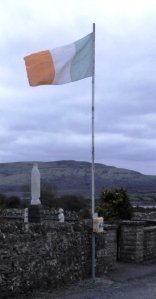
Flag1
Photo: EO’D

In a supplement of the “Dublin Gazette” the Lord Lieutenant and Privy Council of Ireland, declared that the association known as Dáil Éireann, appears to them to be a dangerous association. It was formed and first employed for all the purposes of the associations known as the Sinn Féin organisation, Sinn Féin clubs, the Irish Volunteers and Cumann na mBan.   The order to prohibit and supress it within the 32 counties and six county boroughs of Ireland was signed by the Chief Secretary and General Sir Frederick Shaw, Commander-in-Chief of the forces in Ireland.

Posted in Posts and podcasts

No turf in Kinvara – 1919

Connacht Tribune 23rd August, 1919 p.4

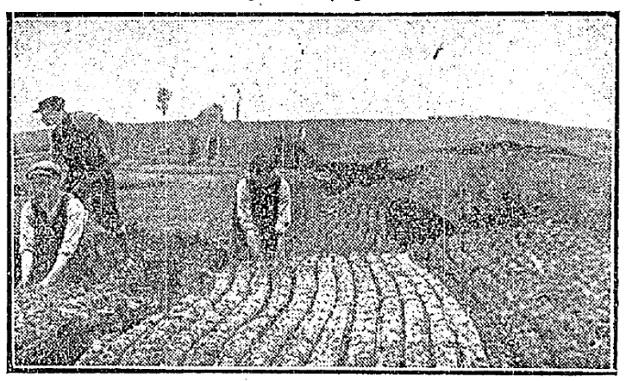
Photo: Irish Independent 2nd October, 1919.

Kinvara is presently suffering from a turf famine, which is attributed to a notice put up under the heading of “Kinvara Sinn Fein Club”, fixing the price, owing to the exorbitant prices hitherto paid for seven cart loads at £6. Turf sellers have decided not to bring any further supplies to the village until the price – hitherto £7 10s per six cart load – be fixed.

Posted in Posts and podcasts

Mutton Island – 1920

Examiner (Tas.) 11th June, 1920

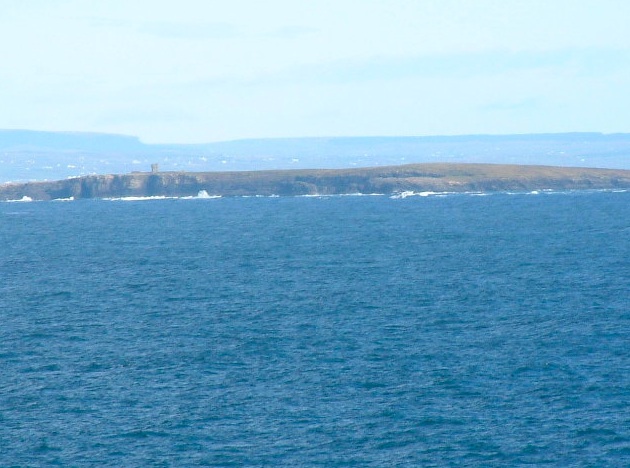
Photograph of Mutton Island with promontory Fort.  © Copyright Charles W Glynn and licensed for reuse under this Creative Commons Licence http://www.geograph.ie/photo/14048,
Photograph of Mutton Island with promontory Fort.
© Copyright Charles W Glynn and licensed for reuse under this Creative Commons Licence
http://www.geograph.ie/photo/14048,

A Sinn Fein tribunal in County Clare sentenced three men to a fortnight’s detention on Mutton Island for refusing the tribunal’s order to rebuild farm wall which they had demolished. The constabulary learned of the incident and sent a boat to rescue the marooned three who, however, stoned their would be rescuers, declaring themselves citizens of the Irish Republic and therefore the constabulary had no authority to intervene. The constabulary withdrew. The prisoners had ample provisions.