
Irish Examiner 1st April, 1850 p.4 (abridged)
As we spare no pains to collect the fullest and most authentic information connected with the social progress of the country and the development of her industrial resources, we are now enabled to lay before our readers a detailed account of the Gort Silver Mines – collected by personal inquiry and personal observation on the spot.
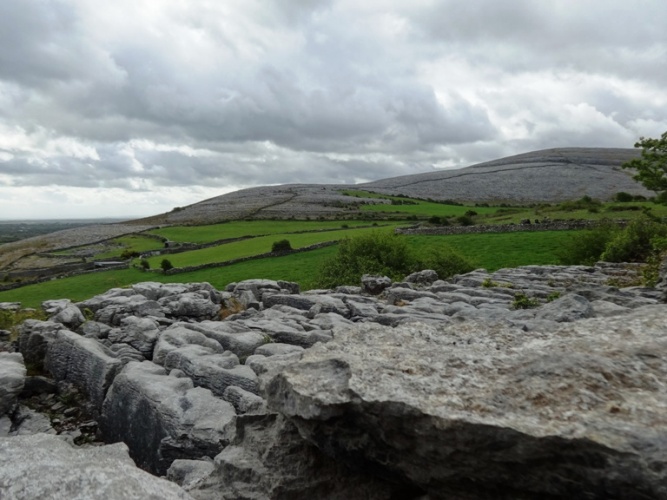
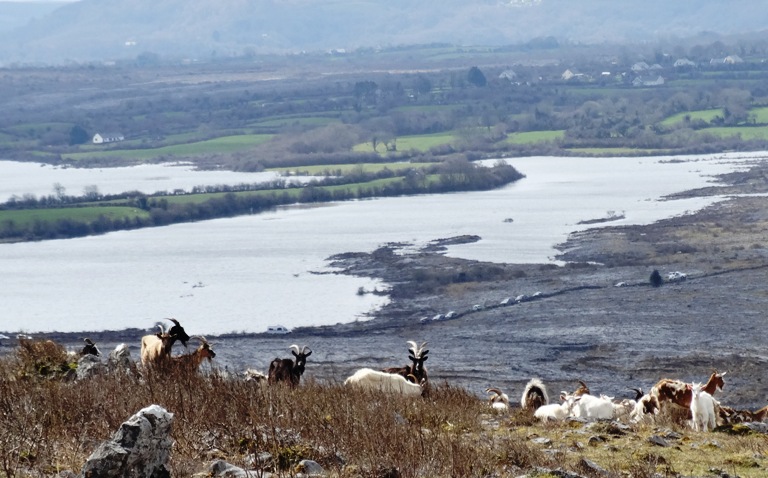
They are situated within a short ride of the thriving town of Gort, in the direction of Kinvarra, at a place called Caherglissance, upon the property of Mrs. Blair. The whole surface of the country appears to be covered with immense fragments of limestone; upon the removal of which very true soil is sometimes found; but more frequently great quarries of limestone will be discovered under the surface. The limestone is brittle and light coloured, and the soil unproductive and barren. In the distance the Kinvarra mountains rise, and give to the landscape a graceful termination. The mines are situated upon a flat surface of country which abounds with turloughs, formed by the subterranean river of Gort. This river flows out of the lake of Lough Cooter, and after proceeding for about a quarter of a mile, falls into a natural cavern of limestone rock at Rinditin where it disappears for about a mile, its course being clearly traced through several holes like wells, several of them of great depth, at the bottom of which water is clearly heard, by dropping a stone into the holes. The river again makes its appearance at Canahoun, where it flows out of a natural and picturesque arch of rock, and after passing through the town of Gort, turning in its progress several large mills, it alternately sinks and rises till it finally joins the sea at Kinvarra, a distance of seven miles, the water percolating through the sand before high water mark. Two of these turloughs are situated close to the mines, and afford an abundant supply of water.
These mines were accidentally discovered by a poor man about five years ago, but attracted no attention at the time. It was not until they were taken under the management of Mr. W. Rickford, Collett, late M.P. for Lincoln, that their real value was discovered. This gentleman is also chairman of the Killaloe Slate Company; he is described by Mr. Montgomery Martin as a man “of energy, decision, business habits, liberality and benevolent conduct.”
The mines are situated close to the surface in some places – so close that we may be naturally surprised at the length of time during which all this wealth lay concealed and useless in the bowels of the earth. Four or five openings have been made in different portions of the rock, and two or three shafts have been sunk, more for the sake of enlarging the field for labour and tracing the direction of the veins of ore with a view to more extended operations, than for the sake of collecting the ore at present. On entering one of the galleries, which are reached by flights of steps cut in the rock, the visitor will, after proceeding a few yards through a narrow passage dimly lighted with candles, arrive at a large chamber, the walls of which resemble a solid mass of crystalized lead, or silver. Here he will find several miners at work, opening new galleries, and tracing the direction of the ore. The large lumps of ore are carried out in wheelbarrows, and the portions of limestone or talc attached to them are separated with a heavy hammer, after which the ore is broken on a stone slab, by women with large hammers resembling a common smoothing iron fastened to a short stick. This gravel is sifted in copper sieves, and all the larger portions broken again until the whole is reduced to the consistency of coarse sand. This sand is afterwards placed in a copper sieve, which is immersed in a cistern of water, and by a curious rotatory motion given by the miner to the sieve, the heaviest portions, containing all the valuable metal, fall to the bottom, and the lighter portions are skimmed off with an iron scoop from the top and thrown away. The finer portion is again subjected to several washings, after which it is packed in casks for exportation to England.
Specimens of the ore of this mine have obtained 55 pounds 2s.6d per ton when brought to this state, and the ton of ore sometimes contains two hundred and forty ounces of silver. We saw nearly 600 pounds worth of ore ready or almost ready for exportation. Some of the specimens of the ore were beautiful. Sometimes it resembles bright masses of lead freshly broken, sometimes its hue is orange or dark brown, and sometimes it assumes the most beautiful blue or green imaginable. One specimen, which we took from a great mass of clear white spar twelve or fourteen feet in thickness and height, was beautifully tinted with light green and resembled a piece of coloured crystal. Some other specimens were of the richest deep blue, and sometimes the blue and the green will be found united in the same specimen. The silver is generally found in connection with the lead, but a few pieces of copper ore have been found, generally of a deep brown colour, spangled with bright gold-coloured marks.
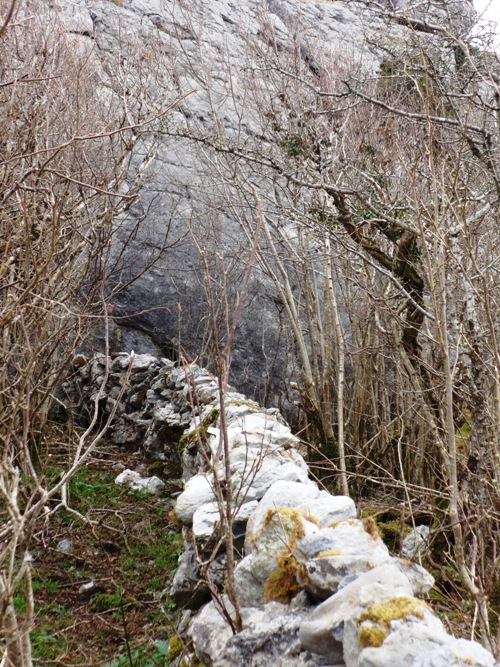
Photo: EO’D
There are at present 150 men employed at the mines, but as soon as the works are opened a little further a large number of persons will be employed. The difficulty of procuring anything not usually required in the neighbourhood is a serious inconvenience and cause of delay. It was, for instance, found impossible to procure a leaden pipe of particular dimensions in Gort, a few days since, for a portion of the works, in consequence of which much time was lost, until it could be obtained from Limerick a distance of thirty miles; but these difficulties are incidental to all new undertakings, and can be remedied only by time. Mr Collett, with a wise liberality, instead of engaging at the ordinary wages of the country (6d to 8d a day), pays the labourers at the rate of 1s and the boys 8d per day. He is, consequently, very popular, and has every reason to approve of the conduct of the men under his charge. He has engaged some Cornish workmen from England, who show a good example of industry to their Irish fellow labourers, and the best feelings exist between them.
In “Dutton’s Statistical Survey of the County of Galway,” he enumerates many minerals found in the neighbourhood of Gort; amongst others, manganese from Gortecarnane, the estate of Lord Gort, and from Chevy Chase the property of Dudley Persse, Esq; ironstone from the same place on the estate of Lord Gort, and soft ironstone, yellow ochre, heavy red earth with small shining particles, fine potter’s clay; purple coloured concretion of limestone, coalsmute, coalslate or coal, fine red fire earth etc from various places in the neighbourhood.
Under the active superindendence of Mr Collett, we may shortly expect to see several, if not all of these mines in active work, and Gort may yet become the centre of the most extensive mining operations yet known in Ireland.
The Advocate

 The Burren and Beyond