The Irish Standard, Jan 10, 1891 p.7 The South Clare railway works have been commenced at Miltown Malbay. Several landowners who refused to accept the offer of Mr. Murphy MP. are now willing to do so, and some have already given up the land through which the line is to run. A cargo of 300 tons of rails has been landed at Cappa Pier, and a large number of car man have been employed drawing the rails to the different working points of the line.
The Courier (Hobart,Tas) 28th July 1854 p2 Enormous Demand for Seaweed (abridged) The great demand for seaweed manure, the high prices it brought, and the great breadth of mind devoted to potato planting this season, may be inferred from the fact that it is computed by those who have had the best opportunities of forming an accurate estimate, that the very large sum of £10,000 has been paid for seaweed this season at the Galway docks alone. If we take into account the quantities which have been disposed of at Oranmore, Kinvarra, Ballyvaughan, and the other creeks and landing places within the bay, the cutting of seaweed this season must have realised upwards of £13,000. It has been conveyed to a considerable distance, by boats along the lakes, by carts on the road, and even by railway. Perhaps in no former year has the use of it been more general, or the price paid for It so high, as in the present season.
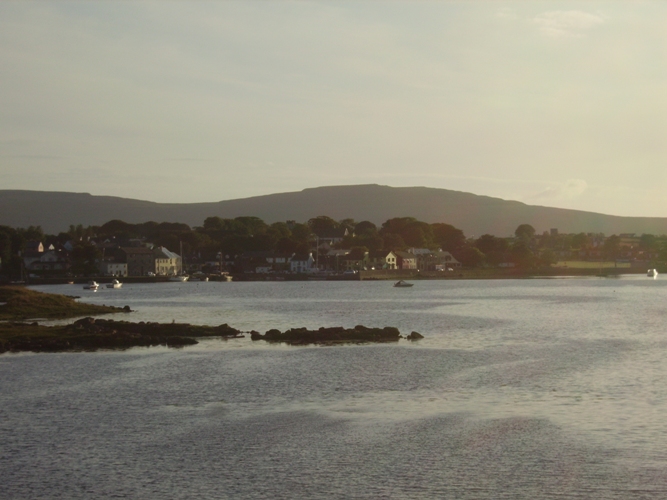
About one hundred thousand pounds of the estimated two and a half millions annual over-taxation of Ireland would build a small link of railway between Ardrahan and Ennistymon by Kinvara, New Quay, Ballyvaughan and Lisdoonvarna and throw open to the public the enjoyment of the open sea and means of transit for the famous Burren oysters, Redbank oysters and Pouldoody oysters, whose banks are along this particular section of the coast of Clare, particularly New Quay.
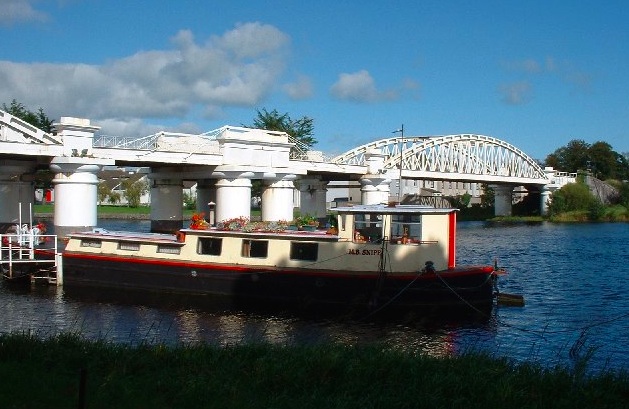
The crowning finish was given on Saturday the 19th of July to the great line of railway from Dublin to Galway, by placing the last rail on the Shannon Bridge. This splendid structure is 500 feet in length and constructed of wrought iron girders, with openings of 165 feet in the clear.
Mr Hermans, the chief engineer of the line, came with a staff of assistants to witness the completion of the bridge and test its strength by driving the locomotive over it. By ten o’clock at night, after great exertion, the closing rail was cut and laid in place, and amidst the cheers of a great crowd of spectators, the Venus engine was driven four times rapidly from end to end of the bridge, which bore the weight without the slightest apparent deflexion. The line was to be inspected for the Government in the course of the ensuing week and would be open to the public on the 1st of August



 The Burren and Beyond