Posted in Posts and podcasts

Prevalent maladies – 1824

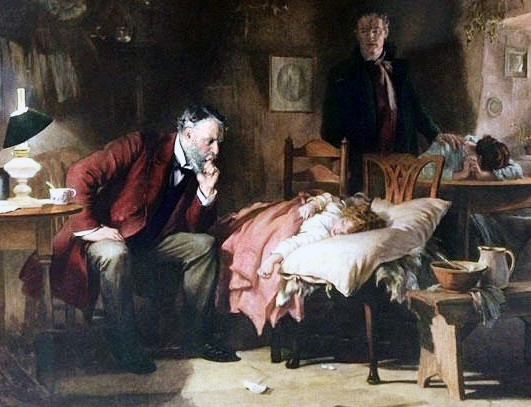
The Doctor - 1891 Luke Fildes (1843–1927)  Wikimedia Commons
The Doctor – 1891
Luke Fildes (1843–1927)
Wikimedia Commons
THE CONNAUGHT JOURNAL 2ND DECEMBER, 1824
The most prevalent maladies in this town (Galway) and neighbourhood for the last year, are stated from the following Report of Dr. O’MALEY, whose practical intercourse with them through the medium of the Dispensary, affords him an unlimited facility of offering the most correct observations:
Fever has been on the decline; however, many cases have occurred sporadicaly, of the intermediate type, termed Synochus; the remainder mild Typhus, with a few instances of the malignant variety. Pneumonia, (inflammation of the lungs and its coverings,) has occasionally existed; Cattarh, with Pleuralgia, (pain of breast, &c.) being exceedingly frequent. A few cases of Pneumonia Typhoides (inflamed lungs with Typhus fever) have also taken place during the autumn.
Inflammatory sore throat often presents itself, owing to the vicissitudes of our atmosphere; and Hepatitis (liver complaint) is a frequent assailant from the same cause, aerial inclemency, and another powerful agent, immoderate spirituous potation.
That Morbid Proteus Rheumatism, acute or chronic, doth constantly uphold a relentless sway, and concentrates, in many individuals, the keenest pangs of enfeebled humanity. Dispepsia (indigestion) and Corrdialgia (spasmodic pain of stomach) in its different varieties, have been, and must be, incessantly frequent in occurrence, until the scanty food of our squalid poor be succeeded by a more generous and abundant measure. Of all diseases which engage the attention of Nosologists, Dysentery & Diarhoea have for the last months stalked with relentless gripe through these wretched domiciles of incomprehensible misery, the hovels of the poor.
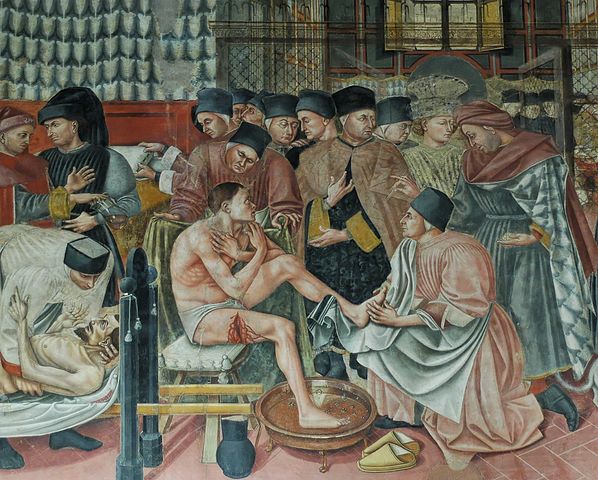
Healing the sick, fresco by Domenico di Bartolo. (1400-1447) Sala del Pellegrinaio (hall of the pilgrim), Hospital Santa Maria della Scala,Siena Wikimedia Commons
Healing the sick, fresco by Domenico di Bartolo. (1400-1447) Sala del Pellegrinaio (hall of the pilgrim), Hospital Santa Maria della Scala,Siena
Wikimedia Commons
These diseases, so different in their nature, have been principally excited by the same causes, namely, no wholesome diet, and deficiency of warm vesture; dysentery indubitably becoming contagious among them, from the limited extent and offensive uncleanliness of their dwellings. This circumstance is worthy of remark, as the Dysentery of these latitudes is seldom contagious, unless under the conditions already mentioned, or when concomitant with epidemic Typhoid affections.- Colic is a malady that next in order rears is stand and among the indigent; frequent cold and wet and indigestible esculents act as its occasional causes. In many instances it has yielded its grasp in the last mentioned genus Dysentery, and in a few has been the precursor of a more certain harbinger of death, Enteritis (inflammation of the bowels.)

The Cholera of our climate, though comparatively imbecile to that of the southern part of the Asiatic region, is a formidable malady, that has occasionally occurred during the estival and autumnal seasons, but in an immediate and decisive practice has invariably yielded.

Hoemophilis (spitting blood) often appears here, but when unconnected with any other affection, is seldom fatal. It, or inflamed lungs, sometimes is a variety of consumption named Inposthumutous, Phthisis, which, with another variety (Tubercular) have occurred here within the last year much less frequently than could be expected from the vicissitudes of atmospheric temperature. It has been computed that in England this disease carries off one-fourth of the population, in Paris, one-fifth, in Vienna, one-sixth, while in Russia it is by no means common, and in tropical climates still less so, from the greater uniformity of their atmosphere, either frigid or torrid. Asthma also constantly presents itself, and unless when produced from malformation, is generally a senile disease, sometimes closing its career with the induction of others.
Dropsy is one of frequent occurrence among the lower class, because it is for the most part a disease of debility. We usually find that it has been preceded by some species of fever, and in other instances it is nurtured by an abuse of ardent spirits, inanition, hard labour and a long exposure to wet and cold. These sap the body and induce affections of the stomach, particularly the liver, weakening the digestive organs becoming frail and instituting in various ways the complaint in question.

Another opportunity shall be taken to illustrate the most prevalent diseases of females and children.

Posted in Posts and podcasts

Dreadful sufferings in the Polar sea – 15th December 1860

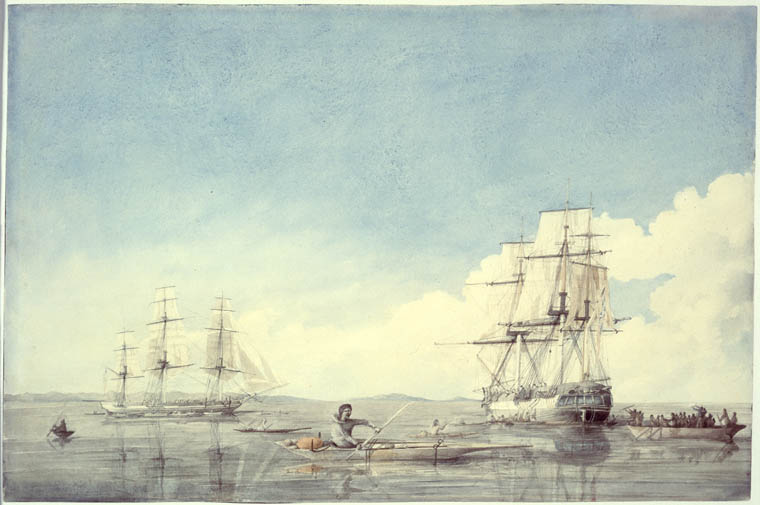
The Hudson's Bay Company ships Prince of Wales and Eddystone bartering with  Inuit off the Upper Savage Islands, Hudson Strait;  Robert Hood (1819)
The Hudson’s Bay Company ships Prince of Wales and Eddystone bartering with Inuit off the Upper Savage Islands, Hudson Strait; Robert Hood (1819)
South Australian Advertiser p3
DREADFUL SUFFERINGS IN THE POLAR SEA.(abridged)

The only survivor of the crew and passengers of the barque Kitty, a sailor named William Armstrong, arrived at Galway by the Prince Albert last August. Armstrong, on the 29th of June, 1859, shipped as mate of the barque Kitty, from Newcastle-on Tyne, which sailed with a cargo consigned to the Hudson’s Bay Company. She was commanded by Alexander Ellis, and besides her crew of able-bodied seamen she took a few passengers, who intended to settle in the locality.
The voyage from the outset was rather boisterous and protracted, for the vessel did not get off the American shore till the beginning of August. On the 11th of that month she was enveloped in a fog off Cape Resolution, and she was suddenly surrounded by huge mountains of ice, so as to render escape almost hopeless. The bergs could be seen through the fog, gradually drawing nearer and nearer, until at last the vessel was touched by them.

Icebergs, Cape York, Greenland Wikipedia.org
Icebergs, Cape York,
Greenland
Wikipedia.org

The crew and passengers wore naturally panic-stricken, but they soon recovered, and commenced efforts to save their lives. Two boats were got out, and as much provisions as could be put into them in a hurry were stowed away. One was under the command of the captain. The other under Armstrong, the mate, left, the ship’s side, just as the bergs closed upon the ill-fated vessel, and crushed her into pieces. She then went down. The remaining boats managed to get through an opening, but only to find themselves in a field of ice, its pieces threatening destruction at every moment.
For days the two boats beat about making attempts to reach the open sea, with no success. The cold began to take effect, and the fearful symptoms of frost-bite became painfully apparent. Remedies such as were within their power were applied, but they were useless. The poor creatures gradually became worse, and dropped off one after another.
Finally the botls separated in a fog. The captain’s boat was never heard of again. Armstrong, with the few persons in his boat still surviving, pursued his course, the little crew in his boat getting fewer in number, while the survivors were becoming weak and sickly. Those who were sinking under the privations, as their hour approached, became maniacs. Two or three besides Armstrong only remained when the welcome cry of ” Land” was raised, and the men strained their eyes and asked one another could it be real. It was at length reached, but too late for some of them. The ecstacy of such a discovery, after being 62 days in an open boat and suffering such privations in a polar region, was too much for them, and all, with the exception of Armstrong, sank to the ground and died. It it is no wonder Armstrong dropped upon his knees, and returned thanks to his God that he had been spared.
Having obtained a little rest, he wandered along the shore, and was fortunate to fall in with some Esquimaux on a hunting expedition. They conducted him to their huts, and there kept him for a considerable time, until he had recruited his strength. They then brought him to a place where some Moravian missionaries were residing, who forwarded him to St John’s in the early part of August. Up to the present no tidings could be got of the vessel, and it was long since supposed that every soul had gone to the bottom.
Haslem Counties Herald.

Close