
Connacht sentinel 20th August, 1929 p.2 (abridged)
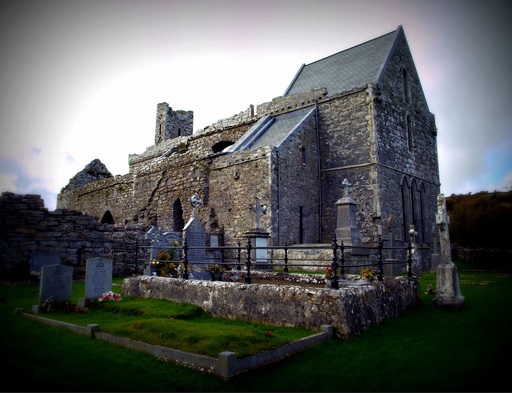
Corcomroe Abbey
Photo: Shaun Dunphy
Wikimedia Commons
Corcomroe Abbey is in Co. Clare. It is about four miles from Kinvara and five miles from Ballyvaughan. “Corcomroe” (in Irish, Corcomoruadh) means the descendants of Moruadh who is said to have been a son of Queen Maeve. Corcomroe Abbey is a Cistercian abbey. Like other Cistercian abbeys, it was dedicated to the Blessed Virgin and had a special name – “de petra fertile” (of the fertile rock) or “de petra saxo” (of the green rock). In his Ordnance Survey letters, O’Donovan states that according to local tradition it was founded by the son of Conor na Siudaine O’Brien on the spot where Conor was killed c. 1267 by Guaire O’Shaughnessy of Dun Guaire, near Kinvara. In his “Manuscript Materials of Ancient Irish History,” O’Curry states that it was founded by Conor na Siudaine O’Brien. Ware and Archdall are in doubt as to whether it was founded in 1200 by Conor’s father, Donogh Cairbrech O’Brien, or in 1194 by Conor’s grandfather, Donal Mor O’Brien. Other writers state that it was founded by Donal Mór O’Brien in 1182. It is, therefore, certain that the abbey was provided by the O’Briens, and it is probable that it was founded by Donogh Cairbrech O’Brien about 1200.
The following are the most important historical events connected with the abbey;
Soon after its foundation it established a branch at Kilshanry in County Clare. In 1249 it became subject to the abbey of Furness in Lancashire. Not far from it, at Sindaine, which, according to the Ordnance Survey maps, is near Newtown Castle, a battle was fought in 1267 between Conor na Sindaine O’Brien and his uncle, Donal Connachtrach O’Brien who was aided by the O’Connors and the O’Loughlins of Burren. Conor was killed; he was buried in the chancel of the abbey church, and his grave was covered by a stone effigy which is still in existence. In 1317 another battle was fought near the abbey between Murtagh O’Brien, the Chieftain of Thomond, and his cousin, Donogh O’Brien, who endeavoured to depose him and who was assisted by the English. Donogh and the English were defeated, and the bodies of Donogh and his followers were interred in the abbey church. In 1418 the abbot, who seems to have been a very distinguished man, became Bishop of Kilmacduagh. In 1544 the abbey was dissolved, its monks were banished, and its possessions were granted to Murrough, Earl of Thomond.
 The Burren and Beyond