
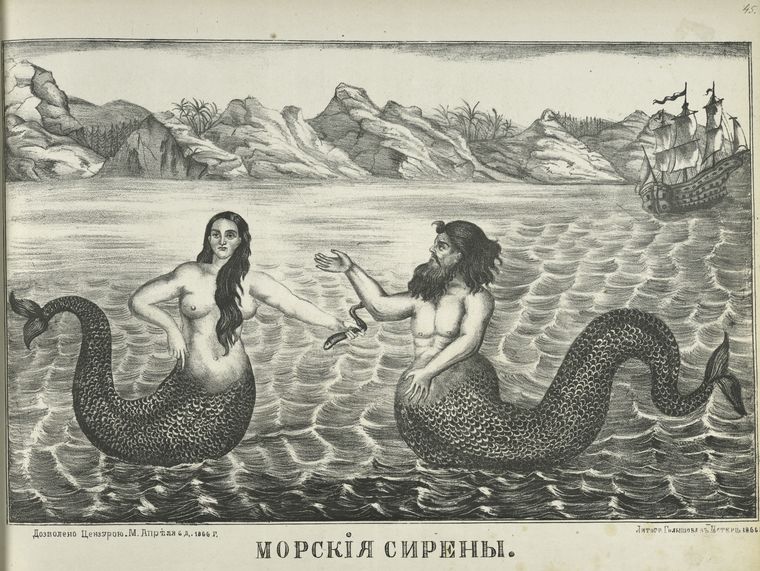
New York Public Library
Wikipedia.org
Walter Scott, London, New York (1888)
THE MERROW (abridged)
The Merrow, or Moruadh/Murrúghach, comes from muir, sea, and oigh, a maid, and is common, they say, on the wilder coasts of Ireland. The fishermen do not like to see them, for it always means coming gales. The male Merrows have green teeth, green hair, pig’s eyes, and red noses; but their women are beautiful, for all their fish tails and the little duck-like scale between their fingers.
Sometimes they prefer, small blame to them, good-looking fishermen to their sea lovers. Near Bantry, in the last century, there is said to have been a woman covered all over with scales like a fish, who was descended from such a marriage. Sometimes they come out of the sea, and wander about the shore in the shape of little hornless cows. They have, when in their own shape, a red cap, called a cohullen druith, usually covered with feathers. If this is stolen, they cannot again go down under the waves.
Tag: Mermaid
A Mermaid in Connemara 1820
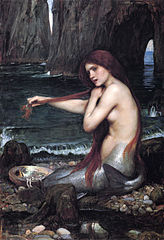
Wikipedia.org
https://widgetworld3.wordpress.com/podcasts/
The Sydney Gazette and New South Wales Advertiser 16th September, 1820
MERMAID
We extract the following article from The Galway Advertiser:-
Naturalists have hitherto doubted of the existence of mermaids and mermen:
We have it now in our (sic.) to set at rest the doubts of sceptics upon this duplex order of animals, one having been lately discovered basking upon the rocks of Derrygimla, in Errisberg (Connomara), after the ebbing of the tide. It was discovered by a female of the lower order, who was then about four months pregnant; she was suddenly startled by a kind of scream, which was followed by the plunging of an animal, half female and half fish, her lower extremities having the conformation of a dolphin. This woman was so terrified as to miscarry, and has never been able to leave her bed since.
The tide being out, the animal had some difficulty in reaching the water. Thomas Evans, Esq. of Cleggan, a Gentleman well known to many of our readers, just arrived upon the coast in time to witness her last plunges. Having gained the water she disappeared for a few moments, but again appeared perfectly composed. Mr. Evans now had a favourable opportunity of examining this so long-doubted genus; it was about the size of a well grown child of ten years of age; a bosom prominent as a girl of 16; a profusion of long dark brown hair; full dark eyes; hands and arms formed like the human species, with a slight web connecting the upper part of the fingers, which were frequently employed throwing back her flowing locks, and running them through her hair. Her movements in the water seemed principally directed by the finny extremity; for near an hour she remained in apparent tranquillity, in view of upwards of three hundred persons, until a musket was levelled at her, which having flashed in the pan, she immediately dived, and was not afterwards seen. Mr Evans declares she did not appear to him to possess the power of speech for her looks appeared vacant, and there was an evident want of intelligence.
As this is the season of the fishery, we are in hopes some of our fishermen may draw her in their nets, as it is extremely probable, at the time she was first discovered, she was in search of some place to deposit her young. We understand several depositions upon oath as to this animal’s appearance are to be made. We are promised a more minute description which we shall be happy to lay before our readers.
 The Burren and Beyond