Connaught Journal January 30 , 1823
New Garden & Farm Seeds.
Elizabeth Cloran of Loughrea respectfully informs the Customers of her House and the Public, that she has arrived to her from London, per the New Harmony for Dublin, her annual, extensive and general assortment of Garden, Farming, Flower Seeds, which she having imported from one of the most eminent Seedsmen in London, is enabled to recommend with perfect confidence.
She is also constantly supplied from the most respectable Druggists in Dublin, with every Genuine Medicine in the Apothecary business, to the compounding and dispensing of which the strictest care and attention is paid by a Gentleman, regularly qualified in that Profession. Oils, Colours, Horse, Cow, Sheep and Dog Medicine, and a choice selection of all the Patent Preparations from the Medical-Hall, 34, Lower Sackville-street, Dublin.
She hopes from her anxiety at all times to procure every Article of the best description, Her moderate charges, and the particular attention to the orders she may be favoured with to merit a continuance of that liberal patronage which she has experienced since her commencement in business.
Messrs Dillon, O’Brien, Harris and Sheehy, all Irish members of Parliament, were arrested by the police yesterday at Loughrea near Galway, while presiding over a committee for collection of rents, under the plan of campaign promulgated by the United Ireland newspaper.
Island Eddy as it appears on ‘A Map of the County of Galway in the Province of Connaught in Ireland’ by WIlliam Larkin (London 1818).FREEMAN’S JOURNAL 18TH OCTOBER, 1884 P6
AN IRISH SHIP CANAL.
The suggestion of constructing a ship canal across Ireland, from Dublin to Galway, or Dublin to the Shannon, has been warmly taken up by eminent and competent men in London. Elaborate plans and surveys have been made at considerable expense, which have been submitted by Captain Eades, the great American engineer. The plans for the Irish Canal have been prepared by Mr. T. A. Walker, Great George-street, Westminster, who recently bored a tunnel under the Severn, the largest undertaking of the kind in the country.
Silently but steadily a staff of engineers have levelled the country between Galway and Dublin Bays, and the plan, although carefully prepared, is largely tentative, its object being to show the practicability of a project of the kind. The proposed canal would be 127 miles in length and would contain upwards of 30 locks. The estimated cost is, of course, ruled by the tonnage of the ships it is intended to accommodate. Thus if for ships of 1,500 tons the cost would be eight millions, for ships of 2,500 twelve millions, and for ships of 5,000 and upwards twenty millions sterling. If built on this scale, and it is considered that anything smaller would be a mistake, the canal would be 200 feet wide on the surface and 100 feet at the bottom.
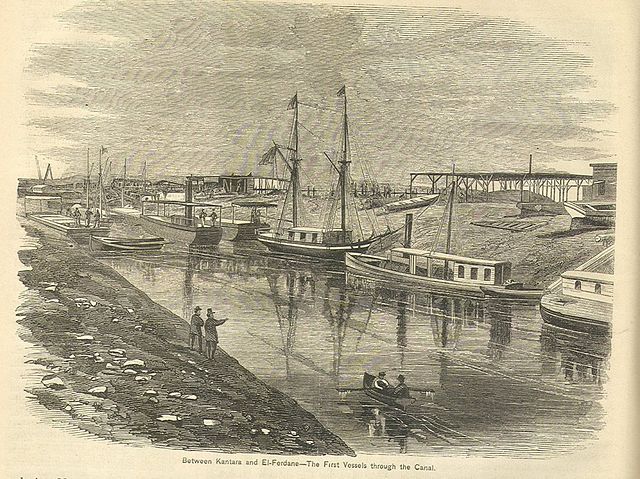
Suez Canal, between Kantara and El-Fedane. The first vessels through the Canal. 19th century image. From “Appleton’s Journal of Popular Literature, Science, and Art”, 1869.In considering these dimensions it must be remembered that the Suez Canal except at its mouth is not 80 feet wide. The depth would be from 30 to 35 feet, and the locks would be fitted with the newest hydraulic apparatus so as to make the process of lockage as simple and expeditious as possible. The passage through the canal would be effected through, a system of towage, although it is somewhat of an open question whether this would be preferable to permitting the steamers to work through.
It is estimated that the passage of a ship from Galway Bay to Kingstown would occupy between 24 and 36 hours. An alternative scheme of a ship railway, in which the ships would be carried in cradles, which, he says, could be constructed for ten millions by his plan, the duration of the passage through the island would, he declared, be reduced to 12 hours.
The proposed course of this great work will be of considerable interest.
The canal starts from Doores Strait (sic.), south of Islandeaddy, in Galway Bay, where the shallowness of the water necessitates the dredging of a channel for a considerable distance out. This proposed canal would give a depth of thirty feet at low water, and would be protected from the silting up of the sand by suitable works. The entrance to the canal would be by a sea lock 600 feet in length, capable of taking ships of 5000 tons. From this lock entrance would be gained to a dock of 29 acres in extent, constructed on an arm of the sea, known as present as Brandy Harbour. The first inland lock would be less than a mile up at Killemaran, (sic.) from whence the canal would pass close to Drumacoo, then turning slightly to the north by Kilcolgan on to Rahasane, and passing about five miles to the south of Athenry, and crossing the Athenry and Ennis Railway at Craughwell, where the fifth lock would be situated. The sixteenth mile of the canal brings it about one mile to the north of Loughrea, from which town there will be a feeder to supply fresh water from the lake which is ten feet above the level of the canal, the latter being 260 feet above sea level. From this point there is; a long straight line of canal without locks until it roaches Eyrecourt, whence an immense aqueduct is to be constructed to carry the canal over the Shannon
The New York Journal says :—There is in New York a moneyed and well organised society which trades in human flesh and blood. The society is composed of the owners of those houses that disgrace the city. The head and front of it is a wretch keeping a place in Chrystie Street, and who boasts of a fortune of 300,000 dollars.
The society has got in its employ a dozen women who make trips regular to Europe. They go to Paris, London, Berlin, Rome, Vienna, Edinburgh and Dublin. They live in “great style.” They go to public parks and squares, win the confidence of young women, and by specious promises induce them to come to New York.
Their favorite dodge is to have the girl recorded on the passenger list as a “lady’s maid.” One woman was known to bring five girls on one trip. When the girls reached this city coaches await them, and they drive off, knowing no one, speaking a strange language, and ignorant of American laws or customs, they are at a loss as to what to do, and usually yield to their fate.
Two weeks ago a handsome, silken roben woman flashing with jewellery, and carrying a fat purse, appeared in Loughrea, CountyGalway, Ireland. She went to a farmhouse occupied by an honest old farmer. She remained there four days,, and before she left she induced the farmer’s daughter, Katie ——, an innocent girl about 17 years old, to start for this city. She said she knew the girl’s sister, who resided in New York, and that her sister was anxious that Katie should come to America to enjoy her wealth. She also showed her parents a cable dispatch asking that Katie should be sent out.
The unsuspecting girl started off, and embarked at Liverpool on the steamship City of Chigago as cabin passenger. The vessel reached New York on Friday afternoon at 2 o’clock, and they took a coach and went off with two men employed on board the vessel. At 3 o’clock yesterday morning Officer Peter W. ——–, of the Fourteenth precinct, saw the coach at Grand and Elizabeth Streets. Two women and two men alighted. The contrast; between the women struck him. He knew at once that the girl was an immigrant who was not yet a day in the city. He tapped her on the arm and bade her go with him, and he took her to the Mulberry-street Station. She told him the whole story about the way in which she was induced to come to America.
Later on he arrested the woman who brought Katie to this city, and he managed to find Katie’s sister in an unsavoury neighborhood.




 The Burren and Beyond