Posted in Posts and podcasts

Lisdoonvarna – 1899

Freemans Journal 18th July, 1899 p.6
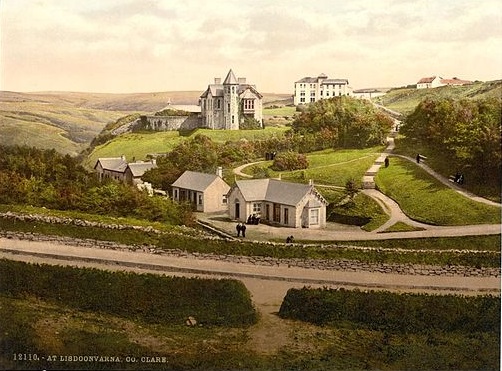
Lisdoonvarna Wikimedia Commons
Lisdoonvarna
Wikimedia Commons

To the Editor of the Freeman’s Journal.
Lisdoonvarna, July 16th 1899
Sir,
As one who has spent most enjoyable holidays in Lisdoonvarna, permit me to give my views to the public with regard to this most picturesque spot as a health resort.  Situated, as Lisdoonvarna is, in the centre of wild mountain scenery, and possessing, as it does, the most salubrious air, and the best mineral waters in the world, it is not surprising that it has been called “The Cheltenham of Ireland.” The air blowing from the Atlantic is genial and bracing, and in my experience of health resorts nowhere have I found the air so invigorating as in Lisdoonvarna and its vicinity. With regard to the medicinal qualities of the waters, Dr. Mapother, a distinguished medical man, in one of his able works says;
“It is not proposed to discuss at any great length the actions of sulphuretted waters or the respective advantage of the various sources in the treatment of cutaneous affections, but merely to call attention to one within twenty hours journey from London.”
Dr. Westropp and Dr. Forster, the resident physicians have given these mineral waters their careful studies for many years, and their experience of its effects on the human system will make their advice valuable for those who follow it. Most enjoyable excursions can be taken from Lisdoonvarna to the cliffs of Moher, to Lahinch Spanish Point, to Kilkee, to Ballyvaughan, either by the sea-coast or more directly by the famous cork-screw hill, to Corcomroe Abbey, interesting ruins in the centre of the romantic Burren hills, and the Lakes of Inchiquin, rich in scenery, are certainly well worth a visit.
For the information of intending visitors I am glad to be able to state that the dispute which existed between the local landowners and the inhabitants has been brought to a final and satisfactory settlement. The whole matter has been peaceably and amicably arranged. A local improvement committee has taken charge of all the wells and baths, and under their management considerable improvements have been already made. The plot of land around the sulphur wells has been neatly planted; the house over the springs has been completely renovated; competent and experienced hands have been employed to distribute the waters; the bath rooms have been put in order so that hot and cold sulphur and spring water baths are available daily from 6a.m to 9 p.m. In conclusion permit me to remind those who have sought in vain to regain health and strengths in English and Continental spas that they will do well to visit Lisdoonvarna, where the waters, baths and pure air are sure to prove more effectual than those already tried.
Posted in Posts and podcasts

Lisdoonvarna – 1897

New Zealand Tablet 16th July 1897 p 9

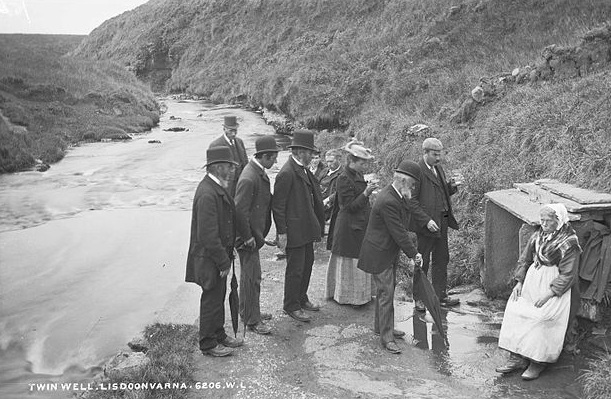
The Twin Wells on the banks of the River Aille at Lisdoonvarna c 1900 National Library of Ireland Wikimedia Commons
The Twin Wells on the banks of the River Aille at Lisdoonvarna c 1900
National Library of Ireland
Wikimedia Commons

CLARE.— Threatened Confiscation of the Famous Spa at Lisdoonvarna Public Meeting of Protest

On Sunday, May 9th an important meeting was held in Lisdoonvarna to protest against the action of the Representative Church Body of Ireland in their endeavour to grab the Lisdoonvarna sulphur springs, the use of which has been free to the public for a number of years. The people of the far-famed watering place have determined to resist by every legal means the threatened invasion of the public rights, and to fight out to the end the pretensions raised by the Representative Church Body. On the facts as disclosed the action of that body cannot be described other than as most unjustifiable.

Something like the same claim endeavoured to be sustained now was put forward thirty years ago by Captain Stackpoole, the former landlord of the district. He built a well house on the site ot the principal Spa which was walled in, the people being denied the access that up to that time they had freely enjoyed. The indignation felt by the people manifested itself in a practical manner. The gates set up by the landlord were blown up and the house damaged

A claim for compensation by Captain Stackpoole was opposed, and the judgment of the late Chief Baron Pigott was that the putting up of the gates constituted an infringement of the public rights. For the injury to the house some slight compensation was allowed, and there the matter rested until, some years after practically the same decision was delivered by Judge O’Brien

Subsequently the estate went into Chancery, and a local improvement committee having been formed, a lease of the house, grounds and wall was obtained at a rent of £15 a year. Since then the committee by the aid of voluntary subscriptions have improved and beautfied the Spa for the benefit of visitors. The house has been enlarged, modern pumps have been bought, new baths have been erected out of the funds collected by the committee. Now it appears that the Church Representative Body, who were the largest incumbrancers on the estate have bought out the other interests having claims upon the property, and as a consequence of their ownership the court lease given to the committee lapses. One of the first acts of the new landlords, regardless of the monies spent by the committee, has been to advertise the letting of the Spa, and even though the Improvement Committee made an offer to rent what is virtually the property of their own creation it has been rejected, it is said, in favour of a syndicate proposal to take over the springs and baths at £300 a year. These tacts demonstrate pretty clearly the injustice of the proceeding comteinplated by the Church Representative Body, and it is to be hoped that the people of Lisdoonvarna will succeed in defeating snch an aggressive and unwarrantable interference with public rights.