A cable from New York, dated Sunday last, states that the Secret Service has frustrated a second Sinn Fein rebellion which was planned to occur next Easter, on the anniversary of last year’s bloody Dublin riots. German gold was scheduled to play a part. The preliminaries were mapped out, and ready to be put in operation, when the Secret Service men stepped in and arrested “General” Liam Merlewes (sic.) one of the leaders of the 1916 outbreak. Baron von Reculinghausen (sic.) was apparently Count von Bernstorff’s designee to watch Germany’s interests in Ireland after Bernstorff was ousted from the United States.
The Canadian authorities, acting upon the information received from the Secret Service, arrested Dr. Patrick McCarton, upon his arrival at Halifax. He was travelling on a fraudulent seaman’s passport. McCarton enjoyed the title “Ambassador of the Irish Republic to the United States.” It is commonly reported that German agents are busy in Ireland, attempting to stir up a second outbreak. A German cargo, which submarines carried, comprising machine guns and ammunition, was landed in lonely inlets in the Irish Sea.
It is understood that the United States possesses the official Sinn Fein report of the 1916 riots and other valuable data in connection therewith. Merlewes (Mellows), prior to the Easter Monday rebellion, spent three months in an English prison. Later he proceeded to Galway, and organised 700 volunteers for the United States, following the failure of the revolt.
McCarton arrived in the United States early in 1917, a fugitive from justice. Both decided to return to Ireland. McCarton sailed on October 17.
The following statement has been issued by the members of the Provisional Committee of the Irish Volunteers – Eoin MacNeill, Chairman, Provisional Committee: Ua Rathghaille, Treasurer: Thomas MacDonagh, Joseph Plunkett, Piaras Bealslai, Michael J. Judge, Peter Paul Macken, Sean Mac Giubuin, P.H.Pearse, Padraic O’Riain, Bulmer Hobson, Eamon Martin, Conchubhair O’Colbaird, Eamonn Ceannt, Sean Mac Diarmada, Seamus O’Conchubhair, Liam Mellows, L.Colm O’Lochlainn, Liam Ua Gogan, Peter White:
SOLE PURPOSE OF VOLUNTEERS
Ten months ago a Provisional Committee commenced the Irish Volunteer movement with the sole purpose of securing and defending the rights and liberties of the Irish people. The movement on these lines, though thwarted and opposed for a time, obtained the support of the Irish Nation. When the Volunteer movement had become the main factor in the National question, Mr. Redmond decided to acknowledge it, and to endeavour to bring it under his control.
Three months ago he put forward the claim to send twenty-five nominees to the Provisional Committee of the Irish Volunteers. He threatened, if the claim was not conceded to proceed to the dismemberment of the Irish Volunteer organization.
NO DISMEMBERMENT OF IRELAND
It is clear that this proposal to throw the country into turmoil, and to destroy the chances of a Home Rule measure in the near future, must have been forced upon Mr. Redmond. Already, ignoring the Irish Volunteers as a factor in the National position, Mr. Redmond had consented to a dismemberment of Ireland, which could be made permanent by the same agencies that forced him to accept it as temporary. He was now prepared to risk another disruption and the wreck of the cause entrusted to him. The Provisional Committee, while recognizing that the responsibility in that case would be altogether Mr. Redmond’s, decided to risk the lesser evil and to admit his nominees to sit and act on the committee. The committee made no representations as to the persons to be nominated, and when the nominations were received the committee raised no question as to how far Mr. Redmond had fulfilled his public undertaking to nominate ‘representative men from different parts of the country.’ Mr. Redmond’s nominees were admitted purely and simply as his nominees, and without co-option.
VOLUNTEERS DEVOTED TO SERVICE OF IRELAND ALONE
Mr. Redmond, addressing a body of Irish Volunteers on Sunday, September, 20, has now announced for the Irish Volunteers a policy and program fundamentally at variance with their own published and accepted aims and pledges, but with which his nominees are, of course, identified. He has declared it to be the duty of Irish Volunteers to take foreign service under a Government which is not Irish. He has made this announcement without consulting the Provisional Committee, the Volunteers themselves, or the people of Ireland, to whose service alone they are devoted.
Having thus disregarded the Irish Volunteers and their solemn engagements, Mr. Redmond is no longer entitled through his nominees to any place in the administration and guidance of the Irish Volunteer organisation. Those who, by virtue of Mr. Redmond’s nomination, have theretofore, been admitted to act on the Provisional Committee, accordingly cease henceforth to belong to that body, and from this date under the holding of an Irish Volunteer Convention the Provisional Committee consists of those only whom it comprised before the admission of Mr. Redmond’s nominees.
CALL FOR A NATIONAL CONVENTION
At the next meeting of the Provisional Committee we shall propose:
1. To call a Convention of Irish Volunteers for November 25, the anniversary of the inaugural meeting of the Irish Volunteers in Dublin.
2. To reaffirm, without qualification, the manifesto proposed and adopted at the inaugural meeting.
3. To oppose and diminution of the measure of Irish Self-Government which now exists as a Statute on paper, and which would not now have reached that stage but for the Irish Volunteers.
4. To repudiate any undertaking, by whomsoever given, to consent to the legislative dismemberment of Ireland, and to protest against the attitude of the pretense that “Ulster cannot be coerced,” avow themselves prepared to coerce the Nationalists of Ulster.
IRELAND AND THE WAR
5. To declare that Ireland cannot, with honor or safety, take part in foreign quarrels otherwise than through the free action of a National Government of her own; and to repudiate the claim of any man to offer up the blood and lives of the sons of Irish men and Irish women to the service of the British Empire, while no National Government which could speak and act for the people of Ireland is allowed to exist.
6. To demand that the present system of governing Ireland through Dublin Castle and the British military power, a system responsible for the recent outrages in Dublin, be abolished without delay, and that a National Government be forthwith established in its place. The signatories to this statement are the great majority of the members of the Provisional Committee of the Irish Volunteers, apart from the nominees of Mr. Redmond who are no longer members of the committee.
Mr Fahy begins his story of Easter Week by recalling the arrest and imprisonment of Liam Mellows in the Autumn of 1915 and his deportation to Reading in April 1916. At that period the Galway County Board of the Irish or Sinn Fein Volunteers, which governed the force, had Mr George Nichols, Galway as chairman; Joseph Howley, Oranmore, treasurer; and Padraic O’Fathaigh, Lurgan, Gort, secretary, with Larry Lardner, Athenry as Brigade Commander. Meetings were held at Athenry and Mellows had his training camp at Ballycahalan. Mr. O’Fathaigh continues his story;
A convention was held in Limerick, at which plans were made for the Easter Sunday Rising. The delegates from Galway were Commandant Larry Gardner, Rev. Fr. Feeney, C.C.; Tresa Bhreathnach, Eamonn O’Corbain and Padraig O’Fathaigh. Mr. Ledden presided at the meeting, and it was arranged that the expected arms from Germany would be taken to Abbeyfeale and there sorted, some to be kept, and the remainder taken by rail to Gort to arm the Volunteers who would muster there on Easter Monday. Handbills about the Gort Monster Meeting were displayed at the Limerick Hall.
“Con” Fogarty would take the arms to Gort. Commandant Colivet would take charge of the Limerick Brigade of the Irish Volunteers at Limerick city. The Clare Battalion, led by Commandant Michael Brennan, would take any Clare barrack they might surprise, but would make no delay in moving to augment the Limerick Volunteers. The Companies of the Galway Brigade would attack the R.I.C. barracks in their area on Easter Sunday.
EASTER SUNDAY 1916
Commandant Larry Lardner was in command, Commandant Liam Mellows having been deported to England. The wily Commandant Mellows, however, succeeded in evading arrest and turned up at Mrs. Walshe’s house in Killeeneen some days before the intended Rising. Liam Mellows ordered that his escape should be kept a secret known only to the Walshe family, Eamonn Corbett and myself.
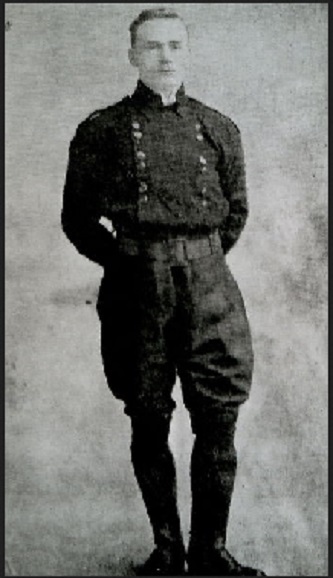
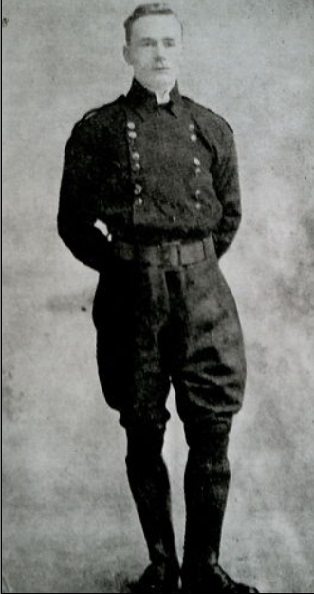
Liam’s uniform, enclosed in a parcel addressed to Mrs. Walshe, was expected to come via Athenry and its safe delivery was important. Since 1909 I taught Gaelic every Wednesday and Thursday night in Athenry. My visit to Athenry on Wednesday elicited no surprise. Eamon Corbett was mixed up in rate collecting and travelled extensively. We got the parcel safely; George Fahy at the Railway Hotel and Berty Powell at the Railway Station would have scented out any danger. We took the parcel with all speed to Killeeneen; I thus missed the Irish class for the first time in seven years.

 The Burren and Beyond