Posted in Posts and podcasts

Christmas Eve Legends – 1927

World News Sydney 24th December, 1927 p 27

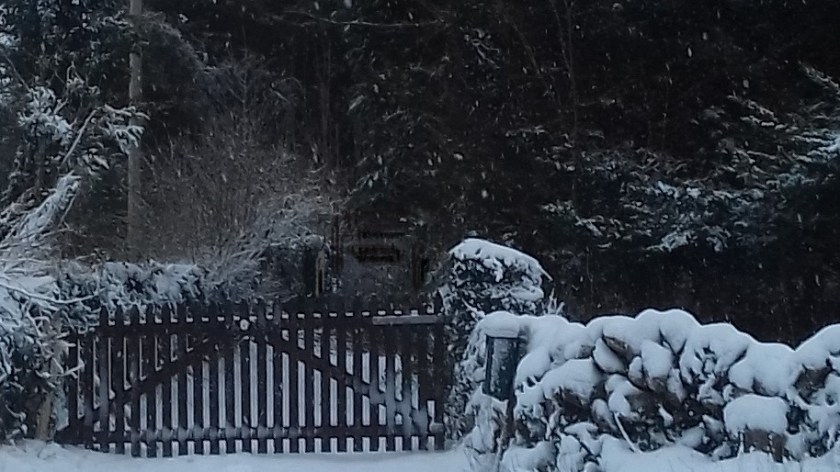
There is is a beautiful belief in Ireland that every Christmas Eve the Christ-Child walks once more through the land, so lighted candles are placed in the window of every homestead and cabin throughout Ireland to guide the Holy Child, lest He lose His way in the dark and cold outside.

In Austria-Hungary this idea is carried still further, for there the doors are opened wide in case the Infant Saviour might wish to come within and rest while on His journey.


The curious legend of the man-in-the moon comes from Germany, where Christmas has always been so essentially the children’s festival. One moonlit Christmas Eve, it is said, a poor peasant was suddenly seized with an overwhelming desire to have some cabbages for his Christmas dinner, and, as he did not have any in his own garden, he decided to steal some from a neighbour’s under cover of night. He betook himself to a quiet garden, and had just gathered his spoil and was preparing to go when, as he reached the gate, the Christ-Child stood before him, and, with sad, pitying eyes, inquired why the man had committed the theft. The ashamed and angry peasant replied roughly, “I did not steal them; Otto told me I might have them.”. And he would have passed by, but the Christ-Child barred the way. At last the culprit was stung to frenzy by those grief-filled eyes, and cried, ‘If I did steal them, may I be put in the moon.” Immediately he was caught up into the white moon, with the bundle of cabbages at his back, and there one may see him still any moonlit night.

In many parts of England, especially in Devon and Cornwall, the belief lingered for many a day that if one looked into a stable any Christmas Eve one would find all the oxen upon their knees at midnight, in memory of the kings who were said to have knelt in adoration round the manger of Bethlehem on that first Christmas night.


In Brittany the peasants believe that this night the cattle receive the gift of speech, and join in praise with all mankind, while in Cornwall the good wives cherish the idea that at this magic hour the water in all wells and fountains is turned into wine, “so holy and gracious is the time.”
Posted in Posts and podcasts

Legends of the County Clare -1855

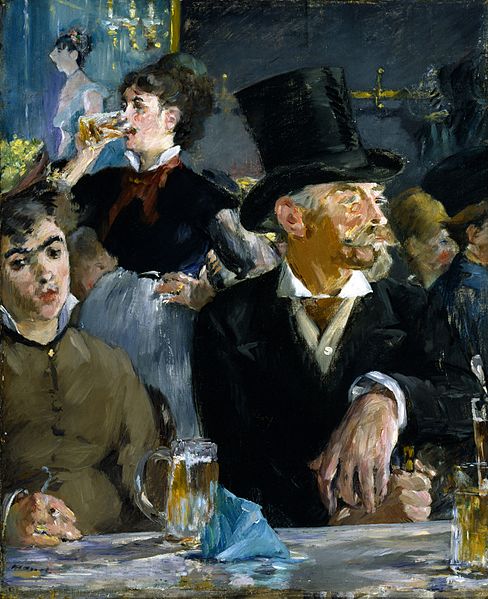
At the Cafe Edouard Manet  (1832–1883) Walters Art Museum
At the Cafe
Edouard Manet (1832–1883)
Walters Art Museum
Freeman’s Journal 20th January 1855 p3
LEGENDS OF THE COUNTY’ CLARE (abridged)

About two miles from the village of Corofin,’in the west of Clare, are the ruins of the Castle of Ballyportree. It is a massive square tower surrounded by a wall, at the corners of which are smaller round towers. The outer wall was also surrounded by a ditch. The castle is so intact the lower part is inhabited by a farmer’s family. In some of the upper rooms massive chimneypieces of grey limestone, of a very modern form, still remain. The horizontal portions of the chimneys are ornamented with a quatrefoil ornament engraved within a circle, but there are no dates or armorial bearings.

From the windows of the castle four others are visible, none of them more than two miles from each other; and a very large cromlech is within a few yards of the castle ditch. The following legend is related to the castle;

When the Danes were building the castle they collected workmen from all quarters, and forced them to labour night and day without stopping for rest or food ; and according as any of them fell down from exhaustion, his body was thrown upon the wall, which was built up over him ! When the castle was finished, its inhabitants tyrannised the whole country, until when the Danes were finally expelled from Ireland.

Ballyportree Castle held out to the last, but at length it was taken after a fierce resistance. Only three of the garrison were found alive, a father and his two sons. The infuriated conquerors were about to kill them also, when one proposed their lives should be spared, and a free passage to their own country given them, on condition that they taught the Irishmen how to brew their famous ale from heather. That secret was eagerly coveted by the Irish, and zealously guarded by the Danes.

At first neither promises nor threats had any effect on the prisoners, but at length the elder warrior consented to tell the secret on condition his sons should first be put to death before his eyes. He said he feared if he returned to his own country, they might cause him to be put to death for betraying the secret. Though somewhat surprised at his request, the Irish chieftains immediately complied with it, and the young men were slain. Then the old warrior exclaimed,
‘ Fools ! I saw that your threats and your promises were beginning to influence my sons; for they were but boys, and might have yielded : but now the secret is safe, your threats or your promises have no effect on me ! ‘
Enraged at their disappointment, the Irish soldiers hewed the stern northman in pieces, and the coveted secret is still unrevealed.

In the South of Scotland a legend, almost word for word the same as the above, is told of an old castle there, with the exception that, instead of Danes, the old warrior and his sons are called Picts.