Stories of Red Hanrahan and the Secret Rose– W.B.Yeats
London: MacMillan and Co. Ltd – 1927
THE TWISTING OF THE ROPE.
Hanrahan was walking the roads one time near Kinvara at the fall of day,and he heard the sound of a fiddle from a house a little way off the roadside. He turned up the path to it, for he never had the habit of passing by any place where there was music or dancing or good company, without going in.
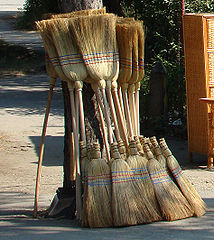
Armed and masked raiders who attempted to invade a farmhouse at Kinvara, County Galway, caught a Tartar in the person of the farmer’s daughter, who pluckily kept the raiders at bay with a broom until her father arrived with a loaded rifle and drove them off.
The men knocked at the door of the house, and sought admission in the name of a neighbour, and on the door being opened the party rushed in and demanded the farmer’s guns at revolver point. Miss Finucane, the farmer’s daughter, resisted them, and during the struggle the men fired at her, but fortunately the shot went wide. Seizing a broom, the. lady belaboured the raiders with it to such purpoee that she was able to hold them off until her father came home with his gun. Continue reading “Don’t upset a Kinvara Girl!”→
Augusta Lady Gregory Project Gutenberg Wikipedia.orgOur Irish Theatre: A chapter in Autobiography by Lady Gregory. New York: The Knickerbocker Press. G. Putnam’s Sons, New York, London. 1913. pp. 4-7
Later in the year I was staying for a few days with old Count de Basterot, at Duras, that is beyond Kinvara and beside the sea. He had been my husband’s warm friend, and always in the summer time we used to go and spend at least one long day with him,–we two at first, and then later I went with my son and the boy and girl friends of his childhood. They liked to go out in a hooker and see the seals showing their heads, or to paddle delicately among the jellyfish on the beach. It was a pleasant place to pass an idle day. The garden was full of flowers. Lavender and carnations grew best, and there were roses also and apple trees, and many plums ripened on the walls. This seemed strange, because outside the sheltered garden there were only stone-strewn fields and rocks and bare rock-built hills in sight, and the bay of Galway, over which fierce storms blow from the Atlantic. The Count remembered [Page 4] when on Garlic Sunday men used to ride races, naked, on unsaddled horses out into the sea; but that wild custom had long been done away with by decree of the priests. Later still, when Harrow and Oxford took my son away and I had long spaces of time alone, I would sometimes go to Duras to spend a few days.
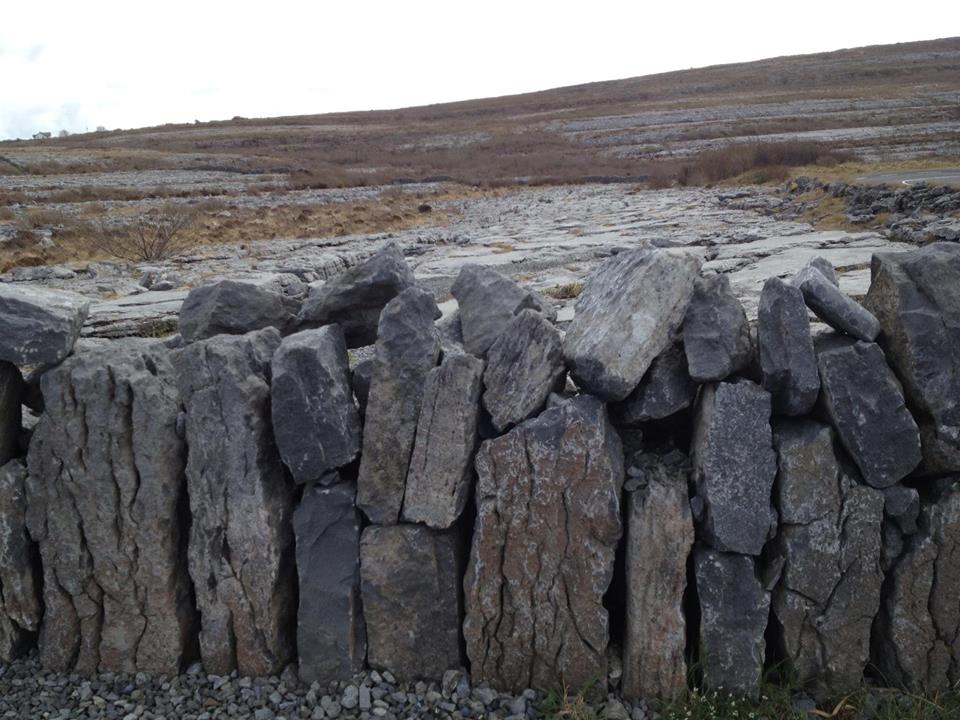
I always liked to talk and to listen to the Count. He could tell me about French books and French and Italian history and politics, for he lived but for the summer months in Ireland and for the rest of the year in Paris or in Rome. Mr. Arthur Symons has written of him and his talks of race,–to which he attributed all good or bad habits and politics–as they took long drives on the Campagna. M. Paul Bourget came more than once to stay in this Burren district, upon which he bestowed a witty name, “Le Royaume de Pierre.” It was to M. Bourget that on his way to the modest little house and small estate, the Count’s old steward and servant introduced the Atlantic, when on the road from the railway station at Gort its waters first come in sight: Voila la mer qui baigne l’Amérique et les terres de Monsieur le Comte. For he–the steward–had been taken by his master [Page 5] on visits to kinsmen in France and Italy–their names are recorded in that sad, pompous, black-bordered document I received one day signed by those who have l’honneur de vous faire part de la perte douloureuse qu’ils viennent d’éprouver en la personne de Florimond Alfred Jacques, Comte de Basterot, Chevalier de l’ordre du Saint Sépulcre, leur cousin germain et cousin [who died at Duras (Irlande) September 15, 1904]; la Marquise de la Tour Maubourg, le Vicomte et la Vicomtesse de Bussy, la Baronne d’Acker de Montgaston, le Marquis et la Marquise de Courcival, le Comte et la Comtesse Gromis de Trana, la Countesse Irène d’Entreves, and so on, and so on. I do not know whether the bearers of these high-sounding names keep him in their memory–it may well be that they do, for he was a friend not easily forgotten–but I know there is many a prayer still said on the roads between Kinvara and Burren and Curranroe and Ballinderreen for him who “never was without a bag of money to give in charity, and always had a heart for the poor.”Augusta Lady Gregory
On one of those days at Duras in 1898, Mr. Edward Martyn, my neighbour, came to see the Count, bringing with him Mr. Yeats, whom I did [Page 6] not then know very well, though I cared for his work very much and had already, through his directions, been gathering folk-lore. They had lunch with us, but it was a wet day, and we could not go out. After a while I thought the Count wanted to talk to Mr. Martyn alone; so I took Mr. Yeats to the office where the steward used to come to talk,–less about business I think than of the Land War or the state of the country, or the last year’s deaths and marriages from Kinvara to the headland of Aughanish. We sat there through that wet afternoon, and though I had never been at all interested in theatres, our talk turned on plays. Mr. Martyn had written two, The Heather Field and Maeve. They had been offered to London managers, and now he thought of trying to have them produced in Germany where there seemed to be more room for new drama than in England. I said it was a pity we had no Irish theatre where such plays could be given. Mr. Yeats said that had always been a dream of his, but he had of late thought it an impossible one, for it could not at first pay its way, and there was no money to be found for such a thing in Ireland.
We went on talking about it, and things seemed [Page 7] to grow possible as we talked, and before the end of the afternoon we had made our plan. We said we would collect money, or rather ask to have a certain sum of money guaranteed. We would then take a Dublin theatre and give a performance of Mr. Martyn’s Heather Field and one of Mr. Yeats’s own plays, The Countess Cathleen. I offered the first guarantee of £25.
Excerpt of review titled Lady Gregory’s Note-book An entertaining volume.
“The greatest wonder I ever saw was one time near Kinvara at a funeral. There came a car along the road and a lady on it having a plaid cloak, as was the fashion, and a big hat, and she kept her head down and never looked at the funeral at all. I wondered at her when I saw that, and I said to my brother it was a strange thing a lady to be coming past a funeral and not to look on at it at all. And who was on the car but O’Gorman Mahon, escaping from the Government, and dressed up as a lady! He drove to Father Arthur’s house in Kinvara and there was a boat waiting, and a cousin of my own in it, to bring him out to a ship and so he made his escape”.
Lady Gregory claims the right to praise “The Kiltartan History Book,” because as she says, “there is not in it one word of my own.” But she has contrived all the same to impart a share of her sly humour into almost every page.
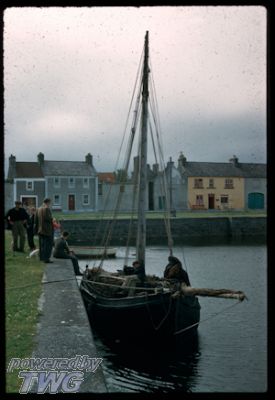
KINVARA HARBOUR
The harbour at Kinvara embraces a small inlet of Galway Bay, containing its waters along the fringe of the village. When you round the bend at Seamount College it presents itself, postcard perfect. We used to swim there, even had competitions – the most notable being the Green Island swim – a race from the pier to the small patch of green outside the Doctor’s surgery (beside Seamount) and back again. A trophy for the winner and a sense of pride for all else who actually completed it!
Kinvara Harbour has history – aspects of which can be found among Hansard Papers, Commons Sittings question and answer sessions. Kinvara Harbour page on widgetworld3 contains excerpts from these papers:
PIERS AND HARBOURS (IRELAND)— KINVARRA HARBOUR.
HC Deb 24 November 1882 vol 275 cc15-6
It was one night,” he says, “after walking back from Kinvara and down
by the wood beyond I felt one coming beside me, and I could feel the
horse he was riding on and the way he lifted his legs, but they do not
make a sound like the hoofs of a horse. So I stopped and turned around
and said, very loud, ‘Be off!’ and he went and never troubled me after.
The Celtic Twilight (1902)
W. B. Yeats

 The Burren and Beyond