It may not be generally known that the largest barley markets in Ireland are carried on at Kinvarra. Throughout yesterday and today business in the barley market has been in progress. From four to five hundred carts of barley arrived yesterday and were disposed of, and about the same number today. Yesterday some hundred tons of the corn were taken by an agent at Ardrahan Railway Station for the Dublin distillers.
Mr W. H. Persse, of the Galway Distillery, who attended the market, accompanied by a large staff of men, loaded a ship with two hundred tons of barley at sixteen shillings a barrel. The loading of another vessel for the same gentleman is going on today and the carts of grain are coming in hundreds.
The barley markets were established in Kinvarra thirty years ago by the late Mr H.S. Persse, founder of the Galway Distillery, because the place is so centrally situated and the climate and soil of the district were found to be most favourable to the growth of barley. After various experiments, it was proved that Webb’s Kinver Chevalier barley gave the finest results and the grain grown in the district about Kinvarra is held to be the best in Ireland.
A general meeting of the Royal Irish Academy was held last evening during which Mr F. J. Foot read a paper on the botanical peculiarities of the Burren district, County Clare, illustrated by a botanical map.
He stated that many rare plants grow in great abundance in localities quite different from those usually known as their habitation. He was much struck by this while engaged in a geographical survey in that part of the country. The abnormal position of these plants was alluded to in a very able paper read by Rev. Mr O’Mahony before the meeting of the British Association in Dublin.
Although the barony of Burren was composed chiefly of carboniferous limestone, which sometimes rose in hills 1,000 feet above the level of the sea, the soil nourished plants of a rare and beautiful character. Mr Foot alluded to the peculiarities of the plants, some of which were remarkable for a fresh and beautiful foliage. Handsome drawings of them were exhibited.
A Member inquired whether these plants were scattered over Ireland at large, or whether they were peculiar to the west? There were many such plants as those alluded to by Mr Foot found in Portugal.
Connacht Tribune 5th December, 1925 p5 (abridged)One for the road. Photo: EO’D
There is more illegal trading going on in this village than in any other village in Ireland, said Supdt. English, Gort, at Kinvara District Court, when Mr –, a publican in a village between Kinvara and Clarenbridge, was prosecuted for a breach of the licensing code on Sunday. The district justice, after hearing the evidence, imposed a fine of 40s and endorsed the license.
The evidence was that on a recent Sunday the Guards who were on public house duty visited the place and found the front door and the bar opened, and a crowd of people in the yard. There was a man in the kitchen and Mr and Mrs — were in the shop. Mr — was behind the counter with a bottle of stout in one hand and a glass in the other, in the act of filling out the liquor. When the Guards approached the crowd ran away and it was his (superintendent’s) opinion that “scouts” were on the look out.
The Guards, he continued, had the greatest difficulty in supervising this illegal traffic in Sunday drinking and this man was convicted before in January last. Mr — told the Guards that the man in the kitchen was an invited guest and a friend of his. The Guards examined the premises and found traces of porter on the counter and fresh porter in glasses. At the time the Guards visited the place it was 12.25 p.m. – Guard McGuire and the local sergeant corroborated. When they went there they said the door was wide open, and when Mr — saw them entering he endeavoured to close up the bar by pulling down a latticed shutter between the shop and the bar, and when questioned he said the men were all bonafide travellers.
Magistrate (to defendant):
Have you anything to say?
Mr –;
The men were all bonafide.
Magistrate;
You could not have them there before one o’clock, even if they were. You should know the provisions of the new Act as a publican.
Defendant;
I have nothing to do with the yard attached.
Magistrate;
It is attached to and licensed as well as your premises and you are bound to see that nobody is there only those entitled to be there. You are bound to exercise strict supervision over the yard as well as the premises.
Mr –;
People come there and put their carts in my yard while they are at Mass.
Magistrate;
I know nothing about that. It might be a cloak to get drink illegally.
Superintendant;
There is more illegal trading going on here than in any village in Ireland and the Guards cannot exercise supervision owing to the “scouts”.
Magistrate;
I hope that this thing will be put down and that the Guards will keep a watchful eye on the place, and I will impose a fine of 40s and endorse the license and make a D.W.P. order against the man found on the premises.
Everyone in Galway is aware of the immense quantities of herrings that are at present in the bay but the Claddagh men will only go out every second night to capture them.
On Tuesday night Captain Oliver, one of the pilots, went out in his boat. This being a prohibited night, he soon found that he was being chased by two large hookers – watch boats, as they are termed – each filled with men. Seeing that he could not fight them he ran into Oranmore Bay and thus escaped.
On Friday night the “watchmen” succeeded in committing an outrage. Several boats from Kinvara were fishing when three or four Claddagh hookers, with about twelve men in each, bore down and cut away some of the nets. The boats that escaped came into market with immense quantities of herrings.
Very few of the Claddagh boats are marked, according to law, so that identification in such cases is almost impossible.
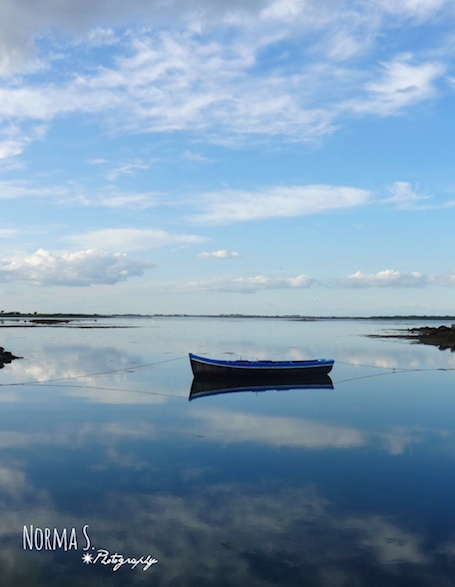
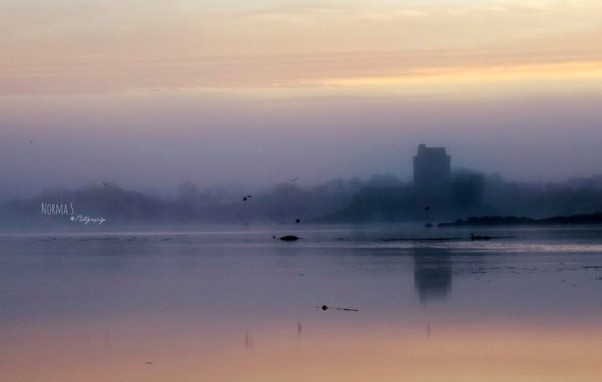
Freemans Journal 19th January, 1924 p8Galway Bay Photo: Norma Scheibe
Lieut Commander O’Donnell, of the Free State Coastal Patrol, a native of the Aran Islands, has initiated a scheme of coastal traffic in Galway Bay and proposes to run a direct service from Galway to Kinvara with the motor boat, St. Nicholas, and later to trade along the Northern coast of the county to Clifden.
==========
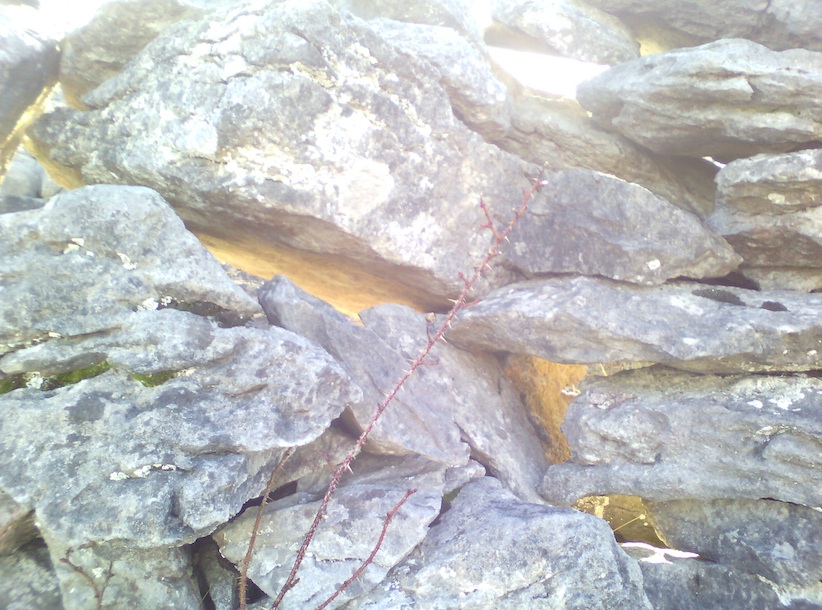
Tuam Herald 11th March, 1899 p4 (abridged)Photo: Kinvara Stone EO’D
A large and representative meeting of the electors of the parish of Kinvarra was held recently at Kinvarra for the selection of a candidate for the office of County Councillor of the Gort Division and of candidates for the District Councillorship of Kinvarra, Doorus, Killinny and Cahermore.
The Revd John Moloney, P.P. Presided and the attendance included the Revd Father Davoren, C.C. And Messrs J.W. Brady Murray, John Flatley, William Flatley, Fergus O’Dea, John O’Dea (Doorus), John Quinn, PLG; Miko Hynes, Ml O’ Donoghoe, Martin Corless, Patrick Curtin, John Quinn (Kinvarra), Thomas Greene, (Loughcurra), F. Green, P. Hynes PLG; M Brennan, Stephen Leech, Thomas Leech, John Morris, John Fahy, PLG; Thomas O’Halloran, John Finucane, Thomas Fahy, Patrick Hynes, (Corrishooa (sic.)); John Burke, Thomas Burke, Thos Kavanagh, J. O’Connor, Michael Howard, John Tierney, Wm. Whelan, A. Staunton, P. Kennedy, Ml. Kennedy, William Connor, John Davenport, T. Doogan, Ml Grady, E. Holland, F. Fox, Wm. Quinn, Michael Mooney, F. Lally, T. Lally and many others.
Among the ladies present were the Misses Hynes, Mrs Cullinan, Mrs Watson, Mrs Johnston, Mrs O’Halloran, the Misses Joyce and Mrs O’Donnell.
(further details in Kinvara in the news-archives on theburrenandbeyond.com)
Patrick French, son of Roebuck, waa a Catholic. He was a very generous donor to the Kinvara church, his gifts including a beautiful chalice.
James, French, brother-in-law of Oliver Martyn, Tullyra, spent much of his iife in France, owing to the delicate health of his children. His daughter Frances, married Bartholomew De Basterot, who thus became heir to the Durus property. The establishment of his claim, however, involved him in a legal suit extending over thiee years. The enormous expense thus entailed so impoverished him that he was forced to sell some of the property.
It was purchased by Robert Gregory, Coole Park, and Mark Lynch, Galway. The latter erected Durus chapel for the convenience of the tenantry. As this occurred in the eighteenth century we may conclude that the penal code was not rigorously enforced in all parts of the country.
Robert Gregory continued the erection of the Kinvara pier and quay which had been begun by James French. To do so it was necessary to demolish the fine old chiefs (sic.) of Kiloveragh which stood opposite Dun Guaire Castle. Though displaying little reverence for the historical monuments of the district, this gentleman showed a commendable enterprise of more material value to inhabitants.
James De Basterot built a new residence at Durus and planted extensively. He was an artist of merit and some of his pictures are still to he seen in Kinvara church. His son, Bartholemew, was a distinguished writer. Though one of the absentee landlords, he manifested a kindly interest in his tenants.
Tiirowen House was purchased about 1650 by Christopher French. The latter was Mayor of Galway during its siege by Ludlow who added considornbly to the Tirowen estates, probably after his betrayal of Galway. Early in the eighteenth century, a daughter of his married the Hon. Mary St. George, hence the Tirown Frenches were afterwards known as the St. Georges.
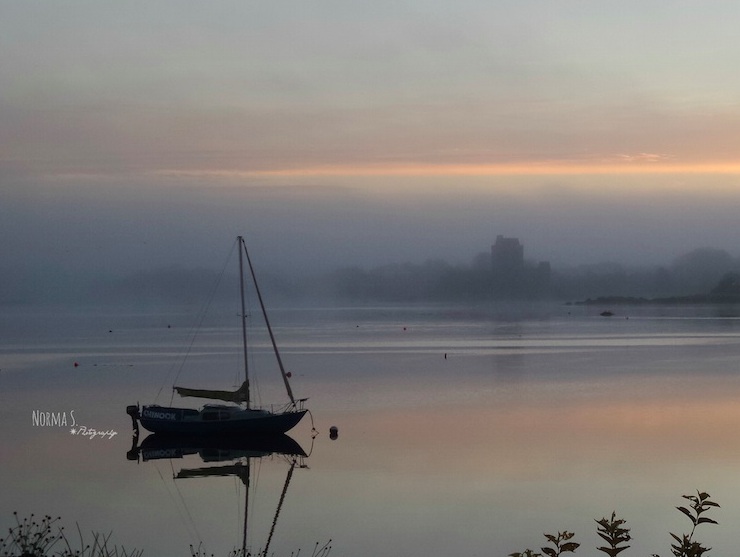
Connacht Tribune 24th Dec 1910 p5 (abridged)Kinvara Photo: Norma Scheibe
On Monday morning the Kinvara cattle drivers, M.H. Donohoe, Gortnaclogh; T. Gorman, John Hynes, P. Healy, Bartly Quinn, Moy, and John Smith, Kinvara, were released from Galway Jail after undergoing a term of six months’ imprisonment. They were tried at the Summer Assizes and sentenced by Judge Kenny for driving cattle off the lands of Funshinbeg. The severity of the sentence and the respectability of the prisoners evoked the greatest sympathy at the time, and the Nationalists of the district vied with one another in doing the farm work and harvesting for their families ever since.
They were met at the door of the prison as they emerged, by Mr. Ml. O’Donohoe, J.P., Co.C, and seven cars, laden with members of the Kinvara hurling ciub. They were sumptuously entertained by Mr. O’Donohoe, and started from Eyresquare after “doing” Salthill, about 3 p.m. for Kinvara. They were loudly cheered passing through Oranmore and Clarenbridge, and on reaching Kilcolgan they were greeted with illuminations. They were met outside Kilcolgan by a big contingent with cars and horses, from the Kinvara and Duras branches U.I.L., consisting of Messrs. T. P. Corless, D.C., president; M. Curtin, B, Quinn, M. Melia, Pat Hanlon, Bryan Kilkelly, T. Keane, Joe Forde, Pat Halvey, P. Callanan, P. Whelan, Ml Carty (Secretary), Michael Huban, A. Connors, C. O’Loughlin, P. Noone, J. Moylan, John Glynn, etc., who cheered them loudiy. As Ballinderreen was approached it was seen that every house was illuminated, bonfires were ablaze on every hill, and lighted torches lit up the horizon. A noticeable feature in Ballinderreen was a big force of police, under arms on the outskirts of the crowd.
A hurriedly convened meeting was held under the chairmanship of Mr. Michael O’Donohoe, Co.C, J.P., who thanked the sterling Gaels and fearless Nationalists of Ballinderreen for the great reception they had given the prisoners (cheers). He would never forget it. He reminded them of the early days of the Land League Movement and of the proclaimed meeting in 1879, and said he was glad to see the same spirit animating them today. Mr. T. P. Corless, D.C., also addressed the meeting.
Amidst a scene of great enthusiasm the procession, which had now assumed enormous dimensions, started for Kinvara. The houses along the route were illuminated and bonfires and torches blazed at Pollough and Toreen.
At Ballyclera the whole village turned out and the procession passed with great difficulty through a virtual sea of fire. Dungora Castle presented a grand appearance with its many and various coloured lights. Overlooking the town and harbour, the lights could he seen for miles. The turrets on the top were beautifully lighted and arranged in such a way as to resemble a huge harp. A bonfire was ablaze in front of the Castle as the prisoners were passing.
Kinvara town was brilliantly illuminated and an immense bonfire was lighted in a field opposite the Convent of Mercy.
In Moy and Gortnaclogh, the homes of the prisoners, bonfires and illuminations were kept up until morning.
Mr. Cruise, D.I., and a number of extra police were drafted into Kinvara, but notwithstanding the greatest excitement, everything passed off quietly.

 The Burren and Beyond