
CONNACHT TRIBUNE 29TH MARCH 1924 p.5
A very interesting concert was held in the convent school, Kinvara, on the nights of the 16th and 17th of March. The concert was organised by the nuns in aid of the church, all the artistes being from the boarders of Seamount House and pupils of the convent national school The first part of the programme consisted of a varied and choice selection of vocal and instrumental music and dancing, interspersed with tableaux, Irish dialogues, and some very pretty pieces acted by the smaller children. The item “An Bhean Deirce,” was particularly well done; also the dancing. The opening chorus was very impressive, the stage being artistically decorated and lighted, and the children and young ladies dressed and grouped with exquisite taste. There were twelve violins in the band, and the performance showed very careful training, and was much appreciated. In addition there was a solo on the ‘cello by Mr C O’Dea and one on violin by Miss M Flatley, who promises to be a perfact master of this instrument.
In the operetta, “The Wishing Cup,” with which the second part of the programme opened, Miss P. Murphy was a magnificent success as Gipsy Queen; Miss C Johnston acted the part of Elsa very dramatically; Miss Boland and Miss Hayes also did their parts exceedingly well, the latter being gifted with a very sweet singing voice. About thirty took part in this operetta, and the movement and the acting of the different performers was so perfect that there was not a dull moment in it from start to finish. They all, gipsies, fairies, maids and will-o-the-wisps, played their parts with marked success. This operetta was followed by a short amusing farce, which was very well staged and brought a most enjoyable entertainment to a close.
The large crowd present both nights appeared highly appreciative of the efforts of all the performers. This concert has been the most successful held in Kinvara for a long time, and reflects great credit on the nuns who were responsible for the organisation of it and the training of the children, which gave a real pleasure to all who were privileged to be present.
Tag: Kinvara
A close call – Kinvara Quay – 1896
Tuam Herald 30th May 1896 p.2(abridged)
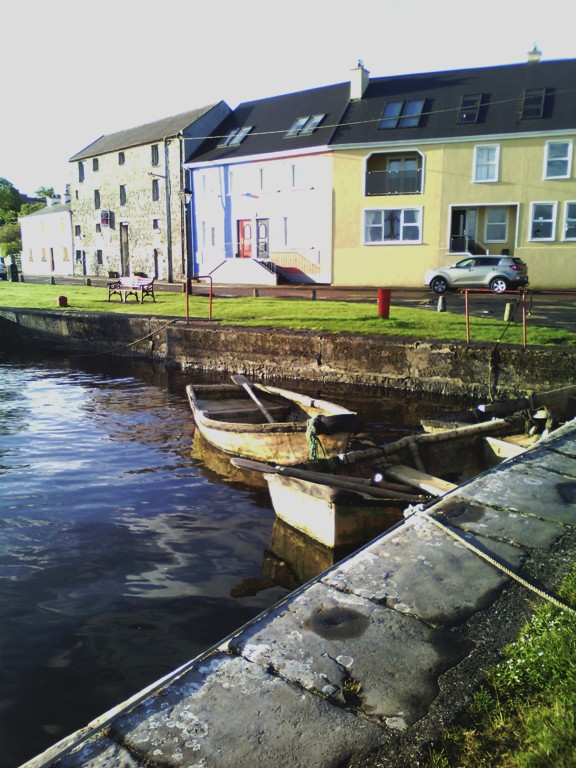
On Friday last while Sergeant Feeney of the Kinvarra station was on patrol duty with a party of his men, he noticed an unusual volume of smoke in the direction of Kinvarra Quay, and at once went in that way. He found that a large boat belonging to a man named McDonagh from Connemara, and which had been moored at the quay was on fire. He and his men immediately jumped on board the boat and on entering the hold found two of the boatmen asleep. Having roused the men the entire party proceeded to extinguish the flames. Were it not for timely arrival of the police, the certainty is that the two men would have been burned to death.
Kinvara – 1916
Connacht Tribune July 1st 1916 p 4
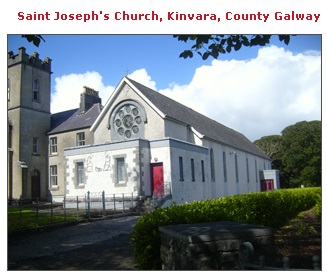
Every man, woman and child in Kinvara parish and district, and most people throughout Co. Galway and the West, know that Kinvara Church and Convent have been searched by armed police. A great many well-informed people are aware that the Rev. Parish Priest, the Rev. T. Burke P.P. has made a strong protest to General Sir John Maxwell, the military governor of Ireland. The whole subject is talked of far and wide and the story suffers nothing in the telling. But the new censorship that is exercised today in Ireland, as if a war were actually proceeding within our shores, and the country had got out of hand, decrees that “no correspondence between General Sir John Maxwell and Father Thomas Burke, P.P. Kinvara, is to be published.” So with the shadow of blood on the Irish horizon and feeling and passion inflamed, we are back again to the old coercionist regime. We cannot help asking ourselves is this possible in the 20th century of have the military governors of this country, clothed in the “petty brief authority” that a fateful chance has given them, taken leave of their senses?
If those governors imagine that by suppressing in Ireland the plain, if painful truth, they are serving any good purpose in constitutional or military government they are making a colossal mistake. The affair at Kinvara has been grossly mishandled from the beginning and the characteristically Prussion attitude of the new censorship in Ireland does not improve but considerably aggravates a painful situation. Surely the military governors of this country ought to be able to defend their own attitude, and the attitude of their subordinates, without resorting to the equivocal expedient of a clumsy endeavour to conceal from the public all the facts! Even viewed from their own standpoint, the attitude of the censor in this respect is extremely stupid. It makes a mystery where none existed and renders the people suspicious of an authority that resorts to methods that are given so sinister an aspect. We publish elsewhere the protest made at the conference of priests held at Gort on the 6th of this month. Surely a body of clergymen are entitled to a full, frank and public explanation and apology from the Government for a proceeding that tends to bring the authority exercised in this country into contempt.
For sale – Kinvara – 1910
Connacht Tribune 5th March, 1910 p8
Photo: EO’D
At a special meeting on Monday, Mr T.P.Corless, D.C., presiding, and the following being present;
Messrs. Thomas O’Halloran,
Bartley Bermingham,
Michael Corless,
Augustus J. Johnston
Edward Holland
Michael Connolly
the chairman submitted a letter from Mr Coghlan Briscoe T.C. stating that he forwarded the tenants memorial to the Congested Districts Board, and was bringing all possible pressure to bear on the board to purchase Kinvara from the trustees of the Sharpe estate. Mr Briscoe’s powerful appeal for justice, made before the Town Tenant’s Executive in Dublin, was loudly applauded. The action of the agents in threatening legal proceedings against the tenants was severely commented on.
Within the last few days notices have been served on the tenants to pay up or Mr Concanon, solicitor, will be instructed to proceed for the recovery of the rent. The committee have decided to await developments and appeal to the tenants to withhold the rents. In view of the situation that now exists on the property the committee earnestly exhort all who have not as yet joined the League to do so at once, as the fight has now reached an acute stage. The committee are in communication with Mr Briscoe and Mr Wm Duffy M.B. and several well known leaders, with a view to holding a public meeting and infusing new life into the district. On the motion of Mr Corless, seconded by Mr Thomas O’Halloran, a resolution thanking Mr Briscoe and the “Freeman” was passed.
The largest sheep fair in 50 years – Kinvara – 1912
Connacht Tribune 26th October, 1912 p5
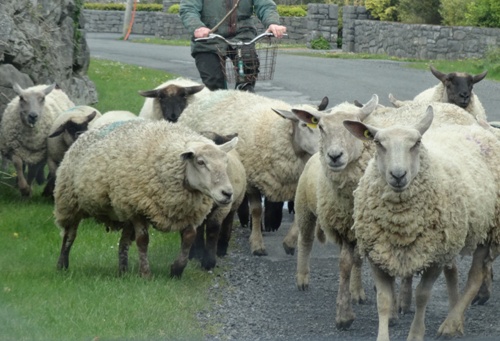
The sheep fair was held on Thursday, October 17th, and was by long odds one of the largest held in Kinvara for over fifty years. Owing to the depression in the sheep trade for a considerable time, people were afraid it would be impossible to dispose of their stock at any price. All doubts on that point were set at rest the evening before the fair by the great influx of buyers to the town from all points of the compass. Tipperary, Roscommon, Clare, Cork, Limerick, Mayo, sent their quota to swell the big contingent of buyers. Hugs flocks of sheep were driven into the town all through the night, and long before day the town was crowded as it was never crowded before, the fair extending far out the Galway and Clare roads.
Kinvara Dramatic Society – 1958
Connacht Tribune 20th December, 1958 p 8
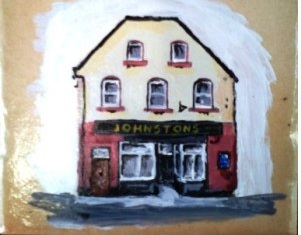
EO’D
Kinvara Dramatic Society scored a notable success with “A Damsel From Dublin” which ran for three nights this week to packed houses at Johnston’s Hall, Kinvara.
Under the inspired direction of Mr Kieran Moylan, the play lacked nothing in production and comedy. Kieran himself took the part of the “damsel” and few could have done it better. Paddy Joe Keane played the part of Michael Guinan, “the man of the house” to perfection; Toddy Byrne was an excellent “son of the house” in the role of Michael Junior. In the major male roles Sean Nolan and Brian Clery as two “neighbours” acquitted themselves very well. Joe Regan and Paddy Geraghty carried off their parts as solicitors in excellent fashion. Miss Sally Regan, the female lead, as “Belinda Duffy” and her “mother” played by Miss Bridie Quinn, were excellent. Mrs Margaret Connolly as “Mrs Cleary” was first class.
The evening opened with some catchy choruses by Messrs Kieran Moylan, Toddy Byrne, P.J. Keane and Joe Regan, and the Misses B. Quinn, M. Connolly, F. Halvey, S. Regan and M. Muldoon. Miss Mary Keane and Miss A. O’Shea rendered solos, and Miss Roseen Moylan danced a hornpipe.
Musical selections by Messrs Joe Leary, J.Wade, Bob Gardiner and Syd McPhillips added to the enjoyment.
Miss B. Quinn N.T. who compered the show thanked the audience and artistes.
The production will be staged at Clarenbridge Hall on Sunday next.
New Quay – 1907
Nenagh News 17th August, 1907p3 (abridged)
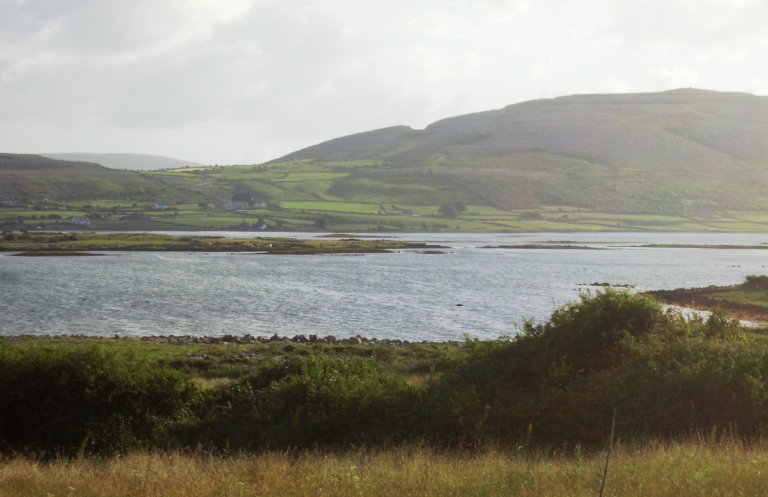
Photo: BO’D
New Quay is encircled on the south side by the rugged range of the Burren Mountains showing the ancient ruins of Corcumroe Abbey, Aughmama Abbey, Mucknish castle, and other castellated ruins along Bellharbour Bay, with the villages of Curranroe, Kinvara, Bellharbour, Ballyvaughan and Finavara, in the immediate vicinity. The air at this district and its surrounds, filled with the ozone and saline of the salt sea of the Atlantic Ocean infuses new life and vigour into one accustomed to living in inland places where the air is entirely devoid of those health giving properties and less embracing.
There are two bathing centres in New Quay supplied with bathing boxes, and a splendid range of sanded strand, one at New Quay and the other at Old Quay, a short distance away towards the Flaggy Shore. The circle of sea surrounding New Quay extends from Curranroe, at the boundary of Clare and Galway, by Munna and Carton, along one of the northern peaks of the Burrin Mountains and continuing on by Old Quay, the Flaggy Shore, Finavarra, Martello Tower and Scanlan’s Island. At this point the entrance is to Bellharbour Bay by a narrow strait dividing Finavarra from Mucknish castle and Ballyvaughan and continuing inland by the southern slopes of Finavarra demesne, and Corcumroe Abbey to Bellharbour Quay and circling outward in the opposite direction by Muckinish Castle, Oughmama Abbey and Ballyvaughan, under the shade of the Burren Mountains.
In fine weather the open sea from the mountain heights and verdant plains of this district, presents one crystal sheet of sparkling surface, with ships, steamers, trawlers, and every style of sailing boat strewn here and there along the surface of the water, from the coast to the circle of the horizon, touching the Atlantic Ocean in the West where the top rigging of the largest barque afloat is seen as a speck above the curvature of the sea, until the full sails and hull of the vessel are exposed to view as it approaches nearer along the surface of the sea.
In stormy weather this open expanse of sea presents an entirely different appearance form what it is in fine weather. To residents of the district the disturbed and placid surfaces of the sea are as familiar as the rising and setting of the sun, but to the visitor or tourist unaccustomed to the fury of the tempest, a short sojourn at New Quay brings the extreme changes caused by the elements into view.
There are intermediate phases in the elements and surface of the sea which only add to the enjoyment of a sail in open boats, but woe betide the boats or even larger vessels, tossed about like shells on the surface of the mountain waves, rolling in silvery breakers from the Atlantic ocean against the cliffs and rock-bound coast.
Kinvara – turf tax – 1912
Tuam Herald 14th September, 1912 p.2 (abridged)
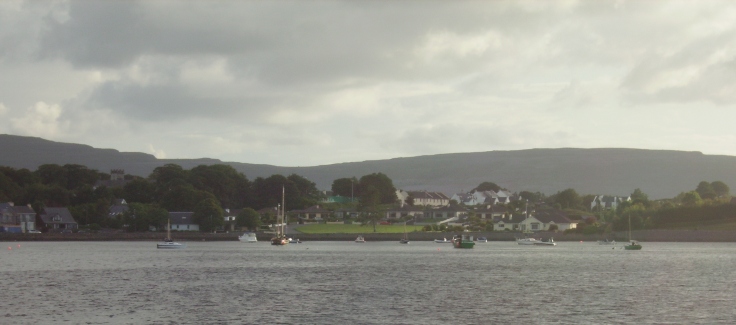
Photo: BO’D
The harbour authorities of Kinvara exact three pence for every load of turf coming in from Connemara. During the turf season over 20 boats come and go every day and this season the cost for a boat load of turf was from 45s to 60s.
The men who bring the turf from Connemara are fine specimens of Irishmen. Each puckaun contains three men and they are excellent sailors and navigate their crafts in so expert a way that never an accident occurs. The turf is expensive but most necessary. There is no turf in the immediate neighbourhood of Kinvara or within miles of the town, so the people must depend on the supply from Connemara brought in these boats from over the bay.
Kinvara – a history
Historical notes on theburrenandbeyond.com
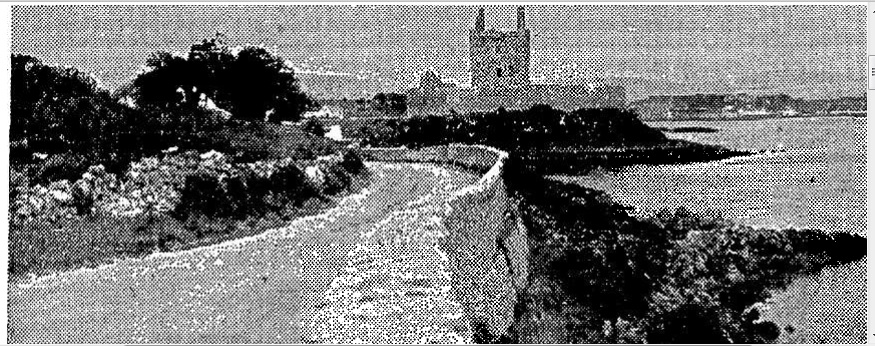
Irish Press
12th November, 1931
A fair point – 1907
Nenagh News 17th August, 1907 p3 (abridged)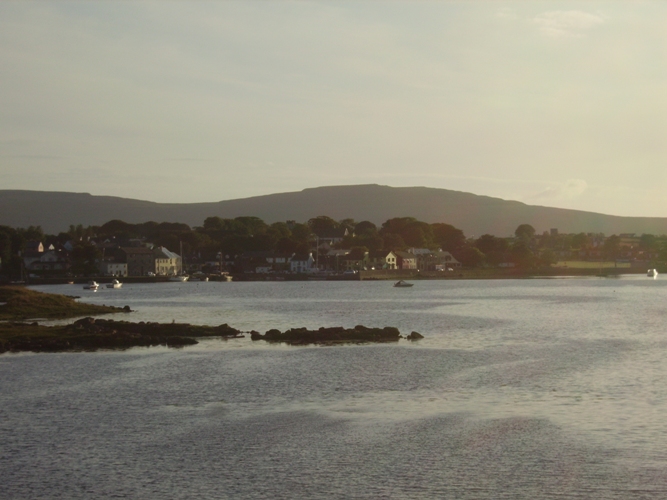
Photo: BO’D
About one hundred thousand pounds of the estimated two and a half millions annual over-taxation of Ireland would build a small link of railway between Ardrahan and Ennistymon by Kinvara, New Quay, Ballyvaughan and Lisdoonvarna and throw open to the public the enjoyment of the open sea and means of transit for the famous Burren oysters, Redbank oysters and Pouldoody oysters, whose banks are along this particular section of the coast of Clare, particularly New Quay.
 The Burren and Beyond