Posted in Posts and podcasts

Kilmacduagh – 1876

Tuam Herald 11th November, 1876, p1
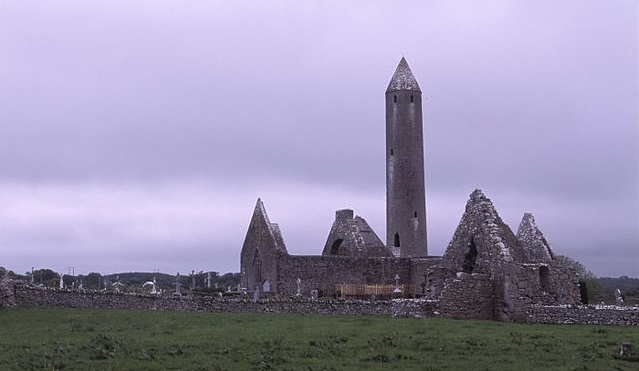
Kilmacduagh
Photo: Jerzy Strzelecki
Wikimedia Commons

Kilmacduagh is a parish in the barony of Kiltartan, County Galway. The See of Kilmacduagh, now a part of that of Galway, was founded by St. Colman, who, being son of Duagh, was distinguished from other Colmans, his contemporaries, by the appellation of MacDuagh. He build a monastery and church called after him, Kilmac-Duagh, whence the name of the parish. The latter comprises 6,015 statute acres. Some ancient remains are to be seen in the neighbourhood, including a round tower, which declines about 17 feet from the perpendicular.

In a lake in the parish, called Lough Deehan, the waters having sunk very low in the year 1784 or 1785, a house was discovered in the mud at the bottom, formed of oak timber of great thickness, the sides and roof of which was formed of wattle-work of the same substance: it appeared as if intended to float, and the timer of which is was constructed was perfectly sound.
Posted in Posts and podcasts

Kinvara – 844

Connacht Tribune 12th December 1931 p 5 (abridged)

Photo: EO'D
Photo: EO’D

The Danes left their mark in Aidhne with the following incursions;
In 816 A.D. Corcomroe was raided. Glen Columkille and Oughtmama suffered and the northmen went through Aidhne to Oranmore and Loughcorrib. After the plundering of inis Cealtra the marauding vikings used the island as a base from which they plundered the church of Beagh. In 843 the warrior Turgesius, operating from Loughrea sought to establish his authority in Connacht.

The following year the Danes landed at Kinvara and proceeded in their woeful way by Kilmacduagh to Clare.

Posted in Posts and podcasts

Irish homes and Irish hearts p2 – 1868

Freeman’s Journal 28th March, 1868 p11

Kilmacduagh Abbey Photo: Borvan53  Wikimedia Commons
Kilmacduagh Abbey
Photo: Borvan53
Wikimedia Commons

(abridged)
The See of Kilmacduagh was founded by St Colman in the seventh century. Here the cathedral was built, close behind a round tower and surrounded by six other churches. We explored the ruins well and I was fortunate in having a cicerone who had often visited them before, and took a vivid interest in them. It was irritating to see cattle and sheep grazing in the area, more especially as the place is held sacred by the people who bring their dead for burial in its precincts. The former owner of the place was proud of the ruins and took pains to preserve them. It has now unfortunately, passed into younger and more careless hands. It is supposed that one of these seven churches was a college chapel, another a monastery and a third a convent – the other three being probably smaller churches or oratories dedicated to some favourite saints. The convent chapel is the most perfect and the east window and several arches with their corbels show it to have been one of great beauty.

The round tower is especially remarkable from its leaning seventeen feet out of the perpendicular and it is certainly a most singular object. Tradition says it was built by Gobhan Saor, the architect of Glendalough and Antrim.

On leaving this interesting spot I drove through some pretty country, with distant views of “the lonely hills of Clare,” all radiant with the sunshine, to Lough Couter. It was pleasant to see all along the way how the people greeted the priest; they came out from their cabin doors and children ran from their play to get a word from him.

Posted in Posts and podcasts

Sunday closing – 1879

 Photo; Decatur Wine & Spirits Wikimedia

Photo; Decatur Wine & Spirits
Wikimedia
NEW ZEALAND TABLET VOLUME VI 10TH JANUARY, 1879 P17 (abridged)

It is nearly eight years since the Most Rev. Dr. M’Evilly, Lord Bishop of Galway, impressed upon the people of the diocese and of the diocese of Kilmacduagh and Kilfenora, of which his Lordship is Apostolic Administrator, the propriety of closing public houses on Sundays and his Lordship was almost implicitly obeyed. Since that time nearly all the respectable traders in Galway, in Gort, in Oughterard, in Ennistymon, in Kinvarra, and all the large towns in the dioceses mentioned, have kept their establishment closed on Sundays. Hence the law makes very little difference in this part of Ireland.
Two, or at most three, obscure public houses were kept open on Sunday in Galway, and these were frequented by a straggling lot of persons. It is a remarkable thing about Galway that when the bill for Sunday closing was before Parliament a petition was sent forward from the vintners of Galway in favour of that measure. There are about 120 public-house-keeepers in the county of the town of Galway, and over 100 signed the petition. Some of the others were absent at the time. But, as I have said, nearly all obeyed the Lord Bishop, so that virtually the operation of the Sunday closing Act will make very little change in the City of the Tribes.