The W.A. Record Sat 20th Sept. 1898, p4 Galway -1898 Death of Mr. John Holland,of Kinvara.
On the 4th of last July John Holland, of Quay, Kinvara, died. Just 50 years ago this worthy man played a part in the stirring events of the time, which deserves to be remembered by true Irish patriots. By him the late J .B. Dillon was placed on board a ship in Galway Bay, and thus avoided the sleuth hounds that were on his track.
The Oldest Man in the World. There is a native of Errislanan in Connemara, who says himself he is 120 years old, while others say he is much older. He remembers distinctly seeing the French when they landed at Killala in ’98, and says he was ” working with the horse drawing stones ” at that time. His name is John M’Donagh. He can only speak Irish, and that very feebly, but this season he went out and planted his own crop of potatoes.
The ’98 Centenary and the Re-naming of Streets. At a recent meeting of the Loughrea Town Commissioners the following letter was read from the Rev. Father Nolan, dated from St. Joseph’s the Abbey, Loughrea : To the Chairman, Board of Commissioners. Gentlemen, I beg respectfully to submit to you that, in my opinion, it would be a desirable and suitable means of keeping fresh the memory of the men of ’98 to have the names of the streets of this ancient town painted in Irish and in Irish characters on boards to be afterwards fixed in conspicuous and suitable places throughput the town. I would also suggest that one of the streets should be named after Peter Finnerty, a Loughrea man, who suffered pain, penalty, and imprisonment in those evil days for love of Ireland. Peter Finnerty, according to John Philpott Curran, was ‘the only printer in Ireland who had the courage to speak for the people.’
Permit me to add that I have confidence enough in my fellow townsmen to lead me to believe that the above propositions shall not only be favourably received but effectively carried out.
I am, gentlemen, your faithful servant,
Joseph Nolan, O.D.C.
Mr. Joseph O’Flaherty proposed and Mr. Martin Kennedy seconded that the suggestions contained in Father Nolan’s letter be carried out. The proposition was carried unanimously, and a subcommittee, consisting of three of the members of the board, appointed to confer with the Rev. Father Nolan with a view of laying before him the opinion of the board, and taking his further suggestions on the question.
(abridged)
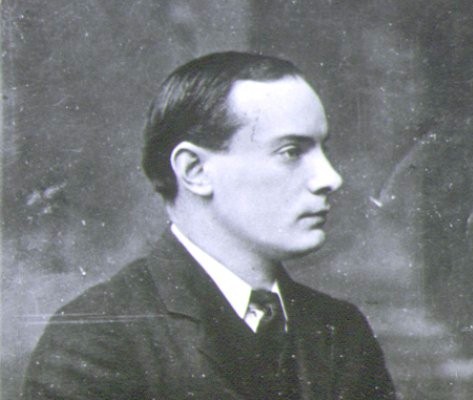
Patrick Pearse was a barrister, but he may be said not to have practiced as he gave himself up to the work of education at which he was most successful. He once appeared in a Galway case. It was to defend the Kinvara Hero who, despite the law, persisted in having his name painted in Irish on his cart. The police prosecuted him and he was duly fined but he triumphed. Lady Gregory and Edward Martyn took up his case and Pearse ably fought it in the Dublin courts with the result that such stupid and silly prosecutions were abandoned and the brave Kinvara man, Bartley Hynes became a hero in spite of himself.
New Zealand Tablet Vol XXVII Issue 9, 2nd March 1899 p9
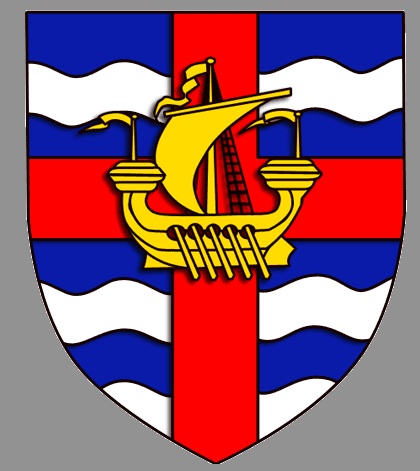
Loughrea Crest Wikimedia Commons
In Loughrea shields have been erected bearing the names of each street in Irish. Father Nolan ODC, who is an Irish scholar, is responsible for the idea, and the painting and lettering of the shields was done by Father Thomas ODC, assisted by the nuns of the Carmelite Convent.
FREEMAN’S JOURNAL 3RD MARCH 1853 (abridged)Photo; BO’D
It is a curious historical fact that the Irish troops, who principally contributed to save the town of Louvain, in 1635, from the tremendous assault of the great French army under Marshals Chatillon and De Breze, were in that bloody contest marshalled and commanded in Irish. A Latin writer of the seventeenth century, who was conversant with most of the European tongues, tells us that the Irish language
“surpasseth in gravity the Spanish, in elegance the Italian, in colloquial charms the French;
it equals, if it does not surpass the German itself in inspiring terror.”
The World News – 25 October, 1902 MARRIAGE IN IRISH.
THE FIRST WEDDING IN LONDON IN THE GAELIC TONGUE.
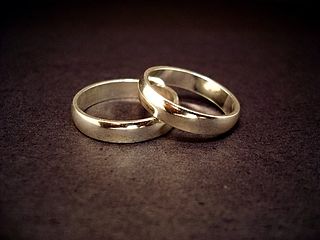
The first marriage solemnised in London ln the Irish language took place recently at Dockhead Catholic Church.
The bridegroom was Mr. John O’Keane, for the past three years the secretary of the Gaelic League of London, the bride Miss Kathleen Dineen, of Forest-gate, a charming young lady whose singing of Irish songs has often stirred Gaelic League gatherings in London.
The ceremony was performed by the Rev. M Moloney. Wherever the Catholic Church allows the use of the vernacular Irish only was employed. From this to the solemn and sonorous Latin of the nuptial mass seemed a natural transition.
After the ceremony, Mr. and Mrs. O’Keane received the congratulations of a large gathering of friends in Irish. Professional men, civil servants, and general workers were largely to the fore. The young pair drove away for Paddington (for Ireland) amid a chorus of hearty and genial benedictions in their native language.
Photo: Gregory David Harington Creative CommonsTHE IRISH SLAVE TRADE – THE FORGOTTEN ‘WHITE’ SLAVES
JOHN MARTIN
GLOBALL RESEARCH JANUARY 27 2013
oped news and global research 14th april, 2008(abridged)
African slaves were very expensive during the late 1600s (50 Sterling). Irish slaves came cheap (no more than 5 Sterling). If a planter whipped or branded or beat an Irish slave to death, it was never a crime. A death was a monetary setback, but far cheaper than killing a more expensive African. Masters quickly began breeding the Irish women for both their own personal pleasure and for greater profit. Children of slaves were themselves slaves, which increased the size of the master’s free workforce. Even if an Irish woman somehow obtained her freedom, her kids would remain slaves of her master. Thus, Irish mothers, even with this new found emancipation, would seldom abandon their kids and would remain in servitude”.
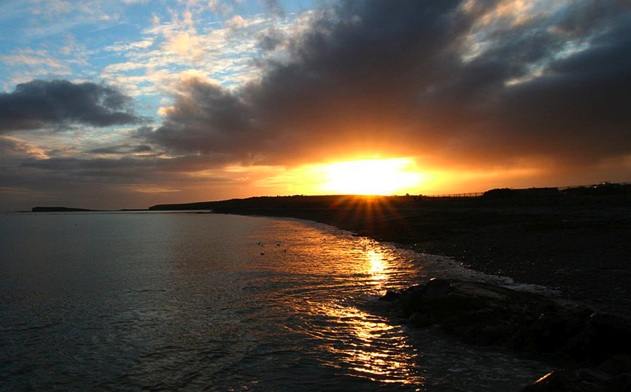
Sunset, Galway Bay wallpapers.varjati.com https://widgetworld3.wordpress.com/podcasts/
PETTICOAT PAPERS. OTAGO WITNESS, 23RD APRIL, 1891 P35
THE IRISH GIRL.
(abridged)
Irish women are the most passionate partisans in the world. Get an Irish girl into the corner of any drawing room, and tickle her with a remark about Balfour. or Parnell, or rents or evictions, or any of the burning questions which rend the “distressful country asunder”, and she will go for you with all the headstrong volubility of her race, and if she doesn’t convince you with her logic, she will do it with her eyes.
Have you never heard an Irish girl sing “The wearing o’ the green” with that passionate abandon which no English girl can approach, until you were ready to curse – Tory though you be – the scoundrels who were “hanging men and women for the wearing o’ the green”? For she has that keen sensibility, that quick sympathy which is so distinctive of the French woman. In fact, she is by nature and temperament a French girl, with a somewhat deeper reserve of passion and a freer system of education and social life than her Gallic Sisters.
That is why the Irish woman succeeds so well in Paris. When she finds herself in a congenial soil she takes root and flourishes with the luxuriance of an indigenous plant. She has all a French woman’s aptitude for intrigue, with more than a French woman’s fire and vigour. Politics, personal politics form her native element, and nowhere are politics so personal as in Paris. And so, when, in obedience to the French maxim, you have looked for the woman, you need not be surprised if she speaks with an Irish accent.
The Irish girl in England often creates an impression of fastness. It is quite a false impression, but springs naturally from her character. She is, as I have said, keenerwitted than home-grown girls “alive all o’er to smart and agonise at every pore.” This is mirrored in her talk, which is fervid and fluent hot from the heart which she bares to you in her speech. She presents herself to you au naturel. She is natural, unconventional, straightforward.
But the Irish girl must be studied at home on her native soil before she can be fully appreciated, and not in Dublin, or Cork, much less in Belfast or Ulster. Generally all big cities approximate to London, as all roads once led to Rome.
I should select Galway as the district where the purest and most unadulterated Irish maidenhood is to be discovered. Often and often, as one drives across the rainswept hills, one comes suddenly upon a cabin and as the clatter of wheels draws near, a figure steps out of the cabin which makes you feel instinctively for your sketch-book, ‘so wonderful are its suggestions of grace and beauty. Only suggestions, alas! For the dress is ragged, and the whole aspect unkempt. But there is a dignity in the carriage, a shimmer in the raven hair, and a purity of complexion.
The features of the girl are reproduced in a score of Galway country houses, only in a prettier frame. The eyes deep grey for choice with all sorts of half lights lurking in the corners, ready to blaze up in passion or melt in pity; eyes that rivet your own till you catch yourself blushing at your own temerity – were there ever such eyes?
All other features are blurred and indistinct if the real Irish eyes are there and as the Cheshire cat lives by its smile alone, so the Irish girl, in spite of a snub nose and a wide mouth, has only to look and conquer. And the voice! I You have no idea of the magic of the human voice if you have never heard an Irish girl tell Irish stories in an Irish house.
Oliver Wendell Holmes says somewhere that he has only heard two perfect speaking voices. One belonged to a German chambermaid, the other I forget to whom. But neither to an Irish girl.
He had never been in Ireland.
At home we often hear soft melodious voices—” voices low with fashion, not -with feeling” – but never in the world have I heard anything like the linked sweetness of an Irish girl’s voice. If it were but a page of Bradshaw that she were reading, the effect would be the same; as the long-drawn notes of a Stradivarias in the simplest melody bring tears from the heart. I cannot explain it, but everyone feels it. There is a note in the human voice which finds its complement in our inmost being. And the Irishwoman has put her finger on that note.
Every Irishman has a touch of Bohemianism in his nature. Thackeray said that we lose our way to Bohemia when we turn the corner of 40. The genuine Irishman never forgets his way there. The Irish girl has it, too, Only a soupcon— like garlic in French cookery; but it gives a flavour to her character. It comes out sometimes in a reckless disregard of expense and consequent financial disaster, sometimes in a wild rush to go nursing in Egypt or missioning in China. I have seen a Galway girl sit up all night while her brothers played billiards, and ride 30 miles after the hounds the next day without turning a hair. And I have seen the same girl sit by a sick bed for a week without taking off her clothes. It is this touch of Bohemianism which sometimes throws the Englishman off his balance. This reckless audacity, this outspoken frankness, which springs from warmth of heart he mistakes for something warmer. And then he notices that the tender grey of the Irish eye can harden into a steely blue, and finds the Irish girl bulwarked by the impregnable rock of maidenhood. She is without fear. Because she is without reproach.
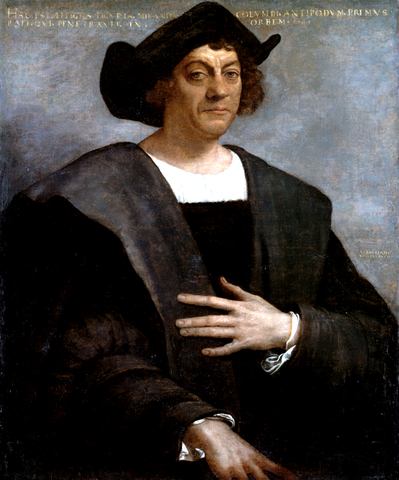
Christopher Columbus – 1519 Sebastiano del Piombo (1485-1547) Metropolitan Museum of Art wikipedia.orghttps://widgetworld3.wordpress.com/podcasts/ BLAIRMORE ENTERPRISE 9TH MAY, 1912
THE CREW OF COLUMBUS – (abridged)
The list of the officers and sailors in the first voyage of Columbus was almost cosmopolitan in its character Among them there was a man of Jewish heritage, Luis de Torres; an Irishman from Galway Ireland, William Harris; an Englishman, Arthur Laws; Italians, Portuguese, Spaniards and several other nationalities, though, of course, the Spaniards were largely in the majority.
It is maintained by some authorities, with considerable plausibility too, that there was a Scotchman in the list and that after Columbus himself he was the first man to tread the soil of the new world – Exchange
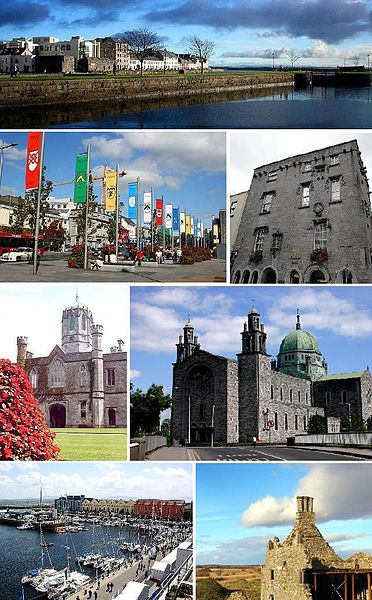
Galway Photo: Creative Commons – Sleepyhead2https://widgetworld3.wordpress.com/podcasts/ THE INTERMOUNTAIN CATHOLIC 15TH JUNE, 1907 P6
GALWAY MEMORIES
Well worth seeing and well worth remembering, dear old Galway; Galway of the stalwart gray houses that have stood for centuries the storms and buffets and driving rains of the Atlantic; Galway of the narrow, winding quiet streets; Galway of the beautiful bay, where of an evening the sinking sun touches with its dying splendor the quaint-colored sails of the fishing boats rocking at anchor.
Pleasant Galway it is, where the people are erect, and sturdy, and kindly, and the children – real, rosy country children – smile at you out of deep blue eyes as you pass; where you are awakened in the early morning by the complaining, musical cry of the shawled and barefoot fishwives.
“Fresh herring! Fresh herring!” they chant, as they trudge, baskets on hip, along the cobbled street. Oh, a quaint, old-world town is Galway, and a good old-world people are they that live there.
It chanced late last summer that a wanderer, weary of the noise and stress of modern life, strayed into the old town, and instantly felt the rest and quiet comfort of the atmosphere, and, going forth to stroll among the streets, found a throng wending their way on some great purpose bent, and so, following, came to an old arched gateway, in a strange little nook, under which these people disappeared. The curious one, going in, was received with prompt and courteous hospitality by the members of the Gaelic League, and was made a free and delighted spectator of the proceedings.
It was the “Feis Connacht,” the great annual gathering of the local country people, who were assembled to hear the old tongue spoken, the old songs sung, and the old stories told, not, as so familiarly known to them, around the cabin fires or on the breezy hillsides, but in the great “town”, in a hall, where judges would listen to their efforts and award prizes and honors to those they liked best.
So it was in the old, long, low-ceiled, whitewashed hall they met, and they thronged from far and near, young and old, the ancient village favorite, white headed and frieze-clad, who was received with shouts of applause, the worthy matron, conscious of her dignity, the young earnest farmer lad, with deep, ever burning hope of Ireland’s freedom in his deep and earnest eyes, and the troops of sunny-faced children, fresh and sweet material these, for the work of keeping the old tongue alive. The old people knew it; they would pass, but it was these tiny ones whose little lispings were listened to with greatest attention by the judges – for within their curled palms lies the future of the Irish language.
They sang, these children with their clear fresh voices, in the soft accents of the old tongue, the ancient songs of their race, and while they sang, one read in their bright eyes and fair, Greuze-like faces, the hopes of the land for the future. Oh, the sweet old songs, “Kathleen-ni-Houlihan,” solemn and mysterious, “Paistin Fionn,” with its wailing refrain, and the slow, stately strains of the “Coolin.”
Even the wild, gypsy-like children of the famous Claddagh were there sturdily chanting and (yet more to their taste) answering back, in the “conversation contest,” with a free, brisk promptness, the questions put by the judges. It was a Claddagh lassie, with a great shawl drawn about her, like unto her elders, who seated herself with much composure, and begun a long story in Gaelic, which convulsed her hearers with merriment that found its origin in the twinkle of her shrewd gray eye.
And it was a Galway matron who, also draped in her shawl, danced with dignity and decorum, the many and difficult steps of the old Irish jig, to the lively strains of an ancient piper, upon a platform, laid for the occasion, upon the stage.
How independent they were, those Connacht people! No sign of shyness or mauvais honte. They stepped up and recited, sung, danced, whatever it might be, with earnestness, and industry. How fine was that old orator, who had his tale to tell, and his say to say (concerning the legitimate freedom of ireland) and who would say it, ignoring the tinkle of the judge’s bell (intimating that his time limit had expired), and indeed, upbraiding those with upraised hands and nodding heard, as he perforced abandoned the rostrum and descended to his place among his fellows.
Good humor and appreciation are ever the order of the day. One and all, fisher and farmer and kirtled housewife, “old men and maidens, young men and children,” and the “quality” mingle in perfect democratic unison on the common ground of “land and language”.
The very remoteness of this region from the hustle and distraction of the world, would seem to militate strongly in favor as an educational field. There is time here, “all the time there is,” to be given to the study of and development of the language, and there is the earnestness, intelligence and independence of a people whose life is spent in the open air, brightened by God’s sunshine and inspired by God’s free winds, and the ever-sweet, salt breath of the ocean, here in the old historic town, whose every stone, every time-worn arch and buttress, and strange, old gray building is a reminder of ancient glories and sorrows. GERALDINE M. HAVERTY
michael kooiman Wikipedia.orghttps://widgetworld3.wordpress.com/podcasts/ THE INTERMOUNTAIN CATHOLIC JANUARY 26, 1907
A resolution passed by the Galway County Council condemning the action of the National bank for refusing to accept checks signed in Irish, has been adopted by several popular bodies in the country.



 The Burren and Beyond