Posted in Posts and podcasts

A Terrific Storm – 1841

Photo: Fir0002 WikimediaCommons
Photo: Fir0002
WikimediaCommons
https://widgetworld3.wordpress.com/podcasts/
THE CORNWALL CHRONICLE (LAUNCESTON, TAS) 30TH OCTOBER, 1841, P2
It seems that Ireland has lately been visited by a terrific storm of thunder and lightning, accompanied at the same time by a severe shock of an earthquake. Cattle and horses were killed by the lightening, and in the county of Galway the lives of three individuals fell a sacrifice to the electric fluid. So frightful and devastating a storm has not been witnessed in Ireland in the memory of its oldest inhabitant, and it is to be hoped that it will be long before the occurrence of such weather.

Posted in Posts and podcasts

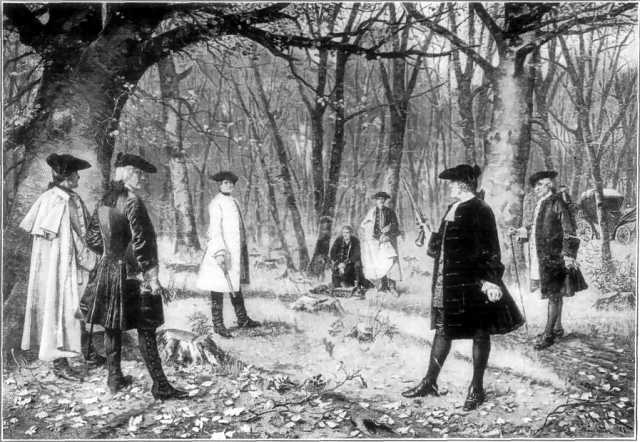
Duelling in Ireland – 1843

Alexander Hamilton- Aaron Burr Duel Gutenberg File of 1902 Book Wikipedia.org
Alexander Hamilton- Aaron Burr Duel
Gutenberg File of 1902 Book
Wikipedia.org
https://widgetworld3.wordpress.com/podcasts/
Launceston Advertiser 2nd November 1843
IRISH DUELLING (abridged)

No gentleman had taken his proper station in life till he had “smelt powder,” as it was called; and no barrister could go circuit till he had obtained a reputation in this way; no election, and scarcely an assizes, passed without a number of duels; and many men of the bar, practising half a century ago owed their eminence, not to powers of eloquence or to legal ability, but to a daring spirit, and the number of duels they had fought.

It was no unusual thing for the opposite counsel to fall out in court in discussing a legal point, retire to a neighbouring field, settle it with pistols, and then return to court to resume the argument in a more peaceable manner.

The public mind was in such a state of irritation from the period of 1780 to the time of the union, that it was supposed that three hundred remarkable duels were fought in Ireland during that interval. Counties or districts became distinguished for their dexterity at the weapons used – Galway for the sword; Tipperary, Roscommon and Sligo for the pistol; Mayo for equal skill in both.

Weapons of offence were generally kept at the inns for the accommodation of those who might come on an emergency unprovided. In such cases, ‘pistols were ordered for two, and breakfast for one,’ as it might and did, sometimes happen, that the other did not return to partake of it, being left dead in the field.

The laws by which duelling is punishable were then as severe as now, but such was the spirit of the times, that they remained a dead letter. No prosecution ensued, or if it even did, no conviction would follow. Every man on the jury was himself probably a duellist, and would not find his brother guilty.

Posted in Posts and podcasts

Marlborough Express – 1887

Broad_chain_closeuphttps://widgetworld3.wordpress.com/podcasts/

MARLBOROUGH EXPRESS 5TH MARCH 1887 P3

A NEW AMERICAN SLAVE TRADE.

The New York Journal says :—There is in New York a moneyed and well organised society which trades in human flesh and blood. The society is composed of the owners of those houses that disgrace the city. The head and front of it is a wretch keeping a place in Chrystie Street, and who boasts of a fortune of 300,000 dollars. 


The society has got in its employ a dozen women who make trips regular to Europe. They go to Paris, London, Berlin, Rome, Vienna, Edinburgh and Dublin. They live in “great style.” They go to public parks and squares, win the confidence of young women, and by specious promises induce them to come to New York. 


Their favorite dodge is to have the girl recorded on the passenger list as a “lady’s maid.” One woman was known to bring five girls on one trip. When the girls reached this city coaches await them, and they drive off, knowing no one, speaking a  strange language, and ignorant of American laws or customs, they are at a loss as to what to do, and usually yield to their fate. 


Two weeks ago a handsome, silken roben woman flashing with jewellery, and carrying a fat purse, appeared in Loughrea, County Galway, Ireland. She went to a farmhouse occupied by an honest old farmer. She remained there four days,, and before she left she induced the farmer’s daughter, Katie ——, an innocent girl about 17 years old, to start for this city. She said she knew the girl’s sister, who resided in New York, and that her sister was anxious that Katie should come to America to enjoy her wealth. She also showed her parents a cable dispatch asking that Katie should be sent out. 


The unsuspecting girl started off, and embarked at Liverpool on the steamship City of Chigago as cabin passenger. The vessel reached New York on Friday afternoon at 2 o’clock, and they took a coach and went off with two men employed on board the vessel. At 3 o’clock yesterday morning Officer Peter W. ——–, of the Fourteenth precinct, saw the coach at Grand and Elizabeth Streets. Two women and two men alighted. The contrast; between the women struck him. He knew at once that the girl was an immigrant who was not yet a day in the city. He tapped her on the arm and bade her go with him, and he took her to the Mulberry-street Station. She told him the whole story about the way in which she was induced to come to America.  


Later on he arrested the woman who brought Katie to this city, and he managed to find Katie’s sister in an unsavoury neighborhood.

Posted in Posts and podcasts

Contagion – 1895

Photo: Eric Erbe, digital colorization by Christopher Pooley, both of USDA, ARS, EMU. Wikimedia Commons
Photo: Eric Erbe, digital colorization by Christopher Pooley, both of USDA, ARS, EMU.
Wikimedia Commons

CAMBRIAN 27th July, 1805

Custom-House, Dublin.

15th July, 1895. (abridged)

Sir,

A.Marsden, Esq. Secretary to the Lord Lieutenant, having by his letter of the 13th inst. transmitted to the Board a copy of one received on that day from Admiral Young, dated Hamoaze, the 8th, containing intelligence respecting the combined squadrons of the enemy.

Enemy consists of seventeen sail of the line and several frigates, which were seen on the 17th of last month in lat.53.12. long 57. steering N.E.  Reported to have a highly infectious fever in many of the ships.  Suggests that precautions be taken to prevent the communication of the infection.

If any of those ships are captured, it should be sent to any port in Ireland,

In pursuance of his Excellency’s desire, signified by Mr Marsden’s  said letter, the Board communicate this information to you.  

In the event of any of the squadron being brought in, proper precautions may be taken accordingly.

By order of the Commissioners.

A.Maclean

Posted in Posts and podcasts

Irish Folk Songs – 1812

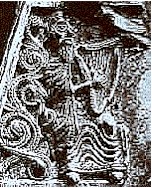
Maedoc Book Cover, Ireland 1000AD Wikimedia commons
Maedoc Book Cover, Ireland 1000AD
Wikimedia commons
https://widgetworld3.wordpress.com/podcasts/
DOMINION 6TH JULY 1812 P 11
IRISH FOLK SONGS
.
Everybody that Ireland has a music of its own, and it is very sweet and beautiful music, too. Many people, however, imagine that the Tom Moore ballads comprise the great musical literature of that country. This is not the case, as the Countess de Cisneros will show in the music she is to sing at her concerts.
As soon as her present tour of Australasia was decided upon, Madame de Cisneros commenced her search for Irish music. She know that Ireland once possessed a race of troubadours—wandering birds who in Gaelic sang the legends of the country to tho music of the harp, Ireland’s national emblem.
“In America,” said the great mezzo-contralto, describing her search, “one can get the most-up-to-date information about everything. I set to work to hunt New York for some of those old harpers’ melodies. I approached several big music publishers. But they all gazed at me sadly, and told me they had never heard of anything of the kind. I was not discouraged. I kept on seeking, and in the end I found a publisher who said that he had somewhere in his library a book of songs just the sort I described. It was Dr. G. Petrie’s, collected early Irish music. I found that Dr. Petrie had taken many of his songs from the work of Mr. Edward Bunting, another enthusiast in Irish folk music. After much disappointment I obtained a copy of Edward Bunting’s work, and I found the two veritable storehouses of the exquisite music of old Ireland. I have been through them all. All are beautiful, but I have selected those which I consider to be the gems of the collections for inclusion in my Australasian programmes.”
In each of her concert programmes Madame do Cisneros will include a series of these delightful old melodies. the first of these is “Farewell, My Gentle Harp.” This song was first put into written form in I650. A well-known harper-Rory’ Dall M’Cahon-sang it in Dublin that year. A note was taken of it by a musician present, who recognised its value, and this note afterwards came into the possession of Mr. Edward Bunting in the course of his researches.
The date of the second number, “The Foggy Dew,” is unknown. Some harper composed it in the dim past. He taught it to others, and it was handed down, a traditional- folk song, from harper to harper, until Harper M’Garvay sang it in Dublin, and it was taken down about tho year 1700. “My Thousand Times Beloved” found its way into written form in similar fashion about the year 1798.
The last of, the four Irish songs of the first programme is called “A Golden Cradle Holds Thee.” Who composed it, and when, nobody knows. Mr. Bunting heard an old Irishwoman sing it away, in the wilds of Galway. He took down the music and tho Gaelic words. It relates a pretty, legend about the fairy fort of Farsoe. A young girl, whose infant brother had died a week before, was said to have wandered into the fort, there to find her brother in a rich cradle; placed; there by fairy hands. The song, with its exquisite music, is the lullaby she sings as she rocks tho golden cradle.

Posted in Posts and podcasts

The night when fairies hold high carnival – 1896

Photo: 663highland Creative Commons
Photo: 663highland
Creative Commons
https://widgetworld3.wordpress.com/podcasts/
THE SAN FRANCISCO CALL 25TH OCTOBER, 1896
The night when fairies hold high Carnival

In Ireland young women place three nuts on the grate bars of the fire. One that cracks or jumps is a faithless lover, while one that burns or blazes is a true one. They burn the shells of nuts eaten on Hallow Eve and cause snails to crawl through the ashes and so trace the initials of the future husband.

These glowing nuts are emblems true
Of what in human life we view.
The ill-matched couple fret and fume,
And thus in strife themselves consume;
Or from each other wildly start,
And with a noise forever part.

But see the happy, happy pair,
Of genuine love and truth sincere;
With natural fondness while they burn,
Still to each other kindly turn’

And as the vital sparks decay,
Together gently sink away;
Till life’s fierce ordeal being past
Their mingled ashes rest at last.

(Charles Graydon, Dublin 1801)

Posted in Posts and podcasts

The Irish Republic – Ukmerge Lithuania – 1922

Jon Sullivan Wikipedia.org

Jon Sullivan
https://widgetworld3.wordpress.com/podcasts/

BLAIRMORE ENTERPRISE 2ND MARCH, 1922
Irish in Russia Heard Peace News
Descendants of the Irish Brigade were deeply affected
Captain Francis McCullough, a former British Officer, writes to the Manchester Guardian from Ukmerge, Lithuania, date December 9:
I sat until late last night before a logwood fire in an Irish castle, surrounded for scores of miles in every direction by Lithuanian forests, deep in snow. The wail of the icy wind through the trees sounded like the keen of the banshee, and sometimes I could catch the distant howling of a wolf. No more suitable setting could have been found for the tales I listened to and told – tales of Napoleon’s retreat from Moscow, of the devastating Williamite wars in Ireland and of that awful period of persecution which followed the Williamite wars.
I held in my hands a sword which had been wielded at the Boyne – on the losing side – and I had examined a fragmentary record printed by order of the last Catholic Parliament which sat in Dublin over two and a half centuries ago. I had heard a violin give one of the saddest and most melting of all the old Irish melodies; and in return I had sung as best I could, in Russia, many of the Irish songs which I had learned as a boy in Ireland over twenty years ago, but have not forgotten since.
It was a strange night and a strange company. Everybody around me claimed to be Irish, but not one of them spoke Irish or English, for the noble Lithuanian family with which I am passing my Christmas holiday is descended from one of the Irish chiefs who left his native country after the fall of Limerick.
One member of the family was absent, young Rory, who had ridden in to town on some business connected with the estate, and who had promised to bring me back any news from Russia that he got hold of, for it is the Russian, not the Irish, situations that accounts for my being in this part of the world. Rory had not returned when I retired to my bedroom, and as I sat down in a chair to await him my mind became filled with thoughts of the “old, forgotten, bygone things and battles ong ago” which had occupied my attention for so many hours that night.
I was awakened by a knocking at my door and the voice of Rory. From the furs, which he had not taken off, and from the snow on his fox skin papakha, I concluded that he had just jumped off his horse and come straight to my room. His face was flushed and his eyes shone. “What is it Rory?” said I. “Any news form the Red frontier?”
“Great news,” he replied, speaking in Russian. “Peace is signed between England and Ireland. The Irish Republic is recognized. The horrors of the Civil War are now things of the past.” He mistranslated “Free State” as “Respublica,” but he had got the gist of the peace terms all right.
To me Rory’s message was more than news. It was the rolling back of the stone from a nation’s sepulchre. And my hosts, whose ancestors had left Ireland over two hundred years ago, were as affected as I.

Posted in Posts and podcasts

!!! – 1904 – Crime?

https://widgetworld3.wordpress.com/podcasts/

Photo: EO'D
Photo: EO’D

THE INTERMOUNTAIN CATHOLIC, SEPTEMBER 17, 1904 P4
CRIME IN IRELAND
The prisons board have again to repeat their complaint that magistrates do not make use of their powers under the juvenile offenders’ act to avoid sending children to jail. “It is disappointing to find so many juvenile offenders imprisoned.”
The board gave a list of cases.
The worse came from Cork. No fewer than eight children between the ages of 9 and 11-12 were sent to jail from Cork in 1903 for “obstructing the footway.”
In Galway a little girl of 10 was sent to jail for seven days for trespass! Is it too much to say that the magistrates who did these things should get as many months as these children got days in prison!

Posted in Posts and podcasts

Import/Export Ireland 1847

https://widgetworld3.wordpress.com/podcasts/

Patrick Abbot / Wesley Johnston Wikipedia.org
Patrick Abbot / Wesley Johnston
Wikipedia.org
The Cork Examiner, 21 June 1847 –

IMPORT OF PROVISIONS.
THE following arrivals have been entered in the Custom
House since our last publication :
–per Ajax Steamer from London – 209 bags biscuit
Timandra from Cavilla – 2250 quarters Indian Corn
Kate from Galatz – 1300 quarters Indian Corn
Marchioness of Bute – 1300 quarters Indian Corn
Tito from Salonica – 1500 quarters Indian Corn
Minerva Steamer from Liverpool – 355 bags Rice 10 packages Flour
Lima from New Orleans for
Soc. of Friends’ Poor Relief
Committee – 361 barrels Flour
– 598 barrels Indian Corn Meal
– 16 barrels Beans, 6 barrels Pork ; per do.
for American
Consul – 4818 sacks Indian Corn, 42 sacks Wheat
– 25 barrels Flour
– 42 barrels Corn Meal
– 2 barrels Beans
– 2 barrels Beef, 26 sacks Peas
Ballinacurra Lass from
Malta – 890 quarters Indian Corn
Lucinda Jane from
Liverpool – 3500 bushels Indian Corn.

EXPORT OF PROVISIONS.
SINCE our last :-
per Ajax steamer for London – 202 firkins Butter,
– 73 bales Bacon
– 12 casks Hams
– 254 sacks Wheat
– 50 barrels Indian Meal
– 656 sheep
– 33 calves
– 300 boxes eggs
– 50 head cattle
– 90 boxes salmon
Nancy Browne for Newport – 76 head cattle,
Wanderer for New Passage – 230 sheep
William for Newport – 340 sheep
Brothers for Newport – 100 head cattle – 60 sheep
Shannon, for New Passage – 240 sheep, 80 head cattle
Jane and Mary Anne,
for Newport – 110 sheep, 60 head cattle
Nonpareil for Newport – 300 sheep.

Posted in Posts and podcasts

FAMINE

hawthorn and burren

Adapted from
William Bennett, Narrative of a Recent Journey of Six Weeks in Ireland. London: C. Gilpin, 1847, pp. 25-9.

We spent the whole morning visiting these hovels, followed by an ever increasing group of wretched creatures, who begged for help. We avoided houses known to contain the fever.  Some were easily identifiable by the small coming from them.
And now language utterly fails me in attempting to depict the state of the wretched inmates. I would not willingly share the harrowing details; but these are the FACTS as they stand. It is our responsibility as Christians, in a Christian land, under a Christian Government to take note.
My hand trembles while I write. The scenes of human misery and degradation we witnessed haunt my imagination, with the vividness and power of some horrid and tyrannous delusion, rather than the features of a sober reality.

We entered a cabin.
Stretched in one dark corner, scarcely visible, from the smoke and rags that covered them, were three children. They huddled together, too weak to rise, pale and ghastly, their little limbs perfectly emaciated. Their eyes were sunken, voices gone, evidently in the last stage of starvation.
Crouched over the turf embers was another form, all but naked. It stirred not, nor noticed us.
On some wet straw, strewn on the floor lay a shrivelled old woman. She moaned piteously, imploring us to give her something. Above her, on something like a ledge, was a young woman, with sunken cheeks. A mother I have no doubt. She scarcely raised her eyes in answer to our enquiries, but pressed her hand upon her forehead, with a look of unutterable anguish and despair.
Many cases were widows, whose husbands had recently been taken off by the fever. The only source of income for these women died with their partners. In other homes the husbands or sons were prostrate, under that horrid disease. Their suffering was the result of long-continued famine and low living, in which first the limbs, then the body, swell most frightfully, and finally burst.
We entered upwards of fifty of these tenements. The only difference between them was the number of the sufferers within. It was difficult to count them until-the eye adapted itself to the darkness, or they were pointed out, or were heard, or some filthy bundle of rags and straw was perceived to move.
The children were the most heart-rending spectacle. Many were too weak to stand, their little limbs attenuated, – except where the frightful swellings had taken the place of previous emaciation.
The childlike expression had left their faces. Many of them were remnants of families, crowded together in one cabin; orphaned little relatives taken in by the equally destitute, and even strangers.
These poor people are kind to one another to the end.
In one cabin was a sister, just dying, lying by the side of her little brother, just dead.
I have worse than this to relate, but it is useless to multiply details, and they are, in fact, unfit.
These people hardly complained. When I asked what was the matter, the answer was the same -‘Tha shein ukrosh,’ – ‘we are hungry’. We truly learned the terrible meaning of that sad word ‘ukrosh’.
My friend the clergyman distributed tickets for meal as best he could. He told me that wherever we went it would be the same. All over the country. Even worse in the far off mountain districts. We had visited near the town, where some relief could reach. It was my full impression that one-fourth of those we saw were dying. They were beyond the reach of any relief. Many more would follow.
This day can never be effaced from my memory.

These were our fellow-creatures.
Children of the same Parent.

Born with our common feelings and affections.

With an equal right to live as any one of us.

With the same purposes of existence.

The same spiritual and immortal natures.

The same work to be done.

The same judgment-seat to be summoned to.

And the same eternal goal.


Ar dheis Dé go raibh a n-anamnacha.

Photo: Norma Scheibe

We remember them. At the rising of the sun and at its going down, we remember them.

At the blowing of the wind and the chill of winter, we remember them. At the opening of the buds and in the rebirth of spring, we remember them.

At the blueness of the skies and in the warmth of summer, we remember them. At the rustling of the leaves and in the beauty of autumn, we remember them.

At the beginning of the year and when it ends, we remember them.

As long as we live, they too will live; for they are now a part of us, as we remember them.

When we are weary and in need of strength, we remember them.

When we are lost and sick at heart, we remember them. When we have joy we crave to share, we remember them.

When we have decisions that are difficult to make, we remember them. When we have achievements that are based on theirs, we remember them.

As long as we live, they too will live; for they are now a part of us, as we remember them.