The Mercury (Hobart Tas.) 8th February 1891 p3 Servant Girls’ remittances to Ireland Boston December 26 Mr. Patrick Donahoe, who in 1889, on behalf of Irish servant girls, sent 276,778 dol. to Ireland, has during the past two months sent nearly 50,000 dol. Mr. Donahoe does almost one-third of the Irish draft business of Boston. He says that the amount sent this Christmas exceeds the record of any previous Christmas. Mr Donahoe has a curious method of advertising, an announcement beginning, “We will, God willing, continue to our draft business etc.”
The Capricorn, (Rockhampton, QLD) 30th October, 1886 p 10
Most determined resistance is being given to an evicting party which has been at work for some days on the Marquis of Clanricard’s estate, near Woodford, County Galway. About 1000 police had been drafted into Portumna, whence they go each morning to the scene of the intended evictions. Mr. Brady, R.M., County Inspectors Wilson and O’Brien, and eight district inspectors are in charge of the police.
The first eviction took place on Thursday, when the police went to a place called Kilnawally. They found about 500 people assembled, the crowd having been brought together by the ringing of the chapel bells. Conroy, whose rent is £24, owed with costs, above £100. The farm had been sold to the agent for the landlord at a public sheriff’s sale in Galway some time ago. An enormous crowd had assembled, amongst them being three Roman Catholic clergymen, Rev. Mr. Coen, Rev. Mr. Egan, of Woodford and Rev. Mr. Roach, of Ballinakill. The Emergency men took three hours to effect an entrance, during which time the party inside and on the roof poured boiling water and lime on them, and threw slates down on them. Even the crowbars, with which the wall was being broken in, were taken from them and dragged inside the house. The Emergency men drew their revolvers repeatedly, but were dissuaded by the police from using them.
The evicting force subsequently proceeded to Drumin, three miles off, to carry out another eviction, but so stubborn was the resistance that the attempt was abandoned, and the party returned to Portumna. On the following day they found that Monatreeva Bridge, five miles from Portumna, had been broken down during the night, and the remainder of the journey, seven miles, had to be performed on foot. The house of a man named Patrick Fahy was reached, and a scene ensued similar to that on the previous day at Conroy’s. When County Inspector Willson went up close to the house to inform those inside that unless they desisted he would be obliged to order the police to fire on them, the answer he got was the pouring of a quantity of boiling lime on himself, which destroyed his uniform. The Riot Act was threatened to be read, but the counsels of the clergy and police prevailed, and the people became less excited. Ultimately, after four hours, possession was taken. Parties of police remained out all night on Friday to prevent further destruction of bridges or obstruction of the road by trees etc. At the house gone to on Saturday the emergency men failed to effect an entrance, and the police entered with fixed bayonets. Those inside resisted, and in the struggle one civilian was stabbed, and one policeman wounded. The police made no arrests. Home paper Sept 4
The Connaught Journal – Galway 17th November 1823 Extract of a Letter from a Lady, dated Hobart Town, June 2, 1823
“We arrived there a little more than a fortnight since. I believe we were all heartily glad to find our feet once more press the earth. The town is infinitely larger than I expected to find it; the streets are very broad, but the houses are separated from each other by gardens, and courts or yards. Those recently built and building are of brick. We are now in Macquarrie-street, and in a very good house. ____has a grant of 400 acres (which he asked for) and will be allowed two men from the Government stores, with rations for six months. Women servants are scarce here; I dispair (sic.) of finding a good one. Men are employed in houses instead of women; your property is more secure with them, and they are not enticed away as the women are. The country is beautiful. It is now the rainy season, but quite mild. The rigour of an English winter is here unknown. Snow rests on the hills, but does not stay in the valleys. The summer must be delightful. Here are wood, coal, and lime. Coal is used in the interior; wood is more generally burned in the town. “Settlers, after a time, make their own candles, soap and beer, if they choose. I have paid 1s. 6d. for moulds, four to the pound; some charge still higher. Colonial soap 10d., and very good for whitening. Mutton is 9d. 8d. and 7d. People complain of a scarcity of wood this winter, and even meat at times, is not to be procured from the butchers. I shall be uncommonly happy to be in my own house once more. We must be satisfied with a rough concern at first, but we shall soon be able to build a better dwelling. Here is excellent free-stone; and the ceder wood from New South Wales is very similar to mahogany and does admirably for doors, shelves, windows, &c. without paint. It is much used. The Huon River has on its banks fine pine, which is in softness and beauty equal to deal. It will light as a candle, & makes a good torch for a short time. Building now is considered as the most secure speculation; but tradesmen of every description do well if they are industrious and steady. It will be his own fault if every shop-keeper, or, as he is termed, store-keeper, does not make a rapid fortune. This place is most rapidly improving. People are quite as smartly dressed as in many parts of England. I have been told lace is exceedingly dear, English silks, &c. I think from the little I have heard, this is an uncomfortable residence for a bachelor. Servants are scarce, and lodgings are not so convenient or comfortable as in England; rooms are not carpeted. Many of the luxuries of life are wanting. If a person comes here he must make up his mind to find every thing in its infancy, and he will not be disappointed. In the room I have now I burn wood, but I have no fire-irons found me; I have no fender, nor hearth brush, nor carpet. If I choose these things I must purchase them; they come here under the head of luxuries. I have not been out, except to change lodgings, since I came. Milk, butter, and cheese, are uncommonly dear; very little of either is used- Sugar and tea are cheap. Good green at 4s. 6d. to 5s. Lump sugar is dear; moist sugar very good, at 6d or 7d. Work people are very idle. Wages are high, so they earn sufficient in three or four days to support them the remainder of the week, which they pass in idle enjoyment. Tortoishell combs are not to be got readily, and are enormously dear. Porter sells well; so does good wine. I wish we had brought a pipe or two out with us from Madeira and England. Paper is dear, I am told; for the tradesman is not willing to pack our goods in paper; he wants you to send some convenience for it. Government will only give 4s. for the dollar, which has injured many people greatly; but in trade you mostly pay and receive the dollar at 5s. Paper money abounds here.- Tradesmen issue notes payable in dollars at 5s.; notes are for 2s. 6d. and 1s. 6d. We look forward to comfort and independence here; and I think with reason. The soil is deep and rich; sheep produce lambs three times in two years; cows are not good for the dairy; horses are very dear; cattle equally so; ardent spirits are very high, and not well supplied to this town.”
The W.A. Record Sat 20th Sept. 1898, p4 Galway -1898 Death of Mr. John Holland,of Kinvara.
On the 4th of last July John Holland, of Quay, Kinvara, died. Just 50 years ago this worthy man played a part in the stirring events of the time, which deserves to be remembered by true Irish patriots. By him the late J .B. Dillon was placed on board a ship in Galway Bay, and thus avoided the sleuth hounds that were on his track.
The Oldest Man in the World. There is a native of Errislanan in Connemara, who says himself he is 120 years old, while others say he is much older. He remembers distinctly seeing the French when they landed at Killala in ’98, and says he was ” working with the horse drawing stones ” at that time. His name is John M’Donagh. He can only speak Irish, and that very feebly, but this season he went out and planted his own crop of potatoes.
The ’98 Centenary and the Re-naming of Streets. At a recent meeting of the Loughrea Town Commissioners the following letter was read from the Rev. Father Nolan, dated from St. Joseph’s the Abbey, Loughrea : To the Chairman, Board of Commissioners. Gentlemen, I beg respectfully to submit to you that, in my opinion, it would be a desirable and suitable means of keeping fresh the memory of the men of ’98 to have the names of the streets of this ancient town painted in Irish and in Irish characters on boards to be afterwards fixed in conspicuous and suitable places throughput the town. I would also suggest that one of the streets should be named after Peter Finnerty, a Loughrea man, who suffered pain, penalty, and imprisonment in those evil days for love of Ireland. Peter Finnerty, according to John Philpott Curran, was ‘the only printer in Ireland who had the courage to speak for the people.’
Permit me to add that I have confidence enough in my fellow townsmen to lead me to believe that the above propositions shall not only be favourably received but effectively carried out.
I am, gentlemen, your faithful servant,
Joseph Nolan, O.D.C.
Mr. Joseph O’Flaherty proposed and Mr. Martin Kennedy seconded that the suggestions contained in Father Nolan’s letter be carried out. The proposition was carried unanimously, and a subcommittee, consisting of three of the members of the board, appointed to confer with the Rev. Father Nolan with a view of laying before him the opinion of the board, and taking his further suggestions on the question.
There is is a beautiful belief in Ireland that every Christmas Eve the Christ-Child walks once more through the land, so lighted candles are placed in the window of every homestead and cabin throughout Ireland to guide the Holy Child, lest He lose His way in the dark and cold outside.
In Austria-Hungary this idea is carried still further, for there the doors are opened wide in case the Infant Saviour might wish to come within and rest while on His journey.
The curious legend of the man-in-the moon comes from Germany, where Christmas has always been so essentially the children’s festival. One moonlit Christmas Eve, it is said, a poor peasant was suddenly seized with an overwhelming desire to have some cabbages for his Christmas dinner, and, as he did not have any in his own garden, he decided to steal some from a neighbour’s under cover of night. He betook himself to a quiet garden, and had just gathered his spoil and was preparing to go when, as he reached the gate, the Christ-Child stood before him, and, with sad, pitying eyes, inquired why the man had committed the theft. The ashamed and angry peasant replied roughly, “I did not steal them; Otto told me I might have them.”. And he would have passed by, but the Christ-Child barred the way. At last the culprit was stung to frenzy by those grief-filled eyes, and cried, ‘If I did steal them, may I be put in the moon.” Immediately he was caught up into the white moon, with the bundle of cabbages at his back, and there one may see him still any moonlit night.
In many parts of England, especially in Devon and Cornwall, the belief lingered for many a day that if one looked into a stable any Christmas Eve one would find all the oxen upon their knees at midnight, in memory of the kings who were said to have knelt in adoration round the manger of Bethlehem on that first Christmas night.
In Brittany the peasants believe that this night the cattle receive the gift of speech, and join in praise with all mankind, while in Cornwall the good wives cherish the idea that at this magic hour the water in all wells and fountains is turned into wine, “so holy and gracious is the time.”
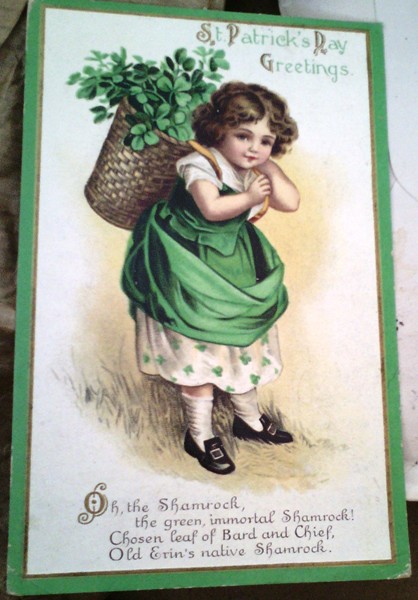
The Feast of St. Patrick, the Apostle Saint of Ireland, is kept on March 17. Some people contend he was born in Scotland, others in France; but most historians favour the former country. When he was 16 years old he was carried into Ireland as a captive, where he was sold as a slave to a chieftain named Michu; this was about the year 400. For six years he was a shepherd on the Slemish mountain in Antrim. All those years he had a zeal for God’s glory, and God must have been inspiring his soul for his future and apostolic work. Soon, however, he escaped, and went to Rome, and here he became a priest. After a few years he went back to Ireland, not as a slave this time, but as the conqueror of Ireland — not the conqueror by fire and sword, but by the word of God. He landed in the south, but he was driven off. He sailed northward, and again landed at Magh Innis, in County Down. Michu, hearing that Patrick had landed with several men, thought that Patrick had come to capture him and take him back to Rome, as his slave. Michu therefore threw himself into a fire. St. Patrick knew that the Parliament of Ireland would be meeting at about this time in Tara, the residence of the ancient kings of Ireland. St. Patrick went, and that day he converted several hundred people. But the main one was the king, and he died as ignorant as ever of the religion of Our Divine Lord. St. Patrick ordained over 300 Bishops, and it is said he visited them constantly until his death. He comforted the sorrowful, and he strengthened them in their faith. St. Patrick passed to his reward on March 17, 493, and the last Sacraments were administered by St. Tassach. A portion of his remains was taken to Rome and deposited in St. Mark’s Basilica. Leo Poidevin. (Aged 12 years 1 month.) Victoria-street, Bowral.
THURSDAY, JULY 23, 1840 The Irish in 1644 as described by a Frenchman of that period (from the Irish Penny Journal) translated by Crofton Croker. the French traveller was M. De la Boulfaye Le Gouz
“Ireland, or Hibernia, has always been called the Island of Saints, owing to the number of great men who have been born there. The natives are known to the English under the name of Iriche, to the French under that of Hibernois, which they take from the Latin, or Irois, from the English, or Irlandois from the name of the island, because land signifies ground. They call themselves Ayrenake, in their own language, a tongue which you must learn by practice, because they do not write it; they learn Latin in English characters, with which characters they also write their own language; and so I have seen a monk write, but in such a way as no one but himself could read it.
Saint Patrick was the apostle of this island, who according to the natives blessed the land, and gave his malediction to all venomous things; and it cannot be denied that the earth and the timber of Ireland, being transported, will contain neither serpents, worms, spiders, nor rats, as one sees in the west of England and Scotland, where all particular persons have their trunks and the boards of their floors in Irish wood; and in all Ireland there is not to be found a serpent or toad.
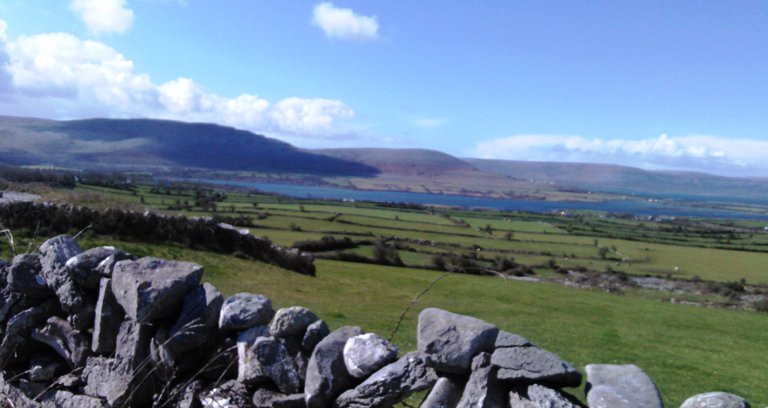
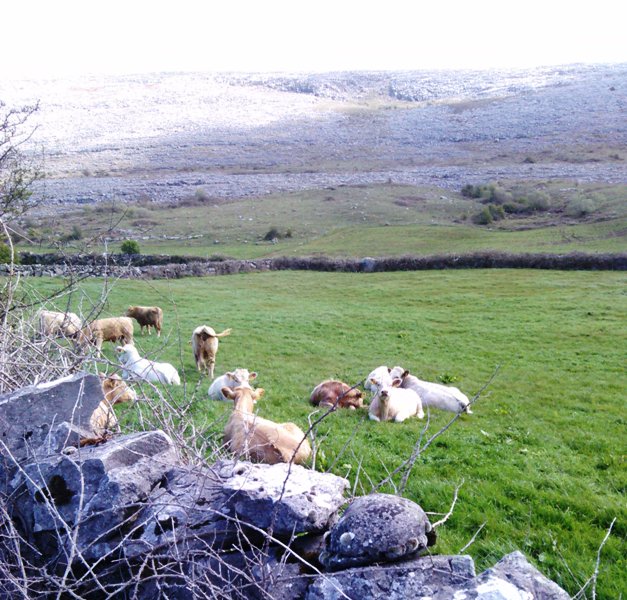
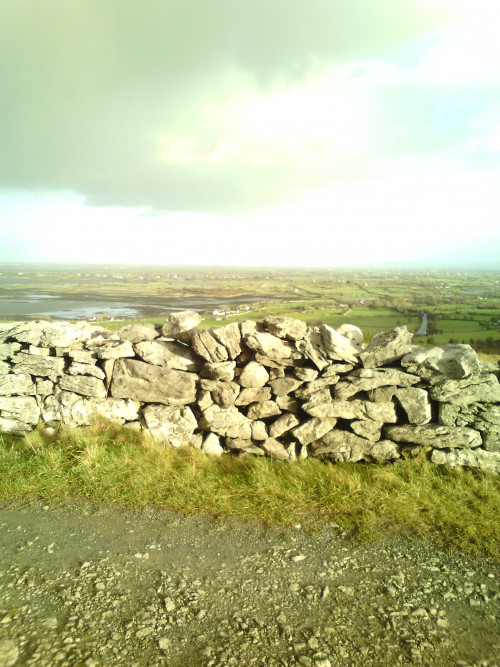
Burren beauties Photo: EO’D
The Irish of the southern and eastern coasts follow the customs of the English; those of the north, the Scotch. The other are not very published, and are called by the English savages. The English colonists were of the English church, and the Scotch were Calvinists, but at present they are all Puritans. The native Irish are very good Catholics, though knowing little of their religion those of the Hebrides and of the North acknowledge only Jesus and St. Columbo (Columbkill), but their faith is great in the church of Rome. Before the English revolution, when an Irish gentleman died, his Britannic majesty became seized of the property and tutelage of the children of the deceased, whom they usually brought up in the English Protestant religion. Lord Insiquin (Inchiquin) was educated in this manner, to whom the Irish have given the name of plague or pest of this country.
The Irish gentlemen eat a great deal of meat and butter, and but little bread. They drink milk and beer, into which they put laurel leaves, and eat bread baked in the English manner. The poor grind barley and peas between two stones, and make it into bread, which they cook upon a small iron table heated on a tripod; they put into it some oats, and this bread, which is the form of cakes they call harann, they eat with great draughts of buttermilk. Their beer is very good and the eau de vie, which they call brandovin [brandy] excellent. The butter, the beef, and the mutton, are better than in England.
The towns are built in the English fashion, but the houses in the country are in this manner: – Two stakes are fixed in the ground, across which is a transverse pole to support two rows of rafters on the two sides, which are covered with straw and leaves. They are without chimneys and make the fire in the middle of the hut, which greatly incommodes those who are not fond of smoke. The castles or houses of the nobility consist of four walls extremely high, thatched with straw; but to tell the truth, they are nothing but square towers without windows, or at least having such small apertures as to give more light than there is in a prison. They have little furniture, and cover their rooms with rushes, of which they make their beds in summer, and of straw in winter. They put the rushes a foot deep on their floors, and on their windows, and many of them ornament the ceilings with branches.
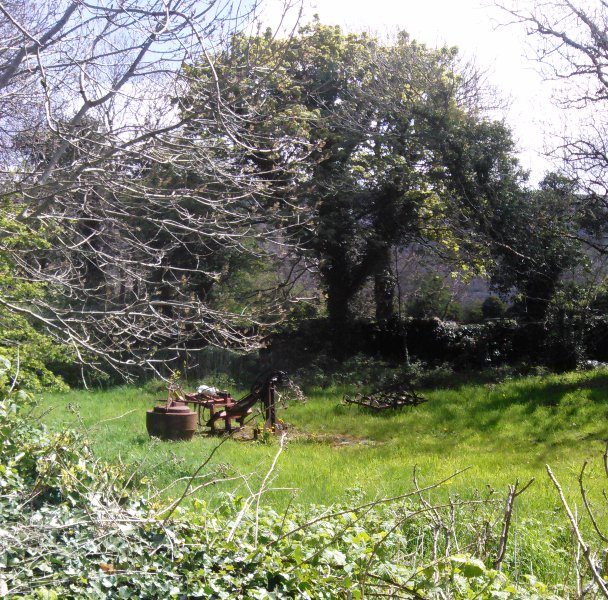
Burren light Photo: EO’D
They are fond of the harp, on which nearly all play, as the English do on the fiddle, the French on the lute, the Italians on the guitar, the Spaniards on its castanets, the Scotch on the bagpipe, the Swiss on the fife, the Germans on the trumpet, the Dutch on the tambourine, and the Turks on the flageolet.
The Irish carry a sequine [skein] or Turkish dagger, which they dart very adroitly at fifteen paces distance; and have this advantage, then if they remain masters of the field of battle, there remains no enemy; and if they are routed, they fly in such a manner that it is impossible to catch them. I have seen an Irishman, with ease accomplish twenty-five leagues a day. They march to battle with the bagpipes instead of fifes; but they have few drums, and they use the musket and cannon as we do. They are better soldiers abroad than at home.
The red-haired are considered the most handsome in Ireland. The women have hanging breasts; and those who are freckled, like a trout, are esteemed the most beautiful. The trade of Ireland consists in salmon and herrings, which they take in great numbers. You have one hundred and twenty herrings for an English penny, equal to a carolus of France, in the fishing time. They import wine and salt from France, and sell there strong frize cloths at good prices.
The Irish are fond of strangers, and it costs little to travel amongst them. When a traveller of good address enters their houses with assurance, he has but to draw a box of sinisine, or snuff, and offer it to them; then these people receive him with admiration, and give him the best they have to eat. They love the Spaniards as their brothers, the French as their friends, the Italians as their allies, the Germans as their relatives, the English and Scotch as their irreconcileable enemies. I was surrounded on my journey from Kilkinik [Kilkenny] to Cachel [Cashel] by a detachment of twenty Irish soldiers; and when they learned I was a Frankard (it is thus they call us) they did not molest me in the least, but made me offers of service seeing that I was neither Sezanach [Saxon] nor English.
The Irish, whom the English call savages, have for their head-dress a little blue bonnet, raised two fingers-breadth in front and behind covering their head and ears. Their doublet has a long body and four skirts; and their breeches are a pantaloon of white frieze, which they call sers. Their shoes, which are pointed, they call brogues, with a single sole. They often told me of a proverb in English, ‘ Airische borgues for English dugues’ [Irish brogues for English dogs] ‘ the shoes of Ireland for the dogs of England’, meaning that their shoes are worth more than the English.
For cloaks they have five or six yards of frieze drawn around the neck, the body, and over the head, and they never quit this mantle, either in sleeping, working or eating. The generality of them have no shirts, and about as many lice as hairs on their heads, which they kill before each other without any ceremony.
The northern Irish have for their only dress a breeches, a covering for the back, without bonnets, shoes, or stockings. The women of the north have a double rug, girded round their middle and fastened to the throat. Those bordering on Scotland have not more clothing.- The girls of Ireland, even those living in towns, have for their head dress only a ribbon, and if married, they have a napkin on the head in the matter of Egyptians. The body of their gowns comes only to their breasts, and when they are engaged in work, they gird their petticoat with their sash about the abdomen. They wear a hat and mantle very large, of a brown colour [ coleur minime] of which the cape is of course woollen frieze., in the fashion of the women of Lower Normandy.”
An islander of the British Isles, and possibly a Highlander, purchased some time ago in the Landed Estates Court, a property in a maritime Irish County, upon which stood what might be described in the words of one of your illustrious bards;
“An old, old monastery once, and now
Still older mansion, of a rich and rare
Mixed Gothic, such as artists all allow
Few precedents are left us to compare
Withal.”
The building did not satisfy the taste of the new proprietor. He scarcely got possession of his title deeds before he commenced improving at once the land and the mansion. The improvements made rapid progress under the special superintendence of the new lord of the soil, who planned and directed early and late. It is his semi-nocturnal predilection for business that raised him to the dignity of a ghost story here.
He was in the habit of remaining about the mansion and grounds long after everyone else had retired, contemplating the progress of improvements or devising fresh ones. While engaged in this manner one evening shortly after twilight, he beheld upon the site of what had been an old out office a luminous figure. It first bore resemblance to the human shape, then gradually assumed the form more and more as twilight deepened. Finally it presented to the gaze of the astonished proprietor the perfect outline of a man, formed of light of a bluish tinge and subdued brilliancy.
Mr—— stood contemplating the apparition till it vanished from his view, owing, as he thought, to some change in the atmosphere, for he felt the air very much colder about the time of the disappearance. He said nothing about the apparition to anyone as he mistrusted his judgement and thought a vivid imagination might have played a trick on him. He resolved however, to discover if possible whether the phantom were reality or illusion. Accordingly he wandered about the scene of the vision every evening after twilight and occasionally his watchfulness was rewarded by a sight of the figure. It sometimes appeared an indistinct mass of still flame, and sometimes presented some outlines of a human form. Seldom did it appear in the complete human shape in which it first presented itself.
Having satisfied himself that his imagination was not trifling with him, the gentleman began to make inquiries of the people about his demesne as to whether any former proprietor of the property or any other person in any way connected with the castle had met an untimely end or disappeared suddenly and mysteriously from the mansion, or, if there were any tale of mystery connected with the place. None was forthcoming.
The lord of the Castle set a considerable number of them to search the spot, the site of the old out offices, where he had so frequently seen the apparitions. At a considerable depth before the surface a skeleton of a man was found. By all appearances he had been a warrior and the place of repose was the cause of the troubled times led by the spirit. The remains were respectfully and decently removed
The correspondent of an Irish-American exchange writing from New York says: From Ireland the tide of emigration has again set toward our shores. At Ellis Island the other day there passed through the Gate of Freedom, as the exit of the little picketed lane is called, 723 Irish lassies— the best clothed, neatest and most cheerful immigrants this country has seen for years. They ranged in age from 18 to 25 and without exception, passed every requirement as to morality and cleanliness, and satisfied the commissioners that there was no danger of their becoming charges on the public for future support.
Sixty-five per cent of the entire number were what is known as “pre-paid”‘ passengers. Their tickets had been sent them from this side. Two hundred and fifty of them will go into domestic service in the metropolitan district. Nearly three hundred went to Boston, The others are scheduled for destinations in the Middle and Western States.
Last month there were to come more than 1,000 other girls from Irish villages. The cause for this invasion is the demand for Irish girls for housemaids. The Labour Employment Bureau can place more than 2,000 of proper character and fitness. The scene on Ellis Island before they were put on board the ferries was strongly suggestive of a country fair. About a thousand of their friends, brothers and sisters of some and sweethearts and friends of others had all got permission to greet them. They just swarmed over the island. Other immigrants looked on in wonder, and listened to the rare, rich brogue which filled the air. The girls had presents of blackthorns for their, brothers and lovers and bits of lace or knittings of woollen for their sisters and long before the first hundred had passed inspection each one was wearing some taken from the other.
The immigrants all had pocket money, and they who had least had friends in waiting. They had substantial wardrobes, too, some in woollen chests, and some in large tin boxes that were written all over with the names and addresses of their owners.
When they got on the mainland and saw the elevated trains, the lovely park, the tall buildings and the crowds rushing for the ferries and heard the din of traffic, these girls from the little inland villages stood in amazement and gossiped among themselves as to what kind of a place New York must be and how soon they would be swallowed up and lost in the hundreds of thousands. They were given their first lesson in the immensity of metropolitan life, and shrank off with their friends, glad not to be alone. Those whose friends had not called for them up to sundown were cared for in the Mission of the Holy Rosary. Deputy Commissioner M’Sweeney, of the Immigration Bureau, said that this season would see ten thousand Irish girls landed in this city.
All told there were fourteen hundred immigrants landed at the island the other day.




 The Burren and Beyond