The Southern Cross (Adelaide SA) 20th June 1924 p. 22
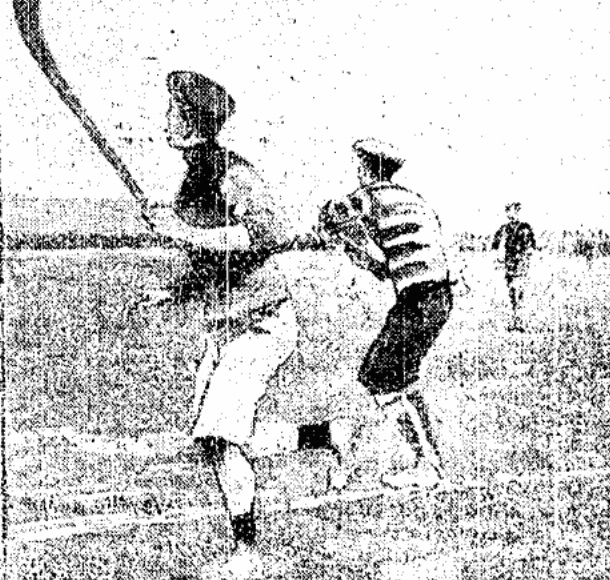
Few nations have a game so distinctive or so characteristic of their people as Ireland has in hurling — a pastime requiring speed, dash, vigor, alertness of mind and body, with a certain amount of dare-devil instinctive courage typical of the race. Short of any of these attributes, a Hurler can never rise to fame in this Irish pastime par excellence.
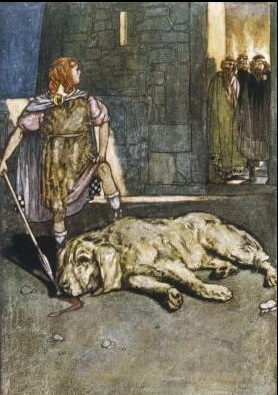
The approach of the Tailteann Games and the proposed visit of a team of Irish hurlers to Glasgow, where they are being matched against selected shinty players, has given new interest to the history and evolution of hurling. Cuhullan (sic.), the hero of the North, is mentioned in the ancient annals for his skill with the hurlbat (sic.) and ball, as well as for his prowess in battle. That great epic “The Pursuit of Diarmuid and Grainne” tells how Grainne was first attracted to the handsome dark-haired prince by his brilliant hurling before Tara, when the Fianna of Munster played against the selected men of Leinster.
Down through the centuries hurling matches were played between rival clans:barony v. barony and parish v. parish matches were a feature of rural life in many parts of Ireland, as far removed even as the Glen of Antrim and the Barony of Carbery in West Cork. But, until the advent of the Gaelic Athletic Associations, about fifty years ago, no organised attempt was made to standardise the game. Almost immediately. Hurling leapt into prominence, and huge concourses all over the country assembled at various venues to watch the tests of strength and skill between rival teams. At first wrestling was allowed, but was quickly found to ruin the cohesion of a side, and so was eliminated. The number of players on each team was fixed at twenty-one for several years, but the demand for more open spectacular play resulted in the reduction of this number, first to seventeen, and finally to the present standard of fifteen. Progressive minds continued to make gradual improvements in the laws governing the game, and scoring areas were altered, dangerous tactics were eliminated, until about the year 1912 the present great game was evolved. Certain areas where hurling flourished in the pre G.A.A. days produced teams of great power and skill, notably the village country in mid and north Tipperary, the fishing villages of Blackrock outside Cork city, Kilfinane town and area on the hillsides in south
Limerick, and the parish of Tulla in Clare and Kilmoyley in Kerry, the Barony of Fort in Wexford, the Nore and Suir valleys in Kilkenny, and the villages and rural areas in south Galway.
Outside Ireland, wherever Irishmen were numerical in strength, hurling clubs were formed, notably in London, Glasgow, Liverpool, New York, Chicago, and Buenos Ares. So the game assumed a somewhat international aspect. Hurlers from Dublin and London visited Glasgow many years back and played against selected shinty players of Scotland. In the months of May and August this year, two international games in the Celtic code will be played, the first in Glasgow, and the second and more important at the opening ceremony of theTailteann Games in Croke Park, Dublin.
Hurling and shinty are very much akin. The shinty ball is smaller and the blade of the stick narrower, but in each version, both sides of the blade — right and left — are used. The hurler is more skilled in overhead play. The Highland shinty player dribbles better and gets greater length on the sod. In either case the dominant hand holds the end of the shaft, the weaker hand directs the stroke, so that from right or left strokes are made with equal facility, avoiding the unsightly turning round familiar in offshoots of the ancient game. In Ireland hurling has become a spectacular game of the most thrilling and attractive kind, characterised by electric speed and kaleidoscopic change of scene from one goal mouth to another. The broad hurling blade, gracefully formed from crooked willow ash is adaptable for accurate overhead hitting, whilst great length “on the sod” is within the capabilities of skilled wrist-work and correct swing, which are the result of early training. Indeed, so subtle is the hurler’s art that no player can hope to reach prominence who has not played since early youth. It may be said of hurling as of violin playing:—”It is impossible to learn the art completely after the age of ten years.” The first-class player takes innumerable risks which look reckless to the uninitiated spectator, but serious accidents are more infrequent in hurling than in any other manly game. The skilled wielder of the ash knows “where to go” in tackling and is usually too close to an opposing striker to be in danger. He parries the attacking blade with his own, and as a result we have that heart-raising sound, “The clashing of rival ash.”
Hurling is now taken up more generally in our schools and colleges than heretofore. The Dublin University College team who propose visiting Glasgow are a skilled team of native hurlers. The game between these and the Scottish shinty players will be a memorable one in many ways — a gesture of the ancient friendship and rapprochement of the Celtic peoples.