Posted in Posts and podcasts

Eviction Scenes in County Galway – 1886

The Capricorn, (Rockhampton, QLD) 30th October, 1886 p 10

Most determined resistance is being given to an evicting party which has been at work for some days on the Marquis of Clanricard’s estate, near Woodford, County Galway.
About 1000 police had been drafted into Portumna, whence they go each morning to the scene of the intended evictions. Mr. Brady, R.M., County Inspectors Wilson and O’Brien, and eight district inspectors are in charge of the police.

The first eviction took place on Thursday, when the police went to a place called Kilnawally. They found about 500 people assembled, the crowd having been brought together by the ringing of the chapel bells. Conroy, whose rent is £24, owed with costs, above £100. The farm had been sold to the agent for the landlord at a public sheriff’s sale in Galway some time ago. An enormous crowd had assembled, amongst them being three Roman Catholic clergymen, Rev. Mr. Coen, Rev. Mr. Egan, of Woodford and Rev. Mr. Roach, of Ballinakill.
The Emergency men took three hours to effect an entrance, during which time the party inside and on the roof poured boiling water and lime on them, and threw slates down on them. Even the crowbars, with which the
wall was being broken in, were taken from them and dragged inside the house. The Emergency men drew their revolvers repeatedly, but were dissuaded by the police from using them.

The evicting force subsequently proceeded to Drumin, three miles off, to carry out another eviction, but so stubborn was the resistance that the attempt was abandoned, and the party returned to Portumna. On the following day they found that Monatreeva Bridge, five miles from Portumna, had been broken down during the night, and the remainder of the journey, seven miles, had to be performed on foot.
The house of a man named Patrick Fahy was reached, and a scene ensued similar to that on the previous day at Conroy’s. When County Inspector Willson went up close to the house to inform those inside that unless they desisted he would be obliged to order the police to fire on them, the answer he got was the pouring of a quantity of boiling lime on himself, which destroyed his uniform.
The Riot Act was threatened to be read, but the counsels of the clergy and police prevailed, and the people became less excited. Ultimately, after four hours, possession was taken. Parties of police remained out all night on Friday to prevent further destruction of bridges or obstruction of the road by trees etc. At the house gone to on Saturday the emergency men failed to effect an entrance, and the police entered with fixed bayonets. Those inside resisted, and in the struggle one civilian was stabbed, and one policeman wounded. The police made no arrests.
Home paper Sept 4

Posted in Posts and podcasts

Galway – 1898

The W.A. Record Sat 20th Sept. 1898, p4
Galway -1898
Death of Mr. John Holland, of Kinvara.

On the 4th of last July John Holland, of Quay, Kinvara, died. Just 50 years ago this worthy man played a part in the stirring events of the time, which deserves to be remembered by true Irish patriots. By him the late J .B. Dillon was placed on board a ship in Galway Bay, and thus avoided the sleuth hounds that were on his track.


The Oldest Man in the World.
There is a native of Errislanan in Connemara, who says himself he is 120 years old, while others say he is much older. He remembers distinctly seeing the French when they landed at Killala in ’98, and says he was ” working with the horse drawing stones ” at that time. His name is John M’Donagh. He can only speak Irish, and that very feebly, but this season he went out and planted his own crop of potatoes.


The ’98 Centenary and the Re-naming of Streets.
At a recent meeting of the Loughrea Town Commissioners the following letter was read from the Rev. Father Nolan, dated from St. Joseph’s the Abbey, Loughrea :
To the Chairman, Board of Commissioners.
Gentlemen,
I beg respectfully to submit to you that, in my opinion, it would be a desirable and suitable means of keeping fresh the memory of the men of ’98 to have the names of the streets of this ancient town painted in Irish and in Irish characters on boards to be afterwards fixed in conspicuous and suitable places throughput the town. I would also suggest that one of the streets should be named after Peter Finnerty, a Loughrea man, who suffered pain, penalty, and imprisonment in those evil days for love of Ireland. Peter Finnerty, according to John Philpott Curran, was ‘the only printer in Ireland who had the courage to speak for the people.’

Permit me to add that I have confidence enough in my fellow townsmen to lead me to believe that the above propositions shall not only be favourably received but effectively carried out.


I am, gentlemen, your faithful servant,

Joseph Nolan, O.D.C.

Mr. Joseph O’Flaherty proposed and Mr. Martin Kennedy seconded that the suggestions contained in Father Nolan’s letter be carried out. The proposition was carried unanimously, and a subcommittee, consisting of three of the members of the board, appointed to confer with the Rev. Father Nolan with a view of laying before him the opinion of the board, and taking his further suggestions on the question.

Posted in Posts and podcasts

Budget – 1934

Advocate (Melbourne) 28th June, 1934 p9,

In the new Budget the large sum of £4,500,000 is provided for housing. Money is being circulated in every city and town and village in Ireland through the Government’s housing schemes. Local labour and, as far as possible, local materials are being used.

From being apathetic at first, the local councils are now seeing social light and are enthusiasticallv co-operating with Mr. Sean T. O’Kelly’s department. So are the medical officers of health. Knowing that facilities are now available to build new houses, the doctors are listing large numbers of cottages and houses as “unfit for habitation,” and these are demolished. The face of the country is literally being changed.


Good housing, it is a commonplace, makes good citizens; and the present Government will be remembered, if for nothing else, for its brave housing policy.


In the Gaeltacht, where there is a centuries old congestion, the problem will take longer to solve than in the less densely populated parts of the country. A special grant of £80,000 is made in the Budget for Gaeltacht housing. At one time there was a notion that the migration, by State suasion(sic.), of the Gaeltacht population to other counties would be the most effective remedy. Anyone who knows the hardship with which the native Irish speakers have built their little homes and the love they bear them, can understand that this policy would prove unworkable.

The present aim is to make the Gaeltacht fit for Gaels to live in; but centuries of bad government cannot be remedied in a day or a decade.

Posted in Posts and podcasts

Kinvara – a history

Historical notes on theburrenandbeyond.com

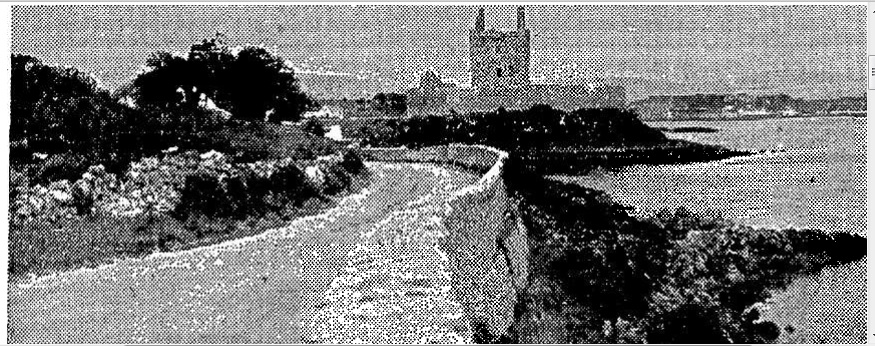
Dungory/Dunguaire Castle, Kinvara, County Galway. Irish Press 12th November, 1931
Dungory/Dunguaire Castle, Kinvara, County Galway.
Irish Press
12th November, 1931