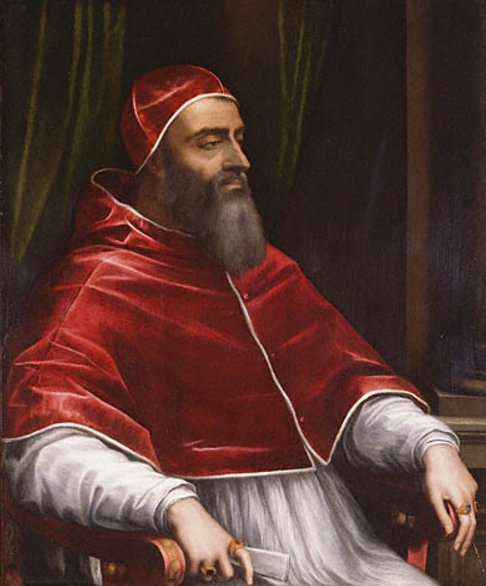
https://widgetworld3.wordpress.com/podcasts/ Pope Clement VII – (Giulio di Giuliano de’Medici) by Sebastiano del Piombo – circa 1531THE EXAMINER, 26TH MAY, 1849 P4
BRIAN BOROIHME’S HARP
It is well known that the great monarch Brian Boroihme (Boru) was killed at the battle of Clontarf A.D. 1014. He left his son Donagh his harp, but Donagh having murdered his brother, Teige, and being deposed by his nephew, retired to Rome, and carried with him the crown, harp and other regalia of his father. These regalia were kept in the Vatican, till Pope Clement sent the harp to Henry VIII, but kept the crown which was of massive gold.
Henry gave the harp to the first Earl of Clanricarde, in whose family it remained until the beginning of the eighteenth century, when it came by a lady of the De Burgh family into that of McMahon of Glenagh in the county of Clare. Following his death it passed into the possession of Consellor (sic.) McNamara of Limerick.
In 1780 it was presented to the Right Hon. William Conyham who deposited it in Trinity College Museum where it now is. It is thirty-two inches high and of good workmanship – the sounding board is of oak, the arms of red sally – the extremity of the uttermost arm in part is capped with silver, well wrought and chiselled. It contains a large crystal set in silver, and under it was another stone now lost.
Tipperary Free Press
As far back as the first historical records the harp has been accorded the place of honour, Irish folk lore places great stress on the harp as the national musical instrument. In all important events where music was admitted, at feasts and banquets, the harp was foremost as the instrument of romance, heroic qualities, and even love. Later it was also used by the clergy in their proselytising travels through the country. (Strangely enough the flute was relegated to the least important place!)
The Irish harp was called the cruit, and as far as can be ascertained the cruit dates back to the twelfth century B.C. records mention the fact of the cruit being endowed with some remarkable attributes. It could evoke real, physical responses in those who heard its sound, including, mirth to the point of hopeless and helpless laughter; joy to a level impossible to describe – and sorrow to the point of death. It was therefore not surprising to find that the players of this instrument commanded considerable attention and respect.
There is an old Irish legend taken from the notes of Oscar Rothschild that tells of the harper Uaithne, who possessed a cruit which formerly belonged to the god Dagda. Uaithne was married to Boinn, the goddess of the river Boyne. She in turn was queen of the fairies.
Maedoc book-cover, Ireland, circa 1000 AD
The couple had three sons called after the three strings of their father’s harp – Gentraiges, Goltraiges and Suantraiges. All three were gifted and remarkable harpists.
A Chieftain’s son named Freoch was related to Uaithne by marriage. His mother, Befind, also came of fairy train. The bond of marriage and, perhaps the bond of the supernatural led Freoch and Boinn to form and alliance that included her three sons. It was all for love.
At that time the reigning King of Connacht (Ailill) and his wife (Medb) had a beautiful daughter. The fame of her lovliness had gone far afield. Her name was Findabair. Freoch wanted to marry Findabar. To further his chances he enlisted the aid of his aunt, Boinn, and she did her utmost to ensure his success. She bestowed on him all the jewellery and equipment of a fashionable man of the highest rank – and – most valuable of all, she lent the aid of her three sons, trained in the use of their fathers cruit (harp).
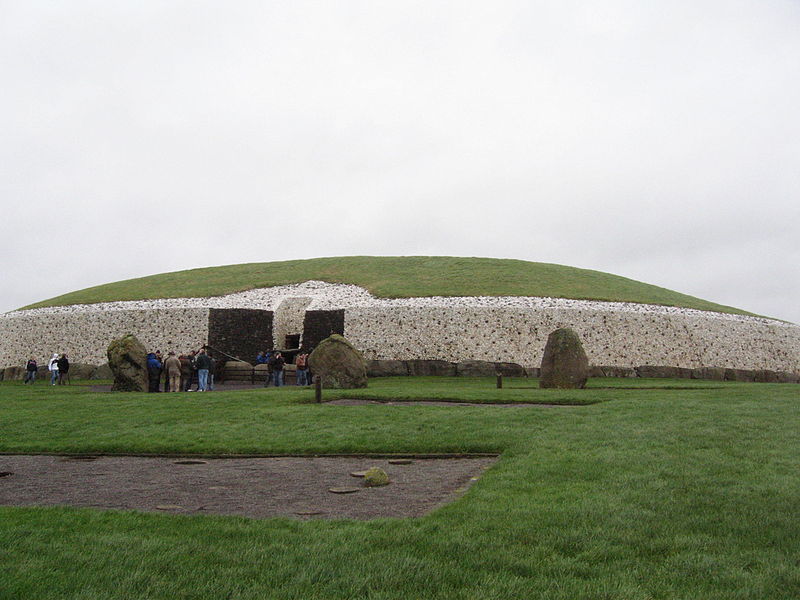
Brú na Bóinne, Newgrange Photo: Barbara y Eugenio
Freoch and his retinue visited the court of the King of Connacht and his daugher Findabar. They spent some time in feasting and other happy pastimes. One day at a game of chess the King wished to enliven his guests with music. This gave Freoch his great opportunity. He requested his three harpers to play the chants of Uaithne (Motherhood). They did. It was a mournful lament and while the harpers played, tragedy overtook twelve of the King’s people, who sorrowed unto death. The King was startled and upset and it was not long before he began to devise means of getting rid of Freoch. He set him trials to test his mettle.
But these trials were of no avail aginst the fairy protected hero. Freoch was triumphant in all and when he completed them his three harpers again played a plaintive tune, again with fatal effect. Thirty of the King’s most dearly loved retainers were smitten to death by the potent magic of the sorrow laden melody.
The King of Connaught had to grant Freoch’s wish. He was betrothed to Findabar and the harps, all three, heralded the joy of their union – their music spilling out and across the countryside, lifting the hearts of all who heard.
Note: Boinn’s husband has also been named as Nuada, Elcmar or Nechtan


 The Burren and Beyond