Posted in Posts and podcasts

Casting the Reel – 1869

The Newcastle Chronicle (NSW) Tue 21st December, 1869 p2.(abridged)
There was a party gathered one Hallowe’en. They sat round the fire burning nuts and telling stories just as we do tonight. One among them was a lady newly betrothed, the gayest, the proudest, the must beautiful of them all. Her lover sat by her side. Her wild and wilful ways had often given him a heartache, but he loved her dearly.
Someone among the party dared her to go and cast the reel – through a high staircase window that looked down on a dark plantation.
The one who tries this charm must stand at a window alone while the clocks toll for midnight, and, throwing the reel, must wind the thread upon her hand, and call three times; and at the third time, if her heart fail not, they say, her future bridegroom will answer from below.
The lady I tell you of, sprung up and said she would go, for she feared nothing in this world or the next, and though her lover prayed her to remain, she still persisted.
‘You shall see,’she said, ‘whether you have a rival!’
She took a light in her hand, and went alone up the staircase. When she reached the casement she stood still and waited, minute after minute, ’til the clock sounded the first stroke of twelve. Then she flung the reel far down into the darkness, and began to wind the thread.
‘Who is there?’ she cried.
All was still, for the very wind seemed to pause and listen to her call.
Again she called;
‘Who’s there?’
This time there came a soft and smothered sound from below, as though one fetched a heavy sigh. The lady’s hand grew cold, and her breath came short; but she had a dauntless spirit, and said to herself,
‘Tis but the night wind in the trees.’
She waited. Just as the last stroke of the hour sounded, she called aloud for the third time,
‘Who is there?’
And in the stillness an awful voice came up fiom the darkness, saying;
‘I am here.’
The lady shrieked and fled downstairs. When she entered the room again, where her companions were sitting in the pleasant fire-light, she was pale and cold as a corpse. When her lover ran to meet her, she held him off and stared at him as if she scarcely knew him.
After that night she was changed. A secret fire within her seemed burning her away. Her old wild temper was gone. Her proud spirit drooped day by day, and the next Hallowe’en she lay a dying.
All through the night she lay as if asleep, but when the clock began to toll for midnight she looked up. Like one startled and afraid, she panted, in a failing voice, ‘Who is there?

Only she heard the reply.

With a shriek she fell back dead.

Her future groom had indeed called.
His name was Death.
Posted in Posts and podcasts

November Night – 1872

Warwick Examiner Sat 24th Feb 1872 p4 (abridged)

Allhallow’s Eve, the night before All Saints’ Day, being the last joyous feast of the ecclesiastical year, before Advent, was anciently kept with cheerful sociability in many rural households, by rich and the poor. It was an occasion that seemed to mark the close of the harvest season, and the beginning of winter, the time of home delights, when the comforts of a well to-do life are enjoyed. There was, moreover, a superstitious notion that on this particular sight of the year (as on the Walpurgisnacht in Germany; which is made such a strange, wild time in Goethe’s ‘Faust’) all the fiends, imps, goblins, witches, and other un-blessed agents of supernatural power would come out and frisk about the world till daylight or cockcrow. Hence it was supposed to be a most favorable occasion for divining people’s fortunes by different methods of conjuration or chance experiment.
In the south of Ireland it is usual for country people to hold their sportive meetings not on the night before November 1, or All Saints’ Day, but on the eve of November 2, which is All Souls’ Day, the day appointed by the Roman Catholic Church for a solemn service for the repose of the dead. The fairies of Celtic fancy are more frolicsome than wicked, and there is something graceful and amiable in the Irish popular superstitions, compared with the ghastly horrors of Teutonic and Scandinavian
tradition.
There is dipping for sixpences, to be caught up with the teeth at the bottom of a tub of water. There is bobbing for apples, fastened alternately with lighted candles around a hoop, suspended and kept twirling at the level of the lips, so that one risks being burnt in the attempt to snatch a
morsel. There is, of course, the prescribed ordeal of burning pairs of chestnuts to represent pairs of lovers, and to show which of the two is destined to bounce off, or whether they shall remain constant to each other in one steady flame of affection. But the Irish festive fortune-tempters have another method peculiar to themselves.
Three or four saucers are placed on the table, in one of which is laid a ring, which denotes marriage; in the second a lump of clay, signifying death; and into the third is poured water, the meaning of which is the sea-that is emigration across the Atlantic. There may be a fourth saucer, containing salt, which means the the person is to be preserved, during the year, from all those fates. A man or woman is blind folded, and the saucers are then changed or shifted, after which he or she is bidden to lay hands upon one of them. The one so accidentally touched is a sure token of what will befall him or her within the next twelvemonth.

Posted in Posts and podcasts

Hallow E’En – 1938


Collected by Brian MacMahon from Nicholas and Mrs Mac Mahon
Toonagh N.S. Co. Clare
Principal Proinnsias Gordún

First Mammy makes a cake and puts a ring and a sixpence into it. Then whoever gets the ring will be married and whoever gets the sixpence the richest of the family. Then we get a long cord and hang it from the ceiling and fasten an apple and a candle on to the cord to see who would get a bite of the apple.


We get three saucers and we put water in one and earth in the other and salt in the last one. Then we put a handkerchief around someone’s eyes and he would put into one of the saucers. If he put his hand into the saucer of earth he would be first to die; if he put his hand into the saucer of water he would be be first to cross the sea and if he put his hand into the saucer of salt he would be first to be married.
Next we put two beans down on the flag of the fire and name someone to be the husband and wife. We leave the beans there until one of them jumps. If they did not jump the people they stood for would not marry. If one of them jumped the pair would not like one another and whichever of them jumped we would make a show of the person for whom it stood.


Here are some tricks. The First is pinning a cup of water to the wall. First you get a cup of water and a pin and be pretending to another person how to do it. You put the cup on to the wall and put the pin under it. Then let the pin fall and the person goes to pick it up. While he is bending down for it you spill the cup of water on top of him.
Another trick is to place a stick on the ground so that you cannot jump over it. To do this you get a stick and put it up near the wall.
Another still is to kiss a book inside and outside without opening it. Geta book and kiss it inside in the house and go out and kiss it outside.
Putting yourself through the keyhole is another. Write your name on a piece of paper and pass it through the keyhole.
Putting your right hand where your left hand cannot touch it is another. Place it on the left elbow.

duchas.ie
The Schools’ Collection, Vol.0613, P.105

Posted in Posts and podcasts

Halloween – Kinvara – 1990

Connacht Tribune 9th November, 1990 p.15Kinvara 1939
Kinvara was thronged with 600 adult spectators and several hundred children for the Halloween Ghost Parade through the streets last Wednesday night (8 p.m. to 11 p.m.). The full moon shone in all its lunar splendor throughout the spectacle.
A large number of costumed adults took part in the colourful parade which commenced outside the national school, proceeded down Main Street (Sráid na Phooka), and Locoal-Mendon Street and arrived at the quay.
Five mysterious people suitably disguised (Toddie Byrne, Paddy Geraghty, Paddy Ward, Pam Fleming and Stan MacEoin) accompanied the parade. At Locoal-Mendon corner there was a fire eating demonstration by Padraig Breathnach, assisted by Little John Nee of Macnas.
The fantastic scenario at the Quay featured three witches, three leprechauns, a horse led by a headless man, four Fir Bolgs twelve feet tall, a caterpillar and mermaid. The Macnas five piece band provided delightful drum rolls for the antics and acts of the characters.
Sweets (1,650 penny sweets in all), nuts (countless) and fruit by the score were distributed free to the children. The Town Crier, Jeff O’Connell, gave out the commands and comments.
For the visitors to Kinvara on the night the whole show was memorable. It was a credit to the local Community Arts Officer, Pam Fleming.

Posted in Posts and podcasts

Halloween – 1902

The Houston Daily Post 26th October, 1902 p34

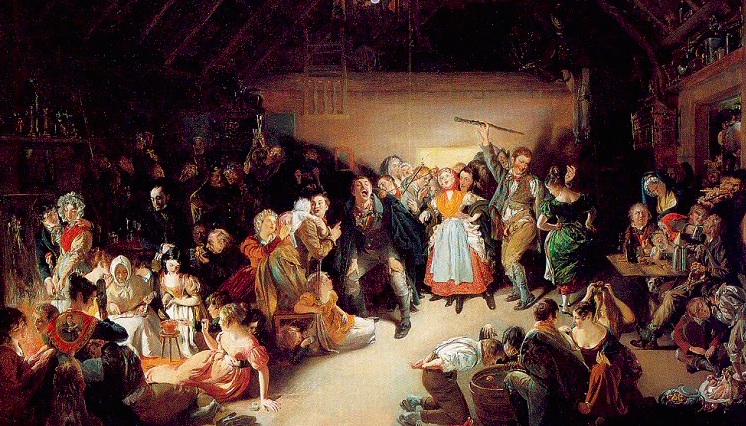
"Snap-Apple Night" by Daniel Maclise - 1833   Wikimedia Commons
“Snap-Apple Night” by Daniel Maclise – 1833
Wikimedia Commons

Cupid’s Cake

Halloween when goblins walk,
And Cupid laughs and spookies stalk
All pretty maids their sports forsake,
To bake themselves a nice big cake.

Within this cake a circlet lies,
A ring that’s hidden from all eyes.
Secure, deeply implanted there,
It lies concealed with every care.

At midnight hour, when elf bells toll,
The cake is cut and from its whole,
One piece is found to hold the ring;
The glistening, mystic happy thing!

A maiden sees it with bright eyes,
As from the piece she lifts the prize,
And on her dainty little hand
She draws the shining golden band.

Then Cupid, naughty little elf,
Comes forth and joins the play himself;
He topsy turvy turns the scene,
‘Till all make love on Halloween.

Posted in Posts and podcasts

If you were born on Hallowed E’en – 1910

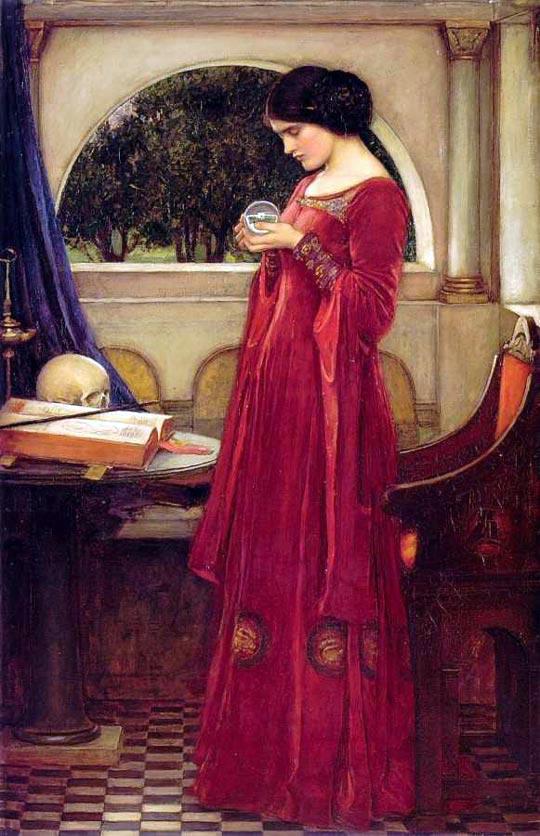
The Crystal Ball John William Waterhouse - 1902 Wikipedia.org
The Crystal Ball
John William Waterhouse – 1902
Wikipedia.org
https://widgetworld3.wordpress.com/podcasts/
THE SALT LAKE TRIBUNE OCTOBER 31ST, 1910 P4

It is an old superstition that children born on Halloween night will be possessed of peculiar faculties of foresight. Such persons are reputed to be gifted with the ability to see the future with a clear vision – they are seers. Among the pagans such a person was set up as a prophet and the wise man of the tribe – to him all homage was due.
History records that it often happened that such a person was not only a seer of the tribe, but the chief and the ruler. It was from the ranks of those of the tribe, if any there happened to be, who were born on Halloween that the rulers were recruited.

Posted in Posts and podcasts

Hallowe’en – not all ghosts are good! – 1864

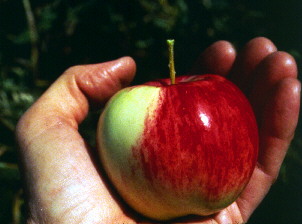
Photo: U.S Department of Agriculture. Creative Commons
https://widgetworld3.wordpress.com/podcasts/
Sacramento Daily Union, 14th December 1864
(abridged)
The customs of Holy Eve are as various as the countries where the feast is kept. A supper of the products of the orchard, connected with the etiquette of a hundred tricks, are attractive features “for the night only”. But it is not the broad board of apples and nuts which excite the midnight revelries of the occasion. A more serious practice swells it to the proportion of a carnival, which has survived the wreck of empires.

A portion of the world of spirits, and it must be said, not the good ghosts for whom we pray, wander through the earth for the sole purpose of making the single married, or place a winding sheet on the wicked frames of those who make too free with the devil at midnight. This is the spell which gives Hallowe’en its ancient power, and invests it with the mystery which secures it perpetual remembrance.

Nine is a number which, for some unexplained cause, provokes the presence of one of the gentlemen from the lower regions.

It happened that a maiden, anxious to be wedded to somebody, proceeded at dusk, with the first apple she received from an unmarried man, to her chamber, and having carefully locked the door, she stuck a pin nine times in the apple. Then she proceeded to the mirror with the apple raised on her hand. She beheld the mirror for only a brief space when her future lover appeared in it. But, alas, what appeared was only the face of the lover, with the club feet and tail of the devil.

There is another instance on record of Satan himself appearing in propria persona before a young lady who tried this spell.

She died in terror at beholding her marital fate…

Posted in Posts and podcasts

The night when fairies hold high carnival – 1896

Photo: 663highland Creative Commons
Photo: 663highland
Creative Commons
https://widgetworld3.wordpress.com/podcasts/
THE SAN FRANCISCO CALL 25TH OCTOBER, 1896
The night when fairies hold high Carnival

In Ireland young women place three nuts on the grate bars of the fire. One that cracks or jumps is a faithless lover, while one that burns or blazes is a true one. They burn the shells of nuts eaten on Hallow Eve and cause snails to crawl through the ashes and so trace the initials of the future husband.

These glowing nuts are emblems true
Of what in human life we view.
The ill-matched couple fret and fume,
And thus in strife themselves consume;
Or from each other wildly start,
And with a noise forever part.

But see the happy, happy pair,
Of genuine love and truth sincere;
With natural fondness while they burn,
Still to each other kindly turn’

And as the vital sparks decay,
Together gently sink away;
Till life’s fierce ordeal being past
Their mingled ashes rest at last.

(Charles Graydon, Dublin 1801)

Posted in Posts and podcasts

Halloween – 1908

Photo: Wikimedia Commons
https://widgetworld3.wordpress.com/podcasts/
THE SUN 1ST NOVEMBER, 1908 P10
*abridged

Halloween, or Samhain night according to the old Druidical division of the year, comes on the last day of summer. It is the gloomiest night of the whole twelve months to the fairy folk. The Fe-fiada, or spell of enchantment, is removed from all the fairy hills and raths as the last bit of daylight fades and all the fairies come trooping forth to moorlands and mountains to join in a mad revel with the ghosts and witches and banshees and, that most demonic spirit of all, the dreaded Pooka.
If you think you hear the wind wailing over the housetops on that night, you are mistaken. It is not the wind but the great lament or Caoin that the fairies make for the dead summer.
As the fairies are allowed to leave their hills, so mortals are allowed to enter them, and many a venturesome lad has gone into the depths of the raths and brought back wonderful tales of fairy palaces and gardens and the like.

Posted in Posts and podcasts

Colcannon – 1914

Colcannon Photo: Sarah 777 Wikipedia
Colcannon
Photo: Sarah 777
Wikipedia
https://widgetworld3.wordpress.com/podcasts/
THE CATHOLIC PRESS 24TH DECEMBER 1914
Colcannon – That my mother used to make (abridged)

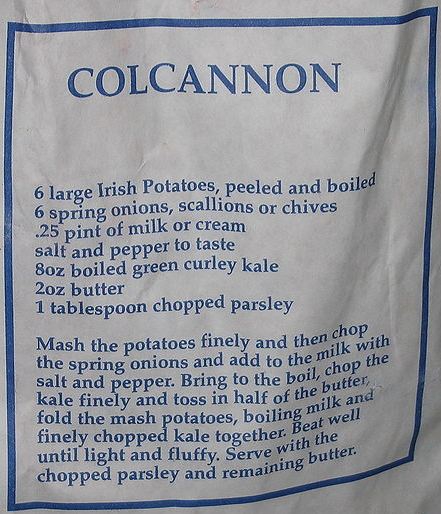
Colcannon is a dish… rather difficult to make, and to have such a success entails much patient labour and by a skilled house keeper. On All Hallowe’en Eve — the night the fairies are ruling — it is a custom in Ireland to have a sort of ‘harvest home’ or gathering to celebrate the end of the harvest work, and at the same time various games are played, including the celebrated ‘snap the apple’. On such occasions there is an impromptu supper, and Colcannon is the piece de resistance.

The -women of Galway excel at making Colcannon…

There’s many a thing I’m missing since I sailed from County Cork,
And many a thing I’m wanting ‘mid the plenty of New York;
I miss old friends and customs, and I miss with many an ache
The Hallow Eve Colcannon that my mother used to make

Did you ever eat Colcannon when ’twas made with thickened cream,
And the greens and scallions blended like the pictures in a dream?
Did you ever scoop a hole on top to hold a melting cake
Of the clover-flavoured butter that your mother used to make?

Did you ever eat and eat, afraid you’d let the ring go past,
And some married old sprissaun’d pounce on it at last?
Then did you go blindfolded round the five plates in a row,
And find the rosary beads three times, as I did long ago?

Indeed. I’m not complaining, for I’ve plenty and to spare,
And there’s nowhere like America for one to win his share
I go thro’ life contented, but November brings an ache,
For the- Hallow Eve Colcannon that my mo ther used to make.