In the new Budget the large sum of £4,500,000 is provided for housing. Money is being circulated in every city and town and village in Ireland through the Government’s housing schemes. Local labour and, as far as possible, local materials are being used.
From being apathetic at first, the local councils are now seeing social light and are enthusiasticallv co-operating with Mr. Sean T. O’Kelly’s department. So are the medical officers of health. Knowing that facilities are now available to build new houses, the doctors are listing large numbers of cottages and houses as “unfit for habitation,” and these are demolished. The face of the country is literally being changed.
Good housing, it is a commonplace, makes good citizens; and the present Government will be remembered, if for nothing else, for its brave housing policy.
In the Gaeltacht, where there is a centuries old congestion, the problem will take longer to solve than in the less densely populated parts of the country. A special grant of £80,000 is made in the Budget for Gaeltacht housing. At one time there was a notion that the migration, by State suasion(sic.), of the Gaeltacht population to other counties would be the most effective remedy. Anyone who knows the hardship with which the native Irish speakers have built their little homes and the love they bear them, can understand that this policy would prove unworkable.
The present aim is to make the Gaeltacht fit for Gaels to live in; but centuries of bad government cannot be remedied in a day or a decade.
To the Editor of the Freeman
Kinvara, December 11th
Dear Sir,
I regret very much that the distress in the west, on which you so seasonably commented in your leader in Wednesday’s Freeman, is not confined to Clifden nor to Connemara, but is to be met with as severely elsewhere.
We have in Kinvara, with its population of over 350 families, want at present bordering on starvation, while the people in the rural districts all round are not much, if anything, better off, and unless our paternal Government open up public works in some form, actual starvation, with its usual sad and sickening train, will be the result before the 1st February.
Our rulers may shut their eyes to and pretend to ignore the present crisis, but there can be no question as to the existence of deep and general destitution among the labouring classes. This distress seems to be more keenly felt by a certain class of small farmers than it is by those who have nothing to fall back on but their daily pay, for the latter are more or less familiar with want, though not to anything like the present extend; while the former were before now comparatively comfortable, but this year an accumulation of misfortunes, for which they were unprepared, came upon them, and crushed them to the very earth. Rot among the sheep, consequent on the severe autumn and winter of last year; losses in the sale of stock, the partial destruction of their crops this year by blight, storms, and a wet summer and autumn – these were the casualties that crowded in rapid succession on the small farmers, and reduced them to a state worse, if possible, than that of the purely labouring class.
How miserable the condition of many among the small landholders is at present no person knows better than the priest who goes among them with all the freedom of a father, and is made their confidant in their weal and woe. It requires no prophet to tell how those poor people are to eke out an existence during the next six months, for starvation and pestilence will victimise many of them unless something is done to give employment to the many hands among them who are able and willing to work.
If, as we are assured, the solas pupuli be the suprema lex, surely the Government of the country is bound to save the people, and when this can be done without any loss to itself, as in the present emergency by opening up reproductive works. The obligation becomes so grave and solemn that no Government can overlook or disregard it without laying itself open to the charge of being anxious to get rid of its subjects “with a vengeance.”
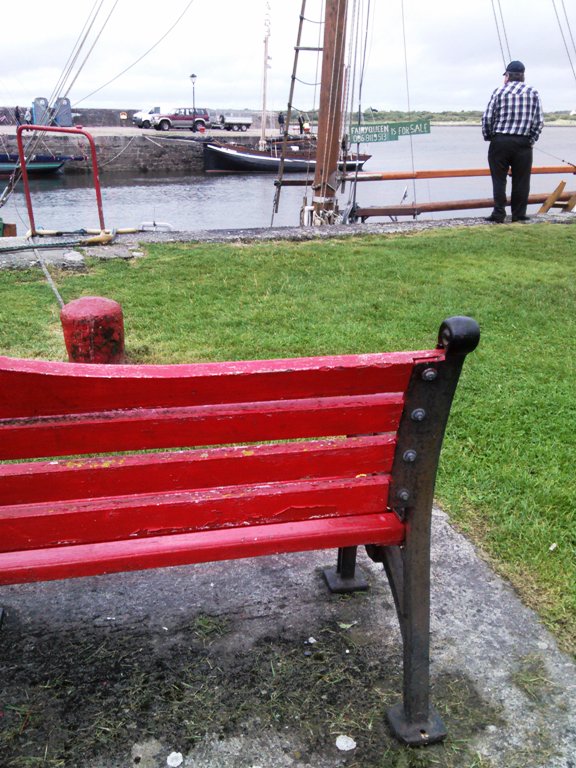
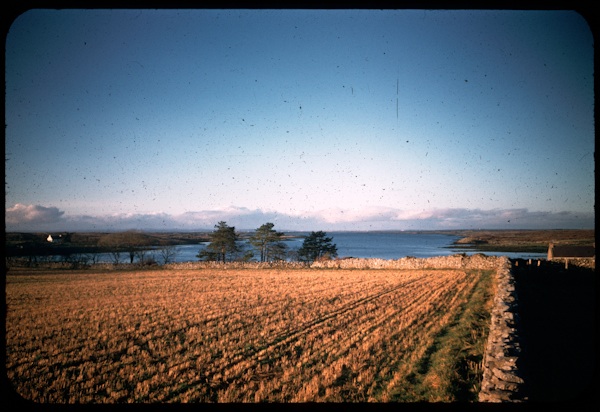
In Kinvara a great deal might be done in the way of giving employment to the labouring classes. We have a beautiful bay, but no trade, except in turf; a good harbour, which we require badly, would do much to encourage and promote trade with Galway; opening a communication between Kinvara and Gort, a distance of seven miles, by means of a railroad, which could be laid down at present, would not only serve the poor by giving them employment, but would also materially benefit both towns. Then again, though it might sound paradoxical to assert it in the depth of winter, still it is perfectly correct to say that we are at the present time suffering from a dearth of fresh water, as the only one spring which supplied the whole town, and neighbourhood, has ceased (not an unusual occurrence) to yield its usual refreshing beverage, and in consequence we are compelled to put up with a substitute of a very muddy description, while never-failing wells of the most crystal like water are to be found on the burren hills about three miles off. But as far as we are practically concerned at present they may as well be thirty miles; for, like the lakes that “shone in mockery nigh” they are untouched and untasted by us. However, it would be very easy and by no means expensive to convey the water from those hills by pipes to Kinvara, and as employment is required for the poor, the present would be a very favourable opportunity for doing a very useful, if not a necessary work.
I am, dear Mr. Editor, faithfully yours,
J. Molony P.P.
Says a writer in the Irish Weekly of October 2;
If the British Treasury is willing to devote only £1,470,000 to Irish Education, as against an Imperial contribution of £1,941,000 to the native developed Scottish system, the precious institution at Whitehall is delightfully generous to this country in other respects.
It maintains at our expense over 100,000 officials who absorb more than £3,000,000 every year in pay, pensions and gratuities. Nearly half the whole cost of Irish Government and administration goes directly into the pockets of the 100,000 odd officials – mostly useless and too often actively mischievous as agents of misgovernment, mismanagement and wrong.
The whole civil government of Scotland was only £5,500,000 per annum a few years ago. In Ireland, with a smaller population the bill was well over £7,500,000. The RIC in Ireland cost three times more than the Scottish Police Force. The Irish Judiciary cost nearly £250,000 more than their ermined brethren in Scotland. So we have in the first place a foreign educational system starved in Ireland; The Scotch fashioned their own system and it is splendidly endowed.
“The land of Ireland, like the land of every other country, belongs to the people
who inhabit it * * * and when the inhabitants of a country leave it ‘en masse’
because a Government does not leave them room to live, that Government is already judged and condemned.”
Principles Of Political Economy
By
John Stuart Mill
Abridged, with Critical, Bibliographical,
and Explanatory Notes, and a Sketch
of the History of Political Economy,
By
J. Laurence Laughlin, Ph. D.
Assistant Professor of Political Economy in Harvard
University
A Text-Book For Colleges.
New York:
D. Appleton And Company,
1, 3, and 5 Bond Street.
1885


 The Burren and Beyond