Parable of the Hidden Treasure by Rembrandt (c. 1630). Wikimedia Commons
Morning Chronicle 10th January, 1846
Workmen employed by Mrs Dr. Silver at Mount Agentino, near Tulla were throwing down an old house (said to be the oldest in Clare) when they discovered a small leather bag in the wall. It contained thirty nine guineas, of the reign of George II. They also found a curious shaped bottle full of gold and silver coins of various dates, said to be of the value of £250; nine curiously chased silver spoons; an antique fish trowel and a valuable enamelled gold ring. The spoons and ring had the arms and initials of O’Grady on them.
Photo: Jessie Eastland Wikipedia.orghttps://widgetworld3.wordpress.com/podcasts/ COLEMAN BULLETIN, 20TH DECEMBER, 1918 P3
RELIC OF FAMOUS BELL (abridged)
An ancient relic is being offered for sale in London. This is the famous “Clog an air” (sic. – bell of gold) a renowned relic which for centuries has been venerated by the people of the West of Ireland. From time immemorial the bell has been in the possession of a County Clare family, the O’Cahanos (sic.).
According to tradition, it descended from heaven, ringing loudly to St. Senan, the patron of the Seven Churches of Scattery, a holy island near the mouth of the river Shannon, opposite Kilrush, in the earliest years of Christianity in Ireland. Hence it was originally known as “Clog na neal,” or bell of the clouds. But the antiquaries are agreed that it is the work of human hands, not angelic, and from its decorations, they date it from the 11th century.
The bell is known to have been used for a period of time in the religious services at Scattery (now a place of ecclesiastical remains of great antiquity) before it was given into the care of the O’Cahanes, the ancient protectors of the island. It attained to an extraordinary degree of fame and sanctity throughout Clare and Galway. No oath was held to be so sacred as one sworn on the Golden Bell. It was believed that anyone who told a lie, after being sworn on the bell, would have his mouth twisted on one side; and down to about the middle of the 19th century it was used successfully for the discovery of information when all other means failed. The relic is in the form of a shrine which probably once contained a bell and clapper. It is made of bronze and silver, and is decorated with the figures of two-winged dragons and quaint serpent interlacings.
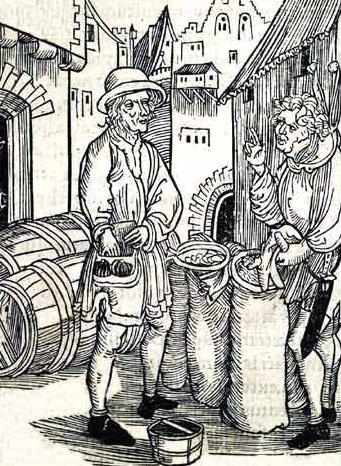
Of Usury, Brant’s Stultifera Navis (The Ship of Fools) 1494 Attributed to Albrecht Dürer – 1471 -1528 (Woodcut)https://widgetworld3.wordpress.com/podcasts/ The Cumberland Argus and Fruitgrowers Advocate 1st December 1930
AHEAD OF HIS TIME – 1930
A Galway shopkeeper, who died a few months ago was firmly convinced that the time would come when the banks would not honor their notes, and that the notes would be worthless. In a number of hiding places in his house and shop he kept his savings hidden in the shape of gold and Treasury notes. In one room he had £200 in gold in a jar concealed under the door. He had another £200 in a chest on the landing of the stairs. Altogether he had over £800 secreted. After his death the hiding places were discovered.



 The Burren and Beyond