Posted in Posts and podcasts

Hallow E’En – 1938


Collected by Brian MacMahon from Nicholas and Mrs Mac Mahon
Toonagh N.S. Co. Clare
Principal Proinnsias Gordún

First Mammy makes a cake and puts a ring and a sixpence into it. Then whoever gets the ring will be married and whoever gets the sixpence the richest of the family. Then we get a long cord and hang it from the ceiling and fasten an apple and a candle on to the cord to see who would get a bite of the apple.


We get three saucers and we put water in one and earth in the other and salt in the last one. Then we put a handkerchief around someone’s eyes and he would put into one of the saucers. If he put his hand into the saucer of earth he would be first to die; if he put his hand into the saucer of water he would be be first to cross the sea and if he put his hand into the saucer of salt he would be first to be married.
Next we put two beans down on the flag of the fire and name someone to be the husband and wife. We leave the beans there until one of them jumps. If they did not jump the people they stood for would not marry. If one of them jumped the pair would not like one another and whichever of them jumped we would make a show of the person for whom it stood.


Here are some tricks. The First is pinning a cup of water to the wall. First you get a cup of water and a pin and be pretending to another person how to do it. You put the cup on to the wall and put the pin under it. Then let the pin fall and the person goes to pick it up. While he is bending down for it you spill the cup of water on top of him.
Another trick is to place a stick on the ground so that you cannot jump over it. To do this you get a stick and put it up near the wall.
Another still is to kiss a book inside and outside without opening it. Geta book and kiss it inside in the house and go out and kiss it outside.
Putting yourself through the keyhole is another. Write your name on a piece of paper and pass it through the keyhole.
Putting your right hand where your left hand cannot touch it is another. Place it on the left elbow.

duchas.ie
The Schools’ Collection, Vol.0613, P.105
Posted in Posts and podcasts

The Tailteann Games

Moher EO'D
Moher
EO’D

https://widgetworld3.wordpress.com/podcasts/

FREEMAN’S JOURNAL 19TH MAY 1927 P37

THE TAILTEANN GAMES – WHAT THEY WERE

(BY N.F. Degidon – abridged)

The ancient festival of Tailteann was first inaugurated in honour of a pagan queen, Tailte, after whom the place was named, and around whose burial mound the athletic feats and various sports and games were performed. It lies about ten miles northwest of Tara.  The date of the first Aonach held there is lost in the mists of antiquity but the Annals of the Four Masters record that “Lugha Lamh Fadha (Lugha of the Long Arm) established the games in the year 3333 of the Age of the World.”  


The festival was a triennial one, ending each time on August 1st and was under the patronage of the King of Tara.  For eighteen centuries – seven pagan and eleven Christian – Aonach Tailteann was held under royal edict, and, whatever its political significance, it was the great triennial social event during the period of Tara’s birlliancy.  It had a very intimate and close connection with the “Feis Teamrach,” or “Festival of Tara,” which was the great national assembly held at Royal Tara.  So important was it that, in the Annals, it is commemorated thus:


Three glories never to be forgotten:

Tailteann, Tara and Aodh MacAinmhireach


the latter being one of the Kings of ancient Ireland.


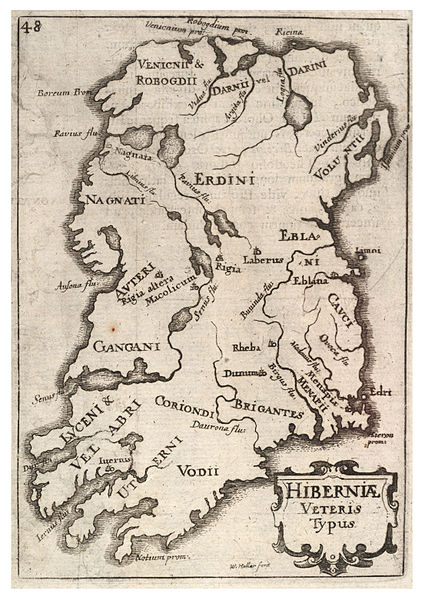
Ireland Wenceslaus Hollar (1607-1677) Scanned by University of Toronto Wikipedia.org
Ireland
Wenceslaus Hollar (1607-1677)
Scanned by University of Toronto
Wikipedia.org

FEATS OF PROWESS

All the athletes of Erin cam to Tailteann to test their skill, and it is said that the Celts of Scotland, Wales, and Brittany sent representatives to enter the lists against their brother Celts.  Feats of prowess, valor, dexterity and strength were the order of the day, while the evenings were given up to music and the gentler arts.  The chieftains of the clans attended these functions with their immense retinues – charioteers, horsemen, runners, jumpers, spear and lance throwers, swimmers, wrestlers, harpists, singers and “shanachies.”


There, during an annual truce, lasting a week before and a week after the Aonach, the laws governing the relations between the clans and the high-king were drawn up or renewed, new pacts ratified, and a sort of general political and social Spring cleaning gone through.  It was designed to build up the spirit of the race, to foster the ideal of mutual tolerationsand brotherhood, and to direct the nation along the road leading to the common weal.


The last official celebration of Aonach Tailteann was held in the year of Our Lord 1169, under the patronage of Rory O’Connor, High King of Ireland; but the festival was of such repute that tradition has it that a fair, or “pattern,” was held there annually up to a century ago.


Though Aonach Tailteann was the chief festival of its kind in Erin, each province, or petty clan, had its own Aonach;  


  • Aonach Carmain was hosted by the Kings of Leinster – the last celebration of which took place in 1079
  • Aonach Cruachan, held at Rathorghan in the Barony of Roscommon hosted by the Kings of Connacht
  • Aonach Colman in the Barony of Ballycowan and afterwards transferred to the site of the present day town of Nenagh
  • Aonach Uisneach in the Hill of Usnagh in Westmeath
  • Aonach an Bhrogha at Brugh na Boinne – the pagan burial place of Irish Kings