
Wikipedia.org
THE MAITLAND WEEKLY MERCURY 28TH MAY, 1910
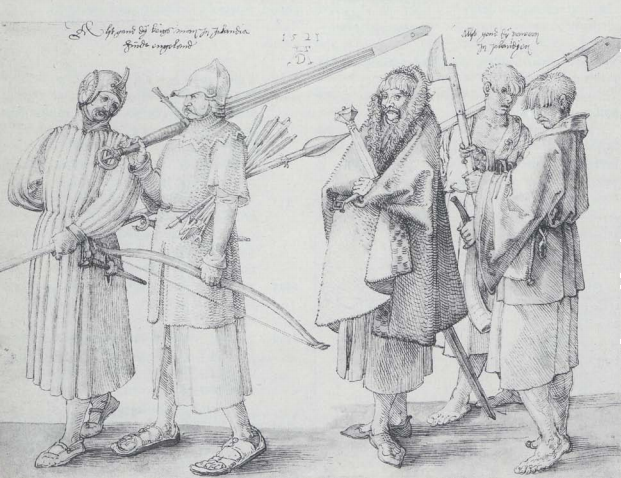
An interesting archaeological discovery was made at Ballinahalla, near Moycullen, County Galway, Ireland. Some workmwn came upon a complete skeleton measuring 8ft 5½in. and subsequently unearthed an old sword bearing the following inscription, in Gaelic – “Donach OKeefe, A.D. 1231.
Tag: Galway
Lynch – 1864
Wikipedia.org
QUEENSLAND TIMES, IPSWICH HERALD AND GENERAL ADVERTISER
28TH MAY, 1864 P4
ORIGIN OF LYNCH LAW
The office of Warden of Galway has become memorable in the literary world since Maturin dramatised the story of the rigid justice administered by Warden Lynch in ordering the execution of his son, in the year 1500. Hardiman, in his History of Galway, gives the particulars at length, which are shortly as follows:-
Warden Fitzstephen Lynch formed a friendship with Gomez, a rich merchant of Cadiz, and had his son, a youth of nineteen, with him on a visit. The Warden’s only son, two years older than young Gomez, and the Spaniard were constant companions and friends. Young Lynch became attached to Agnes, the daughter of a neighbouring merchant, but she preferred Gomez. Lynch, maddened by jealousy, stabbed his friend with a pinnard on the brink of the sea, and hurled the body into the sea. Immediately repentance came, he accused himself of murder, and was conducted to prison.
His own father sat as magistrate in judgment upon him, and from his lips sentence of death was pronounced. The populace became tumultuous, and mediated a rescue, when so rigid was the magistrate in the administration of justice, and so exalted his virtue, that on the night before the day appointed for the execution he embraced his son, led him out, and had him executed from a window!
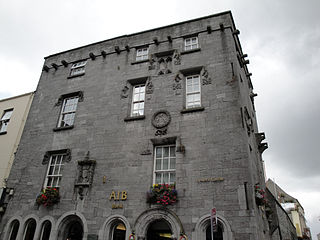
The house still stands in Lombard street, which is yet known by the name of the “Dead Man’s Lane.” Over the window may be seen, carved in black marble, the representation of a human skull with two bones crossed underneath, and is “supposed,” says Hardiman, “to have been put up by some of his family as a public memorial.” This house is always an object of interest to the tourist, and the first to which his attention is directed by his guide in Galway.
Thinking ahead – 1930
Attributed to Albrecht Dürer – 1471 -1528 (Woodcut)
The Cumberland Argus and Fruitgrowers Advocate 1st December 1930
AHEAD OF HIS TIME – 1930
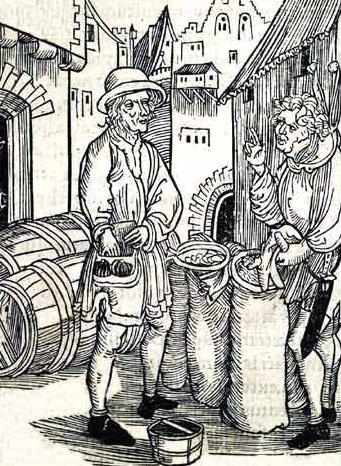
A Galway shopkeeper, who died a few months ago was firmly convinced that the time would come when the banks would not honor their notes, and that the notes would be worthless. In a number of hiding places in his house and shop he kept his savings hidden in the shape of gold and Treasury notes. In one room he had £200 in gold in a jar concealed under the door. He had another £200 in a chest on the landing of the stairs. Altogether he had over £800 secreted. After his death the hiding places were discovered.
Here and there – 1896
Illustrator: Joseph Christian Leyendecker
The Chronicle, 3rd October, 1896 p35
EXCERPT FROM REVIEW OF “HERE AND THERE MEMORIES,” BY H.R.N.
During Lord Mulgrave’s, or a preceding Lord Lieutenant’s, rule in Ireland, there was a curious thing never traced to its source and never explained. In the east of Kildare, at Kill, a strange woman gave a piece of kindled peat to a man, with the injunction to pass it along to the next person on the Naas road, that person to repass it westward still alight, and so on westward.
If the turf were let go out before a new piece were substituted from a living hearth, misfortune would come.
That was on an autumn evening.
Within twelve hours the ‘burnt turf’ had been carried to Galway Bay, across Kildare, the Queen’s and King’s counties, and Galway. No one ever published an explanation of the affair.
Memories of Galway 1907
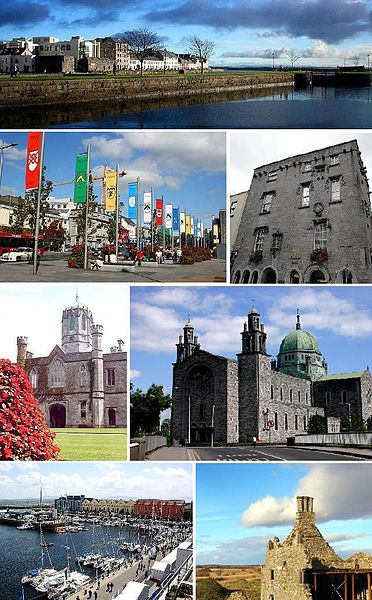
Photo: Creative Commons – Sleepyhead2
THE INTERMOUNTAIN CATHOLIC 15TH JUNE, 1907 P6
GALWAY MEMORIES
Well worth seeing and well worth remembering, dear old Galway; Galway of the stalwart gray houses that have stood for centuries the storms and buffets and driving rains of the Atlantic; Galway of the narrow, winding quiet streets; Galway of the beautiful bay, where of an evening the sinking sun touches with its dying splendor the quaint-colored sails of the fishing boats rocking at anchor.
Pleasant Galway it is, where the people are erect, and sturdy, and kindly, and the children – real, rosy country children – smile at you out of deep blue eyes as you pass; where you are awakened in the early morning by the complaining, musical cry of the shawled and barefoot fishwives.
“Fresh herring! Fresh herring!” they chant, as they trudge, baskets on hip, along the cobbled street. Oh, a quaint, old-world town is Galway, and a good old-world people are they that live there.
It chanced late last summer that a wanderer, weary of the noise and stress of modern life, strayed into the old town, and instantly felt the rest and quiet comfort of the atmosphere, and, going forth to stroll among the streets, found a throng wending their way on some great purpose bent, and so, following, came to an old arched gateway, in a strange little nook, under which these people disappeared. The curious one, going in, was received with prompt and courteous hospitality by the members of the Gaelic League, and was made a free and delighted spectator of the proceedings.
It was the “Feis Connacht,” the great annual gathering of the local country people, who were assembled to hear the old tongue spoken, the old songs sung, and the old stories told, not, as so familiarly known to them, around the cabin fires or on the breezy hillsides, but in the great “town”, in a hall, where judges would listen to their efforts and award prizes and honors to those they liked best.
So it was in the old, long, low-ceiled, whitewashed hall they met, and they thronged from far and near, young and old, the ancient village favorite, white headed and frieze-clad, who was received with shouts of applause, the worthy matron, conscious of her dignity, the young earnest farmer lad, with deep, ever burning hope of Ireland’s freedom in his deep and earnest eyes, and the troops of sunny-faced children, fresh and sweet material these, for the work of keeping the old tongue alive. The old people knew it; they would pass, but it was these tiny ones whose little lispings were listened to with greatest attention by the judges – for within their curled palms lies the future of the Irish language.
They sang, these children with their clear fresh voices, in the soft accents of the old tongue, the ancient songs of their race, and while they sang, one read in their bright eyes and fair, Greuze-like faces, the hopes of the land for the future. Oh, the sweet old songs, “Kathleen-ni-Houlihan,” solemn and mysterious, “Paistin Fionn,” with its wailing refrain, and the slow, stately strains of the “Coolin.”
Even the wild, gypsy-like children of the famous Claddagh were there sturdily chanting and (yet more to their taste) answering back, in the “conversation contest,” with a free, brisk promptness, the questions put by the judges. It was a Claddagh lassie, with a great shawl drawn about her, like unto her elders, who seated herself with much composure, and begun a long story in Gaelic, which convulsed her hearers with merriment that found its origin in the twinkle of her shrewd gray eye.
And it was a Galway matron who, also draped in her shawl, danced with dignity and decorum, the many and difficult steps of the old Irish jig, to the lively strains of an ancient piper, upon a platform, laid for the occasion, upon the stage.
How independent they were, those Connacht people! No sign of shyness or mauvais honte. They stepped up and recited, sung, danced, whatever it might be, with earnestness, and industry. How fine was that old orator, who had his tale to tell, and his say to say (concerning the legitimate freedom of ireland) and who would say it, ignoring the tinkle of the judge’s bell (intimating that his time limit had expired), and indeed, upbraiding those with upraised hands and nodding heard, as he perforced abandoned the rostrum and descended to his place among his fellows.
Good humor and appreciation are ever the order of the day. One and all, fisher and farmer and kirtled housewife, “old men and maidens, young men and children,” and the “quality” mingle in perfect democratic unison on the common ground of “land and language”.
The very remoteness of this region from the hustle and distraction of the world, would seem to militate strongly in favor as an educational field. There is time here, “all the time there is,” to be given to the study of and development of the language, and there is the earnestness, intelligence and independence of a people whose life is spent in the open air, brightened by God’s sunshine and inspired by God’s free winds, and the ever-sweet, salt breath of the ocean, here in the old historic town, whose every stone, every time-worn arch and buttress, and strange, old gray building is a reminder of ancient glories and sorrows.
GERALDINE M. HAVERTY
Don’t upset the girls from Cregg – 1908
Kentucky Irish American 22nd February 1908 p3
Exciting scenes followed an attempt to serve processes for rent due by the tenants on the Rodney estate, near Cregg, County Galway. A crowd of women and girls, armed with balls of mud, attacked the process server and his police guard and caused them to beat a hasty retreat.
Plague of…Locusts (?!)…Galway – 1689

https://widgetworld3.wordpress.com/podcasts/
The Sydney Gazette and New South Wales Advertiser 6th May, 1841
PLAGUE OF… LOCUSTS(?!) …GALWAY – 1689
According to the best account I can get of the swarms of insects which of late years have much infested the kingdom of Ireland, I find that this flying army was first taken notice of in the year 1688. They appeared on the south west coast of Galway, brought there by a south-west wind, one of the common, I might say, trade-winds of this country. From hence they made their way into the more inland parts, towards Bedford, a place belonging to George St. George, Bart., about twelve miles from the town of Galway. Here and in the adjacent country, multitudes of them showed themselves among the trees and hedges in the day time, hanging by the boughs, thousands together in clusters, sticking to the back of one another, as in the manner of bees when they swarm. In this posture or lying still and covered under the leaves of the trees or clinging to the branches, they continued quiet, with little or no motion, during the heat of the sun.
But towards evening or sunset, they would all arise, disperse and fly about with a strange humming noise much like the beating of drums at some distance and in such vast incredible numbers, that they darkened the air for the space of two or three miles square. Those that were travelling on the roads, or abroad in the fields, found it very uneasy to make their way through them, they would so beat and knock themselves against their faces in their flight, and with such a force as to smite the place where they hit and leave a slight mark behind them.
A short while after their coming, they had so entirely eaten up and destroyed all the leaves of the trees for some miles round-about that the whole country, though it was in the middle of summer, was left as bare and naked as if it had been in the middle of winter; and the grinding of the leaves in the mouths of this vast multitude, altogether made a sound very much resembling the sawing of timber. They came also into the gardens and destroyed the bulbs, blossoms and leaves of all the fruit tree, that they were left perfectly naked; nay, many of them that were more delicate and tender than the tree, lost their sap as well as leaves, and quite withered away, so as they never recovered it again particularly several trees in the curious plantation of one Mr Martin.
Nay, their multitudes spread so exceedingly, that they got into the houses, where numbers of them crawling about, were very irk-some; and they would oft to drop on the meat as it was dressing (sic) in the kitchen, and frequently fall from the ceiling of the rooms into the dishes as they were stood on the table while they ate – so extremely offensive and loathsome were they.
Their numerous creeping spawn, which they had lodged underground next the upper sod of the earth, did yet more harm in that close retirement than all the flying swarms of their parents had done abroad; for this young destructive brood, being underground, fell to devouring the roots of the corn and grass, and eating them up, ruined both the support of man and beast. This spawn, when first it gave sign of increasing every day, became a bigger worm, till at length it grew as big as a great white caterpillar; from whence according to the usual transformation natural to those smaller animals, came forth thus our flying insect.
The rage of this plague of vermin was fortunately checked several days. High winds, wet and mysting (sic.) weather, destroyed many millions of them in one day’s time.
Whence I gather, that though we have them in these southern moist climates, they are more natural, and more peculiarly belonging to warm and dry countries. Wherever these ill constitutions of the air prevailed, their bodies were so enfeebled they would let go their hold and drop to the ground from the branches where they struck; and so little a fall as this, at this time, was of sufficient force quite to disable, and sometimes perfectly kill them. Nay it was observable, that even when they were most alive and vigorous, a slight blow or offence would for some time hinder their motion if not deprive them of life. During these unfavourable seasons of weather, the swine and poultry of the country watched under the trees for their falling and ate them up in abundance, being much pleased with the food, and thriving well upon the diet. Nay I have been assured, that the poorer sort of the native Irish (the country then laying under a scarcity of provision), had a way of dressing them, and lived upon them as food.
In a little time it was found, that smoke was very offensive to these flies, and by burning heath, fern, and such like weeds, in this or that corner of their dardens or orchards which lay most convenient for the wind to disperse it among the trees, they would secure their gardens and prevent their incursions; of if they had entered, drive them out again.
Philosophical Transactions
Tea and Pistols – 1864
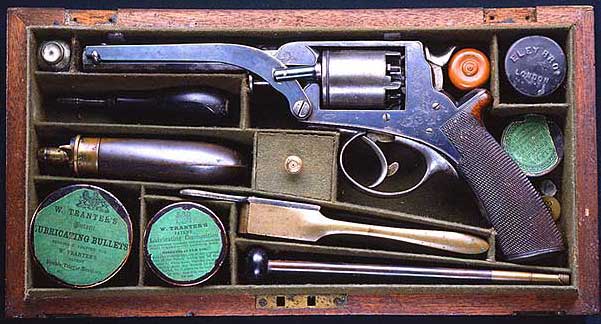
Tranter revolver, in 1863 given to Confederate Major General James Ewell Brown “Jeb” Stuart by his prussian (german) Staff Major Heros von Borcke (1835-1895)
HOW TO SILENCE A FOOL
https://widgetworld3.wordpress.com/podcasts/
A Galway gentleman once entered a coffee house in London and called for tea. His brogue attracted the attention of a scented civilian in the opposite box, who relying on his superior accent, resolved to have a jest at the expense of the stranger. The civilian called for tea too; the Irishman called for muffins, so did the civilian, toast, milk, sugar, &c, were severally called for by the Irishman, and as severally called for by the fop, who enjoyed in his corner the supposed embarrassment to which he was subjecting the Galway gentleman. At last, with the greatest composure, and, if possible, with a richer brogue, the Irishman desired the waiter to “bring up pistols for two!” The jester’s echo was suddenly silenced, and he quickly made his exit.
Galway Ghost causes chaos – 1891
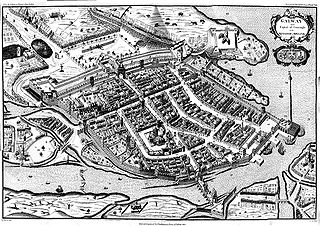
Wikimedia commons
A GHOST AT THE WINDOW
https://widgetworld3.wordpress.com/podcasts/
It would seem (says England and the Union) that Galway is not going to be behindhand in the matter of belief in the supernatural, judging from the state of excitement created a few nights ago by the rumour that a ghost had made its appearance at one of the windows of a house in Abbeygate Street, directly opposite the sacristy of the Pro Cathedral of St Nicholas.
This house, it must be mentioned, was lately occupied by a woman who died after a very short illness. Since her death it became tenanted by another person, but from some cause or another, the last mentioned left, and the place remained unoccupied till last week. On the night it was occupied some children were passing to attend devotion at the chapel, when they say they observed a sort of unusual light in the house, and a woman standing near the open window, who, in a sepulchral voice, said, “offer one prayer for me.” Some of the children fainted on the spot, and this caused others going to their devotions to inquire into the cause.
The tale of the spectre at the window spread like wildfire and in a quarter of an hour no less than 2000 persons had congregated outside the haunted house. The streets on each side became blocked. The crushing and jostling to get a glimpse at the “visitor from the other world” was such as has never been equalled in Galway. Several persons were thrown down and trampled upon, and it was with the greatest difficulty a strong force of police, after about three hours’ incessant labour, succeeded in clearing the streets sufficiently to allow pedestrians and cars to pass. The tramcars were even compelled to stand still in the streets.
The following nights the same state of things have prevailed, but up to the present the real cause of the rumour has not been satisfactorily explained. Several versions of what the object really was that created such a sensation are given, but the adult portion of the community say that fifty years ago there was also “something seen” in the house, it having been the scene of a most brutal murder – namely the assassination of a woman named Maxwell by her husband. From the description now given of the late apparition by the children, who say they saw it, the older people say it is one and the same ghost, which has to put up alternate half-centuries in this world and the other. The police are stationed near the place, where four streets meet, and it is as much as they can do to keep the curious from congregating. It is most surprising that amongst this class are to be found some of the most respectable, and, it might be expected, enlightened people in the town, both male and female. The strangest thing of all is that, notwithstanding the thousands who congregate nightly, not one – even the police – have the courage to try to unravel the mystery.
Galway’s Giant Ghost – 1907

The Damned Soul
Galleria degli Uffizi, Florence
circa 1525
BISBEE DAILY REVIEW, APRIL 27 1909 P8
GALWAY HAS A GIANT GHOST
Apparition Eight Feet High Leaps into the River
Dublin – A spectral figure, grey in color and about eight feet in height is said to have haunted the railway line near Galway for nights.
The apparition, which is described as “tapering toward the top,” walks from the railway viaduct across the bank of the stream and then disappears.
A number of people have visited the place toward midnight when the apparition is due to appear. One man declares that he saw it jump from the top of the viaduct into the Corrib where it disappeared.
It was not “drowned”, however, for on the succeeding night it was seen again by a number of students from Queen’s college Galway. One of the students volunteered to go over and talk to it, but when it appeared he changed his mind.
On a Sunday evening a party of six men, armed with shotguns, revolvers and sticks, sallied forth to “lay the ghost.” They had been in ambush but a short time only when the specter loomed up before them. One of the men raised a revolver, but before he could fire he fell in a swoon. The expedition was abandoned and the man was taken into Galway where he was medically attended.
These strange reports have created excitement in the district, and search parties are out nightly for the purpose of unravelling the mystery.
 The Burren and Beyond