The effects of the thunderstorm on Thursday week were severely felt in Ireland. At Limerick, a woman was killed by lightning while sitting at the fire with her husband. Three persons lost their lives in Galway. Houses and cattle were injured at Marlborough; five cows and a horse belonging to one man were killed.
A person living at Tallaght gives the following account of the tremendous phenomena witnessed there :
“A convulsion took place about three o’clock this morning at Old Bawn, Tallaght; the earth trembled as if it was only held by suspension; the houses rocked most frightfully, as if inclined to bury the inmates; when on a sudden the heavens opened to the eye as one mass of living fire. Immediately after the elements grumbled and sent forth their awful noise, which was loud and terrific. The lightning, or some other uncontrollable power, tore up a part of the road, small at top and opened as it sunk to the form of a balloon, well worth seeing.”
The Sydney Monitor 8th October, 1831 p4 (abridged)Hordeum-barley Wikimedia Commons
I had just closed this article when a friend sent me, at my request, an account of the import of foods from Ireland up to the 1st day of June. It is imperfect because it only gives an account of the imports in London and Liverpool, leaving out Bristol, Glasgow and several other places. It is imperfect in that it does not include bacon and live animals, nor poultry nor eggs.
However, such as it is – here is the account of the imports of the first months of this year of famine in Ireland;
98, 555 Quarters of Wheat
311,848 Quarters of Oats
10,098 “ “ Barley
540 “ Rye
1,556 ” Beans
941 “ Peas
5,880 “ Malt
69,510 Loads of Meal
45,398 Sacks of Flour
12,605 Tierces of Beef
1,408 Barrels of Beef
20,088 Tierces of Pork
13,427 Barrels of Pork
149,639 Firkins of Butter
It is in Galway that the actual starvation is raging most, where the poor creatures cannot get a handful of meal to boil up with the nettles and seaweed! They cannot get a handful of the meal of oats to prevent their souls from leaving their bodies and it is certified that in one small parish eight persons died within a short period from starvation only.
Yesterday – six hundred and eight tons of oats – that is to say – one million, three hundred and thirty four thousands pounds weight of oats arrived in London only – from Galway.
The oats came in five vessels, the Union, the John Guisa, the Charlotte, the lively and the Victory.
Four hundred and fifty girls leave Galway this week for Boston under a year’s engagement to New Hampshire cotton mill owners, who pay their expenses out. Several hundreds more wanted to go. There was an exciting scene on thursday at Limerick depot over the departure of 250 of them.
Flax flowers Photo: D. Gordon E. Robertson Wikimedia Commons
Mr James Hill Dickson, for many years connected with the flax manufacture in the north of Ireland, has made a proposal to the chairman and directors of the Midland Great Western Railway, which they have favourably entertained – of erecting a mill on a platform, with wheels to run on the railway, to which will be attached a portable steam engine, of six horse power, with which to work the mill.
The mill, engine and workmen can be transported at the shortest notice to any given point along the line of railway from Dublin to Galway and into the country, to any farm or district along the line, at moderate distances, where flax may be grown, thus doing away with cumbrous and expensive fixed establishments hitherto so necessary to the successful cultivation of the flax plant and, in these depressed times, so difficult to erect and establish
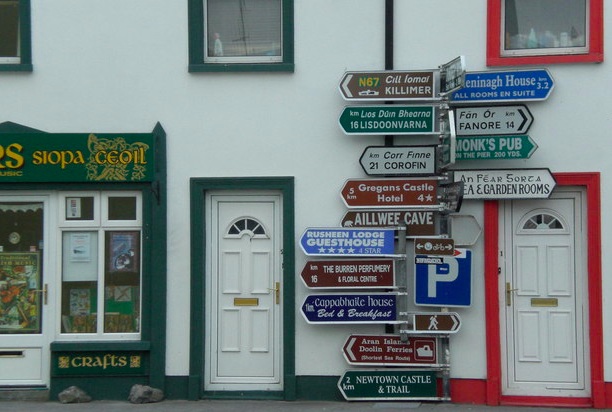
Connaught Journal 14th August, 1823Signpost at Ballyvaughan, Co. Clare. Photo: c. Chris Tomlinson Licensed for reuse under Creative Commons
THE GALWAY AND LIMERICK DAY CARR,
Will start from the Commercial Building’s lane, at 7 o’clock, A.M. on Friday next and every succeeding Monday, Wednesday and Friday having Two Seats each day, from this for Ennis; Two for Gort, and Two for Galway; and also the same day, Two from Ennis to Galway or Gort, and Two from Gort to Galway; and in case of Vacancies, places may be had to Six Mile Bridge, Kilkishen, Tulla, Spancel-Hill, Crusheen and Clarin-Bridge, &c.
The Carr will arrive at the Grey Horse Hotel, Galway, at 7 o’clock each evening; and return at 7 o’Clock next morning, having Two Seats each day for Gort, Two for Ennis, and Two for Limerick; or in case of Vacancies to, or from any of the intermediate Stages, where the Fares and Charge on Parcels may be known.
The Proprietor is preparing Covered Caravans, which will be soon ready to convey Passengers daily to and from the several places mentioned; and he rests his hope of encouragement for the present limited Establishment on the Public Utility of the Undertaking; as the Fare from this to Galway will be little more than half the present expence of travelling from Ennis there, and as the strictest attention will be paid to the safety and comfort of the Passengers.
N.B.- A Carr will leave Stamer’s Hotel, Ennis, at half-past 10 o’Clock every Friday, Monday and Wednesday, with Passengers, for Galway or Gort, and return before 12 from Spancel-Hill with those from Limerick; and also, at one o’clock on Tuesdays, Thursdays, and Saturdays, with Passengers, for Limerick, and return at three o’Clock with those from Galway or Gort.
The Proprietors of the Galway and Ennis Papers will please to publish the above for one post, to be paid for where the Carr stops.
Limerick, August 12, 1823.
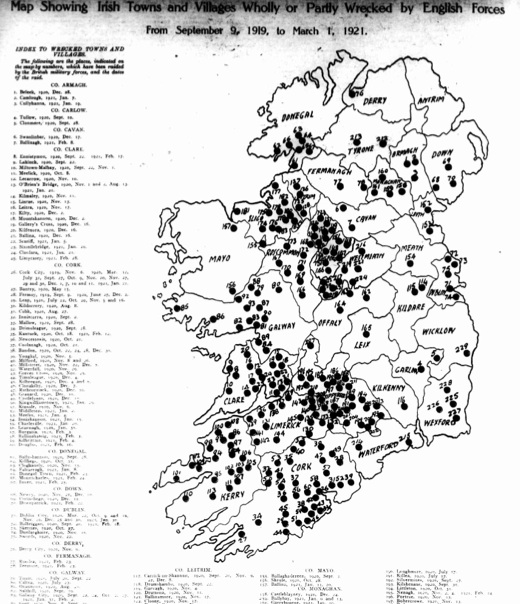
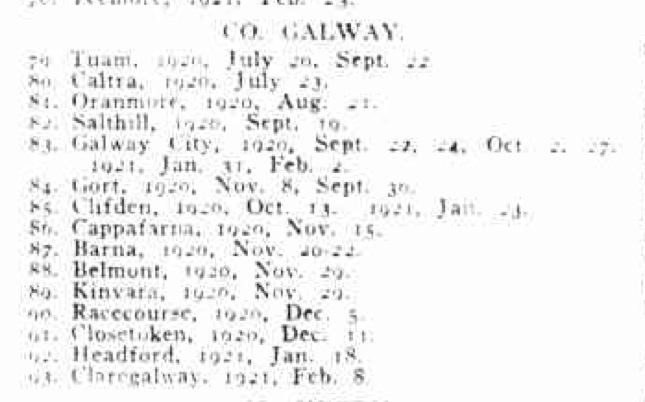
Map Showing Irish Towns and Villages Wholly or Partly Wrecked by English Forces From September 9, 1919, to March 1, 1921. INDEX TO WRECKED TOWNS AND VILLAGES.
The Catholic Press (Sydney, NSW : 1895 – 1942) 8 September 1921
A shark, which the Cunard liner Samaria struck when 150 miles from Galway on her voyage from New York, was removed from the vessel’s bow when she arrived in Galway.
The Newsletter 26th November, 1910 (abridged) p5
Galway was a very pleasant sociable place in olden times. In the summer ladies flocked into it from every corner of Connaught for the sun-bathing – at least so they gave out (says a writer on “Old Irish Travel” in “Blackwood’s Magazine”). Such a muster of fair ones naturally brought a corresponding number of young men in its stream, who came openly and avowedly for amusement, and often returned home provided with a partner for life. There were gatherings every evening to which admittance was had by a small payment, and they were designated routs, drums or assemblies, according to the price charged. The greatest gaiety and unconstraint reigned at these gatherings. In the evenings, if there chanced to be no rout or assembly, the summer visitors and the residents promenaded the streets, going in and out of the shops, buying, chatting with their friends and acquaintances, and enjoying themselves.
The shopping had, however, a serious side to it, for the milliners were always willing to give the ladies credit for the articles of attire which they needed to enhance their looks, and to let the bill stand over till after the fair one’s wedding. So great indeed were the attractions in Galway that they made some people oblivious even of the passage of time.
“There were in this good city,’ remarks the writer, “ladies who grew old without perceiving it and who went on dancing, shopping and bathing until they were upwards of 50.”
Many and ingenious were the devices adopted in those old days to outwit the Customs officers. Boat loads of native brewed poteen or of foreign claret and brandy were ferried across Lough Corrib and Lough Mask snugly stowed away beneath a harmless looking covering of turf or straw. Funeral processions might be seen wending along the rough mountain tracks, the keeners trooping after the coffin and sending their cry echoing over the desolate wastes. The coffin instead of its ordinary burden was filled with tobacco, and the mourners carried parcels of the same valuable commodity beneath their capacious coats. The whole consignment having then been disposed of inland the party would return merrily homewards.
Nuns on bicycle pass in front of the Cathedral of Wroclaw, Poland Photo: Yarl Wikimedia Commons
South Australian Register 21st November 1850
ACTION AGAINST THE SISTERS OF MERCY (abridged)
The following is a compendium report of a recent remarkable trial in the Galway Record’s Court, Ireland. Such was the public anxiety to hear this very novel trial, that at an early hour the Court was densely crowded. Mr Fitzgibbon, Q.C., stated the case. This was an action brought by the administrator of Mrs Eliza McDonnell, to recover the sum of £500 given by her to the Sisters of Mercy, in the town of Galwav. The circumstances were these :—
In March, 1846, Miss Harriet McDonnell, the daughter of Mrs McDonnell, was desirous of becoming a Nun of the Order of the Sisters of Mercy. Her sister, Mrs Ireland, at the request of Mrs McDonnell, called at the Convent of Mercy, to enquire as to the terms of the convent, and to settle with the nuns. The Mother Abbess, stated that it was absolutely necessary that Miss McDonnell should spend six months as a postulant in the convent previous to her reception as a novice. After the ceremony of her reception had taken place, she should pass two years in the convent as a novice before she could be professed. She added that they could not, on any account, shorten the time of her profession, and that it could not be done without a dispensation from the Pope. They agreed to take the sum of £500 from Mrs McDonnell for the daughter, and that it should be left in the hands of her brother-in-law, Mr Ireland, until after her profession. In the meantime they should receive the interest for her support.
In the month of May, 1846, the Rev. Peter Daly called on Mr Ireland, and told him that it would be of great service to the nuns if the family would give them the money at once, as they were going to invest some money on very favourable terms. Mrs McDonnell agreed to give them the money, on their undertaking to return it in case either her daughter should wish to leave the convent before the regular time of her profession, as stated by themselves, or, in case of her death, before then. They agreed to give the strongest guarantee to that effect, and Mrs White entered into the following agreement : —
Mrs Eliza M’Donnell— Madam, you have handed the Rev. Peter Daly, on behalf of the Sisters of Mercy, £500 sterling, the sum agreed to be received from your daughter, Harriet McDonnell, on her being professed a nun in her community, which sum we engage to return you free of interest, should either the nuns or your daughter change their minds before the period of her said profession arrives, or in the event of her decease before then.
In the month of August, 1847, Miss McDonnell took a malignant fever. After all hopes of recovery were over, the nuns had her professed a nun. They now contend that, as she was professed on her dying bed, they have complied with the terms of the agreement – they rely on the ambiguity of the word profession, although it was clearly provided in the agreement, that in case of her death the money should be returned.
Counsel for the case contended that it would be absurd to put any other construction upon the words, ‘period of profession’ – as it was always in the power of the nuns, by that construction, to make the money their own, and to render their guarantee a mere mockery, by professing her dying. They were permitted by the Bishop to profess her dying, merely as consolation; and, if she survived, she should be professed again.
The Bishop of Galway directed them to return the money but they preferred taking their chance in a court of law, thinking to evade the agreement by some ambiguity on the face of it. They were unsuccessful.
The Jury returned a verdict for the plaintiff, with £500 damages and 6d. costs.
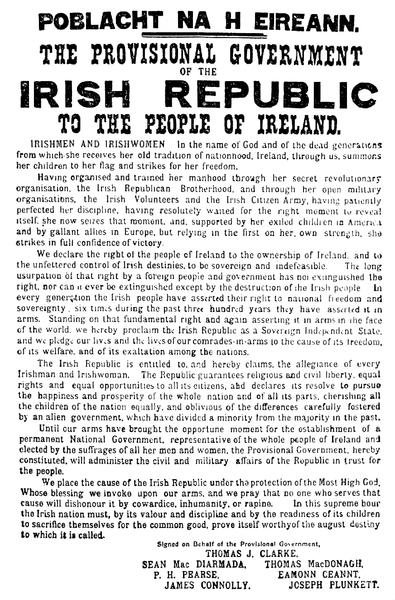
Easter Proclamation 1916Ashburton Guardian Vol XXXVI I. 8441 5th May 1916 p5
ARRESTS PROCEEDING SATISFACTORILY.
(Per Press Association)
LONDON, May 4
An official communique says: “The situation in Ireland is quiet. Arrests of rebels and the collection of arms are proceeding satisfactorily.
“The police barracks at Oranmore were attacked, but resisted until they were relieved. The situation in the West Riding of Galway is under control, the rebels having been dispersed. The south part of Ireland is quiet.
Aliens are being refused entry into Ireland for the time being.”






 The Burren and Beyond