Posted in Posts and podcasts

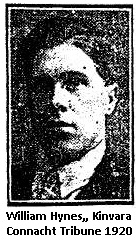
William Hynes, Kinvara – 1920

Connacht Tribune – 1920
The Art of Making Rebels
HOW THE GOVERNMENT PERSECUTED A KINVARA MAN AND HIS FRIENDS
Mr. William Hynes, Kinvara, one of the hunger strikers recently released from Wormwood Scrubbs, was arrested at Abbey, Loughrea, early in Spring, and confined in Galway prison. He was remanded on a few occasions while “the minions of the law” were trying to make a case against him, but subsequently he was released without a stain on his character. The Government, not to be outdone, re-arrested him a few weeks later, and deported him to Wormwood Scrubbs along with Mr. Patrick Kilkelly, now the chairman of the Gort District Council, and hundreds of others.
Mr. Hynes is the youngest son of Mr. Patrick Hynes, Doongora, Kinvara, and comes of a good old stock of fighting Nationalists. He is grandson of the late “honest Bartly Hynes,” of Killina, the first man in Ireland to be prosecuted for having his name in Irish printed on his cart, and who, to credit be it said, refused to pay the fine imposed by a pair of British “Removables.” His brother, Mr. Michael Hynes, was arrested after the Rebellion of 1916, and imprisoned at Frongoch. His cousin, the late Mr. Patrick Hamberry was, following the Rebellion, imprisoned in Frongoch, and died as a result of his cruel treatment immediately after his release.
Posted in Posts and podcasts

August 1916

The Catholic Press 31st August, 1916 p.16

Photo: EO'D
Photo: EO’D

In reply to an inquiry from Dublin, a letter has been received from the joint secretary to the advisory committee dealing with the cases of Irish prisoners in England to hear representations showing why certain prisoners at Frongoch should be released. No counsel or solicitors would be heard as advocates.
The London correspondent of the “Manchester Guardian” regards as serious the announcement that 1,600 Irishmen are being interned for the period of the war, and says that English solicitors are busy with regard to a number of the cases. He adds that the Government would be well advised to announce the steps that interned persons or their friends can take to secure an adequate hearing before the advisory committee.

In reply to Mr. Ginnel yesterday, Mr. Tennant said that, according to the latest information in the possessions of the Home Office, 125 persons were now undergoing penal servitude in connection with the recent rebellion. The Government had not considered the advisability of treating them as prisoners of war.

Posted in Posts and podcasts

Frongoch – 1916

The Connacht Tribune, 1st July, 1916 (abridged)

Frongoch
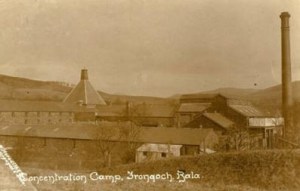
Frongoch postcard

The censor of Frongoch internment camp informs us that Tuesdays and Thursdays are visiting days from 2 to 3 p.m. Prisoners can receive only one visit a month, and applications for permits must be made in writing to the Commandant, allowing sufficient time for reply by post. No admission is granted except on production of the permit. The following have been removed from Stafford to Frongoch;
James Fahy, Doughiska, Galway
Thomas Newell, Castlegar
John Murphy, Athenry
Michael Burke, Doughiska
William Cody, Claregalway
Thomas Silke, Castlegar
Michael Glynn, Lydican
Mr. Joseph O’Flaherty, Loughrea
William Harte, Oranmore
Richard Wilson, Loughrea
Dominic Corbett, Craughwell
Jeremiah Galvin, Slieverue
Christopher Caulfield, Athenry
Martin Walsh, Athenry
Peter McKeown, Athenry
Patrick Kennedy, Athenry
Joseph Cleary, Athenry
Pat Keane, Athenry
Ml Commons, Athenry
Ml Cunniff, Galway
Ml Costello, Galway
Martin Costello, Galway
Pat Costello, Galway
Martin McEvoy, Galway
John Cullinane, Galway
William Higgins, Galway
Michael J. Dunleavy, Galway
Richard Wilson, Galway.