Nation 7th April, 1855: Page 8 “The Sister at Scutari.” (There are one or two good lines in your poem: but that diffuseness which is the besetting sin of “easy writing” spoils it as a whole.) “Lines on a visit to Kinvara Churchyard.” you seem to be under the impression that imagination has some inveterate antipathy to common sense. For example, the lines – “How solemn looks that massive pile. Now stript of all except the aisle; Its walls are crumbling fast away- Like man himself, they too decay.” Now, if there be really nothing but an “aisle,” how do you expect us to believe that there is a “massive pile” – looking solemnly all the while?
Note:
The Sister of Scutari may refer to Mother Mary Aloysius Doyle, Convent of Mercy, Gort, Co. Galway. She nursed with Miss Florence Nightingale in the Crimea
Wairarapa Daily Times, Volume LIX, Issue 9225 19th November 1908 p5Coole Park, Gort EO’D
One of the most interesting survivors among the few who still remain of the noble band of women who nursed with Miss Florence Nightingale in the Crimea has passed away (writes a London correspondent), in the person of Mother Mary Aloysius Doyle, at the Convent of Mercy, Gort, Co. Galway.
The venerable lady had attained the great age of ninety-four years, but her faculties were unimpaired, and only last July she wrote a beautiful letter of sympathy and good wishes on hearing of the fate of the veterans, destined to help the declining days of the survivors of the Crimea and the Mutiny. The great value of the services rendered by the first party of nurses who went out with Miss Nightingale led Mr Sidney Herbert to request Miss Stanley, sister of the former Dean of Westminster, to select further reinforcements for her and letters were written to all the convents in Ireland for trained volunteers. Two other Roman Catholic Sisters who accompanied Miss Nightingale are happily still with us as Sister Mary Stanislaus RRC and Sister Mary Anastasia RRC who are in the Hospital of St John and St Elizabeth, the former of whom, it is pleasant to record is in good health and has may interesting memories to tell of those stirring days.
Freeman’s Journal 26th December 1885 p45 (abridged)
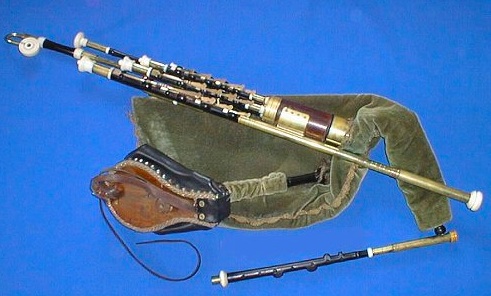
UilleannPipes photo: ‘Ganainm’ Wikimedia Commons
In every district of Ireland there is, or was a generation ago, always one musician who, by reasons of his superior skill, received a kind of patent of nobility and whose name was always spoken in association with that of his locality. In this way the subject of our sketch was known as the Piper of Galway.
Who that lived or travelled thirty odd years ago, in the city or the hills, in the fastnesses of Connemara, or by the shores of Lough Corrib and Lough Con, did not feel his bosom bound with gladness or melt in sorrow at the sweet strains of his matchless and inimitable pipes. His memory was wonderfully retentive and he could perform on his instrument thousands of airs, especially those of his native land. “Felim’s Death on the Field of Athrenee,” and “Red Hugh’s March to the Curlew Mountains,” he played with wonderful and enchanting power; from the Ros Catha of the warlike bard to the saddening symphonies of the “Coolun,” or the plaintive pleading tenderness of the “Molly Asthore,” he was equally and eminently famed. The music of Carolan and the melodies of Moore were all in the gift of this poor blind piper of Galway.
A more interesting character was seldom met with – a man deprived by fate of eyesight, yet by the light of his mind tracked his journey through life in one continued stream of sunshine, beloved by many and respected by all whose respect was worth possessing. Despite his humble condition and the loss of sight (which would be deemed by most persons as one of the greatest of human calamities) he was a happy man.
He was always singing, in sunny weather sprightly airs, and in gloomy weather pathetic ones; but he never looked sad, except when a tale of sorrow excited his pity or when he was about to separate from friends.
Perhaps the most eminent trait in his character (independent of his musical one) was his habitual, we might say, his constitutional benevolence. Many anecdotes of his goodness are told. He was always a temperate and prudent man and would never lower the dignity of his professional character by playing in a tap-room or any place where drunkenness was known. He had a great love of approbation, a high opinion of his musical talents, a strong feeling of decent pride and a great love of country. Green be the shamrocks on his grave.
The death is announced form Gort Convent, county Galway, of Mother Mary Aloysius Doyle, the last of the 16 nuns of the Order of Mercy, who left Ireland in Decemlier, 1854, to assist Florence Nightingale in nursing the Soldiers in the Crimea. She was 94 years of age. She was summoned to Windsor several years ago by the late Queen Victoria to be decorated, but was too old to undertake the journey. Her sister, aged 90, a nun in the same convent, still survives.




 The Burren and Beyond