Posted in Posts and podcasts

THE FLAGGY SHORE

THE FLAGGY SHORE

Sometimes she represents an owl, a cat and very often a bat

There is a special spot in New Quay. It has derived its name from the vast number of enormous rocks which are still to be seen near the shore. The following story is told about this special spot :-
Once upon a time the devil came into Clare. He had nearly all the people of Clare under his control, but the people of New Quay resolved he would never enter. The devil came along one morning holding his little son by the hand. The people of New Quay were well prepaired (sic) for him, so the fight started. They flung stones at one another, but luckily enough the devils little son wasn’t able to fire the stones far enough, and the stones and flags were all in the same spot. This special spot has the honour of being called Flaggy Shore.

Tradition tells us that once upon a time St Bridget was going to church. As she was near Bellharbour, the thunder rolled and the lightning flashed, and the rain poured. St Bridget prayed to God for some shelter and that very moment a huge tree sprang up by the power of God. Bridget prayed that any poor person who would go that way would have shelter. This bush is now called Sceach Brighid.

It is said the banshee is one of the fallen angels who died without being baptised, and is therefore sent to this world to get penance and forgiveness. It is said there is a special room in Skeretts house and the door was never opened, the banshee is supposed to live in this room. It is said the banshee makes it her headquarters and always lived there when she was not occupied screeching around other dwellings as her calling requires. She always sleeps in the room and no one ever dared to disturb her. The floor is supposed to be covered all over a foot high with the dried leaves which blow in from the tress (sic) through the little round openings which represent windows. Sometimes she represents an owl a cat and very often a bat flying through the window in the twilight. She always cries most dismally before the death of a Kerins, Skerrett, Traynor, Mac or O.
Collected by Caitlín Ní Fhathaigh, age 14, Ballyvaughan N.S. from Michael Wall, age 86

The Schools’ Collection, Volume 0615, Page 245//
National Folklore Collection, UCD
Posted in Posts and podcasts

The Flaggy Shore

The Schools’ Collection, Volume 0615, Page 245
Image and data © National Folklore Collection, UCD
Ballyvaughan N.S
THE FLAGGY SHORE
There is a special spot in New Quay. It has derived its name from the vast number of enormous rocks which are still to be seen near the shore. The following story is told about this special spot :-
Once upon a time the devil came into Clare. He had nearly all the people of Clare under his control, but the people of New Quay resolved he would never enter. The devil came along one morning holding his little son by the hand. The people of New Quay were well prepaired (sic) for him, so the fight started. They flung stones at one another, but luckily enough the devils little son wasn’t able to fire the stones far enough, and the stones and flags were all in the same spot. This special spot has the honour of being called FlaggyShore.
Tradition tells us that once upon a time St Bridget was going to church. As she was near Bellharbour, the thunder rolled and the lightning flashed, and the rain poured. St Bridget prayed to God for some shelter and that very moment a huge tree sprang up yb the power of God. Bridget prayed that any poor person who would go that way would have shelter. This bush is now called Sgeach Brighid.
It is said the banshee is one of the fallen angels who died without being baptised, and is therefore sent to this world to get penance and forgiveness. It is said there is a special room in Skeretts house and the door was never opened, the banshee is supposed to live in this room. It is said the banshee makes it her headquarters and always lived there when she was not occupied screeching around other dwellings as her calling requires. She always sleeps in the room and no one ever dared to disturb her.The floor is supposed to be covered all over a foot high with the dried leaves which blow in from the tress (sic) through the little round openings which represent windows. Sometimes she represents an owl a cat and very often a bat flying through the window in the twilight. She always cries most dismally before the death of a Kerins, Skettett, Traynor, Mac or O.
Collected by Caitlín Ní Fhathaigh, age14 from Michael Wall, age 86
Finavarra Demesne, Co. Clare

Posted in Posts and podcasts

New Quay – 1907

Nenagh News 17th August, 1907p3 (abridged)

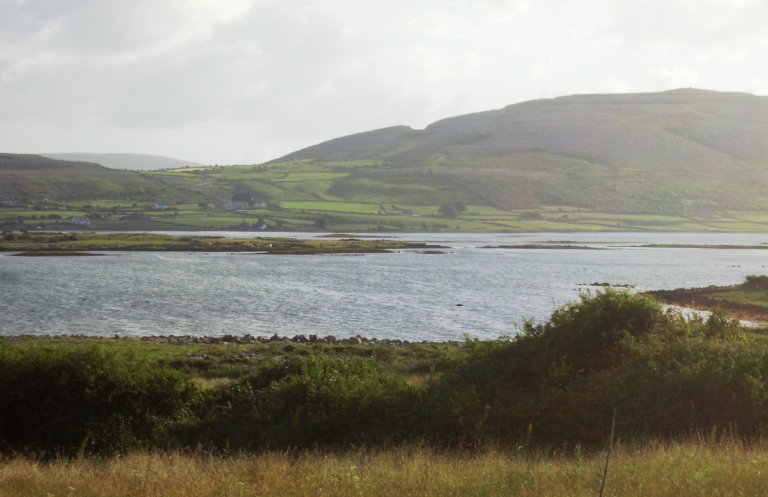
Across the way. Photo: BO'D
Across the way.
Photo: BO’D

New Quay is encircled on the south side by the rugged range of the Burren Mountains showing the ancient ruins of Corcumroe Abbey, Aughmama Abbey, Mucknish castle, and other castellated ruins along Bellharbour Bay, with the villages of Curranroe, Kinvara, Bellharbour, Ballyvaughan and Finavara, in the immediate vicinity. The air at this district and its surrounds, filled with the ozone and saline of the salt sea of the Atlantic Ocean infuses new life and vigour into one accustomed to living in inland places where the air is entirely devoid of those health giving properties and less embracing.

There are two bathing centres in New Quay supplied with bathing boxes, and a splendid range of sanded strand, one at New Quay and the other at Old Quay, a short distance away towards the Flaggy Shore. The circle of sea surrounding New Quay extends from Curranroe, at the boundary of Clare and Galway, by Munna and Carton, along one of the northern peaks of the Burrin Mountains and continuing on by Old Quay, the Flaggy Shore, Finavarra, Martello Tower and Scanlan’s Island. At this point the entrance is to Bellharbour Bay by a narrow strait dividing Finavarra from Mucknish castle and Ballyvaughan and continuing inland by the southern slopes of Finavarra demesne, and Corcumroe Abbey to Bellharbour Quay and circling outward in the opposite direction by Muckinish Castle, Oughmama Abbey and Ballyvaughan, under the shade of the Burren Mountains.

In fine weather the open sea from the mountain heights and verdant plains of this district, presents one crystal sheet of sparkling surface, with ships, steamers, trawlers, and every style of sailing boat strewn here and there along the surface of the water, from the coast to the circle of the horizon, touching the Atlantic Ocean in the West where the top rigging of the largest barque afloat is seen as a speck above the curvature of the sea, until the full sails and hull of the vessel are exposed to view as it approaches nearer along the surface of the sea.

In stormy weather this open expanse of sea presents an entirely different appearance form what it is in fine weather. To residents of the district the disturbed and placid surfaces of the sea are as familiar as the rising and setting of the sun, but to the visitor or tourist unaccustomed to the fury of the tempest, a short sojourn at New Quay brings the extreme changes caused by the elements into view.

There are intermediate phases in the elements and surface of the sea which only add to the enjoyment of a sail in open boats, but woe betide the boats or even larger vessels, tossed about like shells on the surface of the mountain waves, rolling in silvery breakers from the Atlantic ocean against the cliffs and rock-bound coast.