Posted in Posts and podcasts

Piseoga – 1958


The Schools’ Collection, Volume 0026, Page 0190

Collector: Patrick Healy 3rd May, 1958. Barnaderg, N.S. Co. Galway
You all know May is the month of the fairies. Great people or men that lived long ago rises from their graves on every night in the month of May to fight the old battles that they fought long ago these men are called fairies. The bad fairies do great harm and trouble in the month of May they kill cattle take away milk and butter from the cows and a lot of other mischief. The first three days of May is very dangerous for cattle. The fairies takes away the butter and milk from them and cause them to do mischief such as to kick the milk-pail to follow the milkmaid and so on. Every night or evening the milkmaid should make the sign of the cross on the cow’s back with the froth of the milk; this will prevent the fairies from causing mischief to the cows – or to tie a bunch of primroses to the cow’s tail after sun-set or to drive your cattle through hot embers of a fire.
The fairies come around our house’s too to do mischief as well as they come to the cattle; you should sweep the hearth very clean and leave food aside for them. If you don’t: the fairies will come when you are asleep and will torment you by tricking you or pinching you: And if you want to keep out the fairies: scatter the threshold of the door when you are to bed with primroses or hang a horse-shoe over the door:

You should not go alone through hills or forth’s (sic) or lonely places for fear of the fairies might take you away or listen to any sweet singing in lonely places for these are fairies Don’t leave any food over from May Eve it should be thrown away or given to the dog’s because the fairies takes away the good food and leave bad food instead.


On May morning early it is a great custom which is still practised by a lot of people to go out early in the first morning in the month of May to a clover field and roll yourself in the dew. This roll in the dew will prevent you from get colds during the year around. There was a great custom practiced long ago which very seldom you hear about it now – no one in any parish is allowed to light a fire in the house in the morning until they would see the smoke rising from the chimney of the priest’s house first. This old custom resembles some old sacrifice or worship offered long ago by druids or some greats saints as St Patrick.

A host of other’s;
(1) On May morning before sun-rise go out in the garden and the first snail you see pick it up and put it in a plate; then sprinkle the plate lightly with flour and place a cabbage leaf over it and when the sun is setting in the evening you will find the name of the girl whom you are going to marry in the flour?
(2) Then if the snail is quite within his house or shell, when you take the plate up the girl will be rich?
(3) And if the snail is out of his shell when you take it up; the wife will be poor and probably you may be out of your house too or have no house to take you in when you get married.
Posted in Posts and podcasts

A Fairy Story – 1910

Strabane Chronicle 12th March, 1910 p2

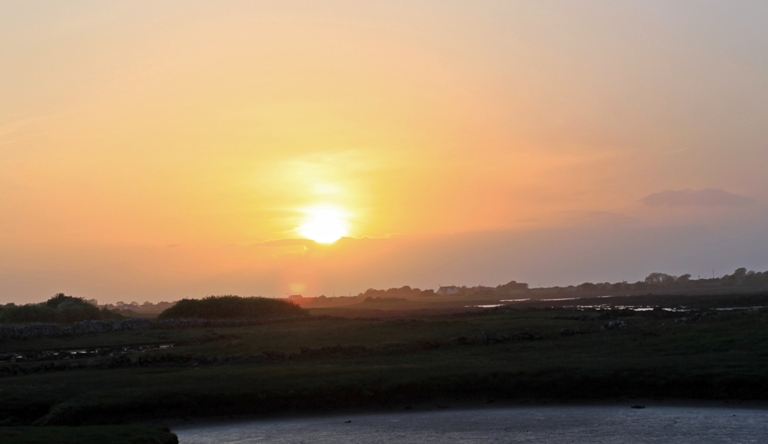
Tawnagh Sunset Photo: Norma Scheibe
Tawnagh Sunset
Photo: Norma Scheibe

A failing fringe of glimmering light was lying gently still,
Along the rise of Errigal, and Aileach’s princely hill
E’en yet the globe of golden fire low on the ocean’s breast,
Had all the waves round Arranmore in ruby vesture drest;
Into the West one lonely cloud went moving slowly by,
Then blushed to find itself alone in all the vaulted sky;
Within the dells the flowers slept, the shadows stretched afar,
And in the dark blue sleeping lake was seen the evening star.
No more the brighter tines of day the falling brook caress,
The thousand dyes that sunset flings upon the waves flew less,
When from the glens among the hills where all day long it slept,
Like ghost of some forgotten age, an errie vapour crept,
It moved adown the whin-clad braes, it lay upon the heath,
It curled around the copeswood lane, and haunted fort beneath.

The fishers down by the olden beach had watched, and then in fright,
They crossed themselves, and whispered low,
“‘Tis the fairies out tonight.”
They gathered round and told strange tales in voices hushed with awe,
Of when that mist came down before what men and women saw
Within the haunted fort and out upon the hawthorn brae,
Or on the bogland lone, if they perchance had gone astray,
Strange eerie rows of little folk unknown to mortal sight,
Around a flame by nought supplied, that beamed a bluish light.

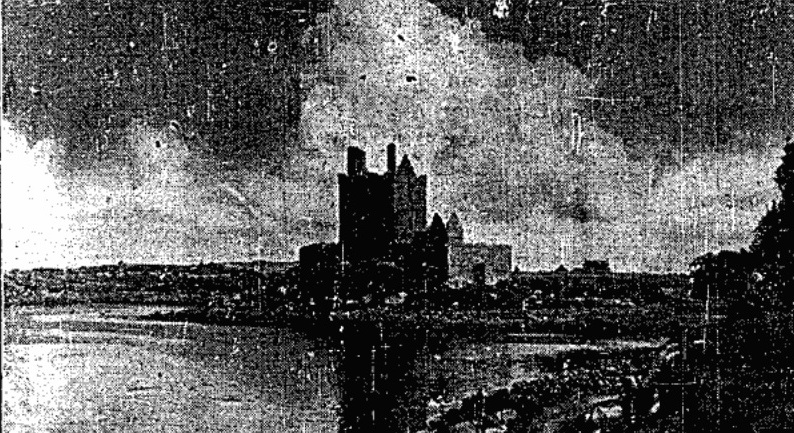
Dunguaire, Kinvara Irish Independent, 1950
Dunguaire, Kinvara
Irish Independent, 1950

But strange to tell among those folk of other worlds than ours
Were some who faded from our earth in youth like summer flowers,
Faded and passed from life away, and sank among the dead;
But when the fishers told their tales Red Michael shook his head.

Red Michael never yet believed in witch or fairy sprite,
Or any shady thing that walks in the watches of the nights;
and he only said when he heard these tales,
“Such things one never sees,
I never yet could have believed in stories such as these.”
Red Michael was a fisherman as bold as fishers be,
He had one child, a rosy boy, as fair as eye could see,
And when the mist came down the hill and crept along the brae,
The child ran from his mother’s side out thro’ the waning day,
And coming from his labour done thro’ the mist acreeping round,
Red Michael found his little boy asleep upon the ground,
And cold and weary were his limbs, his eyes looked strangely grey
He caught a cold and from that hour the baby pined away.

Red Michael’s heart is sad and lone, bereft of hope and love,
His boy has hearkened to the call and left to go above.
“My boy’s in Heaven,” Red Michael cries,
“But, ah, my heart is lone!”
But the country people shake their heads,
“‘Tis the fairies have their own,”
But when he heard them speak he said,
“Such things man never sees,
I never yet could have believed in stories such as these.”

P.MacGill

Posted in Posts and podcasts

Kinvara Twilight – 2014

Kinvara Twilight

Dunguaire Photo: Norma Scheibe
Dunguaire
Photo: Norma Scheibe

At twilight in Kinvara town
The Síog rise to play,
They perch upon the castle wall
And whistle out the bay.

It stirs the air like a blackbird’s sigh
Over the pier and on
Skirts the boats to Smuggler’s Cove
Beside the Canon’s Lawn

Where drowsy swans raise dreamy heads
To the lilt of that impish call
And stir for shore on gilded wings
Past the pier head wall.

The soft sweet hum of fairy breath
Calls cormorant, teal and coot,
And Lapwing, curlew, barnacle goose
Land on Dunguaire’s roof.

And then…

The Síogs gather their golden reins
And rising from their roost
They leap aboard their feathered friends
Into the sky they shoot.

And off across Dungory East 
Round by Loughcurra South
Over the top of Cloonasee
Far from the harbour mouth.

To Carrownamadra next they fly 
Down by the fields of Roo
Past Mountscribe, Townagh, Doorus Park
They part the dusk in two.

On they rush thro’ Rineen and Cloosh
Cregboy and Aughinish Bay
And turn again at Ceathrú an Droim
Behind the old causeway.

Where just beyond there lies a tower,
At Ceathrú an Bruim Fhéar,
A mighty place to catch a view
On a night fair-filled with stars.

’Tis here at last they drop to rest
The Síog and their band,
Twixt stars and moon and shining tides
Of Guaire’s ancient land.

So, if you hear wild sounds tonight
Take no account at all,
’Tis only the Burren birds at play
With the Síog of Guaire’s hall.

© Emer O’Donnell

Posted in Posts and podcasts

The night when fairies hold high carnival – 1896

Photo: 663highland Creative Commons
Photo: 663highland
Creative Commons
https://widgetworld3.wordpress.com/podcasts/
THE SAN FRANCISCO CALL 25TH OCTOBER, 1896
The night when fairies hold high Carnival

In Ireland young women place three nuts on the grate bars of the fire. One that cracks or jumps is a faithless lover, while one that burns or blazes is a true one. They burn the shells of nuts eaten on Hallow Eve and cause snails to crawl through the ashes and so trace the initials of the future husband.

These glowing nuts are emblems true
Of what in human life we view.
The ill-matched couple fret and fume,
And thus in strife themselves consume;
Or from each other wildly start,
And with a noise forever part.

But see the happy, happy pair,
Of genuine love and truth sincere;
With natural fondness while they burn,
Still to each other kindly turn’

And as the vital sparks decay,
Together gently sink away;
Till life’s fierce ordeal being past
Their mingled ashes rest at last.

(Charles Graydon, Dublin 1801)