Posted in Posts and podcasts

Ballyvaughan – 1853

Sangamo Journal/Illinois State Journal 22nd April, 1853
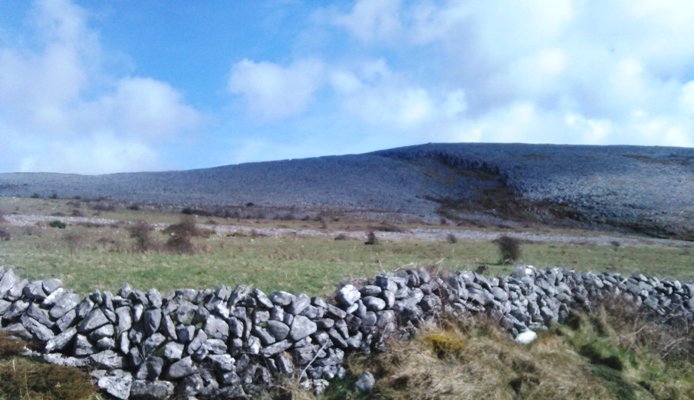
Burren Hills Photo: EO'D
Burren Hills
Photo: EO’D

EMIGRATION FROM IRELAND

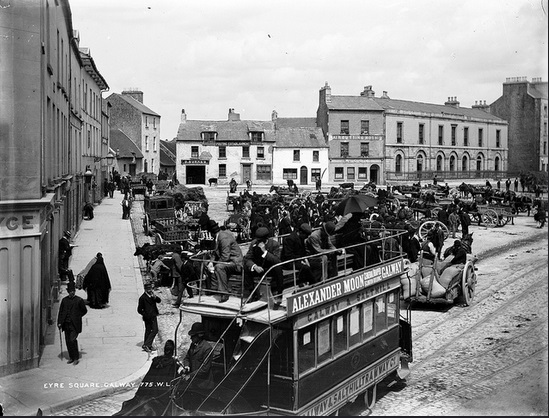
The last American mail brought the sum of £500 pounds to the little village of Ballyvaughan, which is situated in the County Clare on the opposite side of the bay of Galway.   We have heard that this large sum has been sent home for the purposes of emigration, so that the neighborhood of Ballyvaughan is likely to contribute its full contingent to the host of emigrants which are daily rushing towards the English ports.  A few mornings past, the terminus at Eyre square was crowded with the relatives of the emigrants, bidding them farewell on their departure for America. In the language of a person present, when describing the numbers – it was like a fair . The strength and hope of Ireland are so rapidly passing away that sufficient hands will not remain to till the soil .

Galway Paper.
Posted in Posts and podcasts

Eyre Square – 1890

Tuam Herald November 15, 1890 p2.

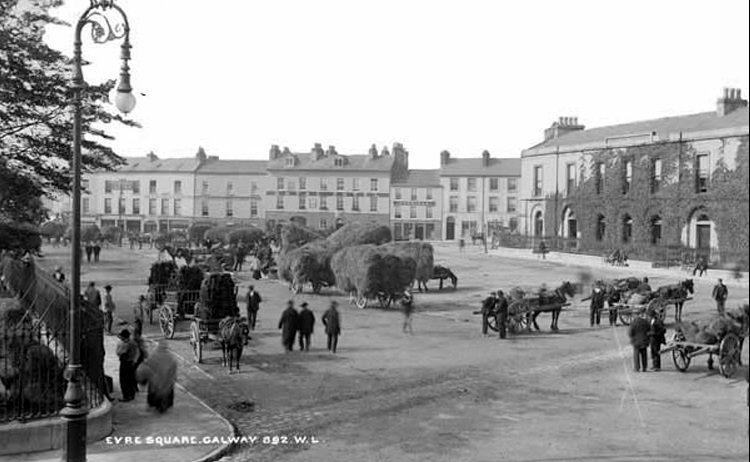
Eyre Square, Galway c.1885 National Library of Ireland
Eyre Square, Galway c.1885
National Library of Ireland

On Saturday night some soldiers of the Connaught Rangers, a detachment of which was under orders to proceed to Malta, on the 14th, attacked the police in Eyre Square with stones. Were it not for the timely arrival of assistance, Sergeant Redington would have been badly injured. Tuesday night the disturbance was renewed, and all the available police were brought out. Sergeant Boylan had his skull fractured from a stroke of a belt by one of the soldiers whose conduct was very violent. The police used their batons, and ultimately the soldiers were got to the barracks.

Posted in Posts and podcasts

Galway Banquet – 1843

The Cork Examiner, June 30th, 1843 (abridged)

Eyre Square, Galway c.1897 National Library of Ireland Wikimedia Commons.
Eyre Square, Galway c.1897
National Library of Ireland
Wikimedia Commons.

The great public banquet to Mr. O’Connell took place this evening at the magnificent and extensive pavilion, erected for the purpose in Eyre Square, and served as a fitting conclusion to the grand and imposing scene of yesterday. The preparations were all on the most extensive scale, and no trouble or cost was spared to render the banquet worthy of the great importance of the occasion. The pavilion was large enough to contain upwards of 1,000 persons, and was fitted up with great taste and effect. Over the two principal entrances the word “Repeal” appeared in gas lights, and behind the head table several beautiful devices were also formed in the same brilliant material. The tickets collected by the stewards at the dinner amounted to 560 in number, and when the occupants of the principal table and the stewards were enumerated, the entire of the gentlemen present somewhat exceeded 600 in number.

Posted in Posts and podcasts

The ‘lament’ of Padraic O’Conaire – 1943

eyre sq
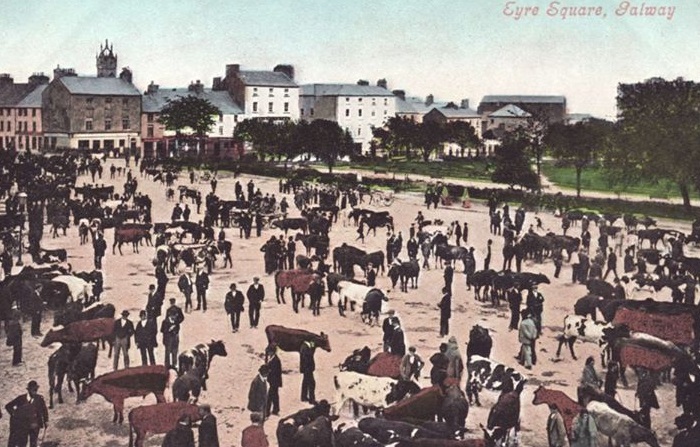
Cattle Fair, Eyre, Square, Galway

Connacht Sentinel 13th April, 1943 p.2
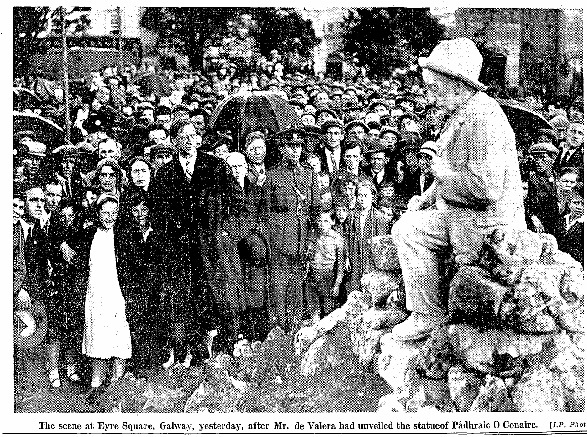
In 1935 Eamon de Valera veiled a statue of Padraic O’Conaire in Eyre Square, Galway. The Square was used for a variety of purposes including a turf dump during the Emergency. The storage of turf at Eyre Square ended in the late 1940s. Mr Kevin McDonagh marked its departure, from Padraic’s perspective, with the following poem.

O dreadful change! O piercing sight!
O prospect ugly, bleak and bare!
I’ve half a mind to stand upright
And part forever from the Square.

The crafty folk who jeer and scoff
At things that poets find most sweet.
Have tumbled down and carried off
Those noble piles of rich brown peat.

I’d fondly hope they had been stacked
To lend a rustic atmosphere
To my surroundings and distract
My brooding mind from every care.

‘Tis many a time they raised in me
A thrill as when (with eyes agog)
I’d notice floating lazily.
The Mist That Does Be On the Bog!

I’d e’en had hopes – a foolish batch
That soon a cottage might arise
Amid the peat with golden thatch
And blue smoke curling to the skies.

Exit now, my dreams are shattered quite,
And, like the peat, dissolved in air,
I’ve half a mind to stand upright,
And part forever from the Square.

Kevin McDonagh

Posted in Posts and podcasts

A Scene Unique – Eyre Square – 1922

Skibbereen Eagle 3rd June, 1922 p.2 (abridged)

Photo: Mr deValera unveiling statue of Padraic O'Conaire Photo: Irish Press 10th June, 1935
Photo: Mr deValera
unveiling statue of Padraic O’Conaire in Eyre Square, 1935
Photo: Irish Press
10th June, 1935

A scene, unique in the history of Galway, was witnessed at Eyre Square on Thursday night, 25th inst, when Messrs Stephen J. Cremin, Secretary of the local Transport Workers, and W. J. Larkin, Dublin, headed some hundreds of town tenants, with a fife and drum band, who tore the bronze statue of Lord Dunkellin from its pedestal, and marched in triumph with it to Nimmos Pier, a mile distant. Here, amidst the shouts of the crowd, it was thrown into the sea. On Friday, apparently to prevent its recovery, it was taken up on the beach, and the arms and legs sawn off.

Lord Dunkellin, who was one of the Clanricarde family, and a Lieutenant Colonel in the British Army, was born in 1827 and died in 1873. He was M.P. for Galway City and County and the bronze statue, one of John Henry Foley’s works, was erected in 1873 by public subscription.
Flowers and the railings in the square were injured during the removal of the statue.

At subsequent meetings the Labour leaders declared that they would root out the slums of Galway and rename the Square after the late Father Griffin.