Posted in Posts and podcasts

Great Meeting in Gort – 1869

Tuam Herald 13th November, 1869 p.1
The Land Question (abridged)


Gort, Sunday Night
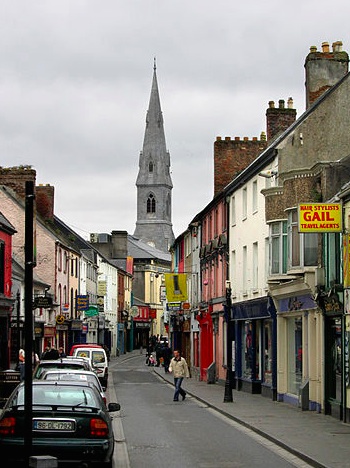
This patriotic little town may well take credit to itself for the support which it has this day given to the cause of tenant right in this country. It afforded not only to the people on this side of the extensive county of Galway, but to thousands in the northern districts of the county Clare, an opportunity of expressing their opinions on the present unsatisfactory state of the land laws in Ireland, and of pointing out the mode in which the tenant farmers of the country desire that they should be altered. Some influential gentlemen residing in the town and neighbourhood were anxious that the people should, in the form of resolutions, express their grievances with a view to their redress by a Ministry and by a Parliament which have already manifested an anxious wish to remove those evils which have been a source of misery and discontent to the country.

The notice by which the meeting was called was given only a few days back, and yet the meeting of today was a great success, keeping in view the fact that it was not a county meeting, but was composed mostly of people within a circuit of ten miles of the town. The Athenry and Ennis Junction Railway, however, ran special trains, and brought large numbers of people from longer distances. The train which left Ennis at eleven o’clock arrived in Gort at twelve o’clock bringing people from Ennis, Crusheen and Tubber, and the train from Athenry, which arrived shortly after, carried large number of tenant farmers from that station, from Oranmore, Crughwell (sic.) and Ardrahan. The traffic arrangements were under the direction of Mr. Thomas O’Malley, the manager, and were admirably carried out by Mr William Lawlor, the efficient station master of Gort.

Many of the farmers came in on horseback heading bodies of 400 or 500 people. Ardrahan furnished a contingent of about 400, and the united parishes of Ballymena and Crughwell sent by rail about 300 persons, who were accompanied by the Rev. Francis Arthur, P.P. and the Rev. M O’Flanagan, C.C. This body on entering the unfurled their banner, which had inscribed on it the mottoes, “Fixity of Tenure” and “Tenant Right,” and the Rev. M. Nagle, P.P., Kilbeaconty, accompanied a body of his parishioners, numbering, perhaps, five hundred. The Rev. John Barry, P.P., Behagh, and the Rev. Michael Killeen, C.C., accompanied about 800 from their parish, with banners bearing the words, “Fixity of Tenure” and “Tenant Right.” Numbers also came from Corofin, Ballyvaughan, Kilkeely, New Quay, Feakle, Derrybrian, Loughrea, and Kinvara.


A very large body of tenantry came on horseback from Kinvara, accompanied by their landlord, Isaac B. Daly, and Mrs Daly, who drove in their carriage, and who were loudly cheered. By one o’clock there could not have been less than from 10,000 to 12,000 people in the town, all evidently interested in the cause which brought them together. Previous to the commencement of the proceedings a procession was formed, headed by a number of young girls, some of whom were entirely dressed in green, and these were followed by well-dressed young men carrying green banners, having inscribed on them the words, “God save Ireland,” “fixity of tenure,” “tenant right,” and “Cead mille failthe,” (sic.) and the harp in gold was on several of them. There was scarcely a person in the whole procession, which walked round the market-square, accompanied by music, who was not in some way ornamented with green.

They cheered on passing the houses which by some patriotic device attracted attention. An excellent cast of the face of O’Connell was placed in one of the windows of Forrest’s Hotel, and beneath was a saying of the Liberator’s, “He who commits a crime gives strength to the enemy.” At Glynn’s Hotel, there was a sign on a green ground, and the words “Prosperity to Ireland.” These received respectful attention on the part of the people who, as the hour approached for the commencement of the meeting, assembled in front and around the platform which was erected in the middle of the square, and was so spacious as to accommodate about one hundred and fifty persons. On the motion of Mr. L. S. Mangan, Gort, seconded by Mr. Thomas Boland, the chair was taken amidst loud applause by the Very Rev. T. Shannon, P.P., V.G.

Posted in Posts and podcasts

County Clare Feis – 1905

New Zealand Tablet 24th August, 1905 p9

Road to Doolin Photo: Christine Matthews Wikimedia Commons
Road to Doolin
Photo: Christine Matthews
Wikimedia Commons

In declaring the County Clare Feis open at Ennis recently, his Lordship Most Rev Dr. Fogarty, Bishop of Killaloe, having referred at length to the language and industrial movement, said money was not everything. We should try not only to bring money to the Irish home, and neatness and comfort and industry, but the brightness also and the enlightenment that come from the revival of our Irish customs and music and language.

He drove the previous night, coming to the feis, through sixteen miles of the most charming country, studded with those numerous white painted cottages which were such a feature of the County Clare.

It was evening, and the hour for the day’s labor being over the people would naturally turn to relaxation and enjoyment, but that lovely country was as silent as the grave— not a note of music or a volce was heard— and he felt for our people and said, “God bless every man or woman, young or old, Catholic or Protestant, who is doing his best, however little, to bring back to this lovely country and to its dear people the sound of music and contentment and prosperity.”

Posted in Posts and podcasts

Ennis – 1887

Elyria Democrat, Ohio

Ennis.  Wikimedia Commons
Ennis.
Wikimedia Commons

1st December, 1887

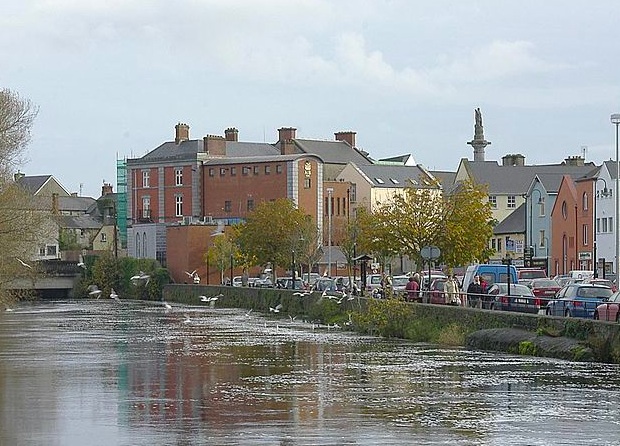
Dennis McNamara, a shopkeeper at Ennis, Ireland, has been sentenced to twenty weeks’ imprisonment for selling copies of United Ireland, William O’Brien’s paper, the selling of which has been proclaimed. This is the first instance in which a person has been prosecuted for selling papers.

Posted in Posts and podcasts

Irish homes and Irish hearts p4 – 1868

Freemans Journal 28th March, 1868 p11 (abridged)

The Burren Photo: EO'D
The Burren
Photo: EO’D

It is a long dreary drive of nineteen miles to Ennis, through an open limestone country, with low craggy hills. In all this part of Ireland the eye wearies for the pretty villages and comfortable farm-houses which give life and variety to the flat counties of England. The station at Ennis is a wretched one, the platform being of earth, and it was not improved by recent rain and trampling of a crowd of emigrants. Although this is the terminus of the Ennis and Limerick line, the train was in no hurry to start. Everybody took their time, and just half an hour after the one named in the time bills the train set out.

It progressed very slowly on its way, and I was not sorry, for it gave us the opportunity of an excellent view of Clare Abbey — close by which the line passes — one of the loveliest ruins I had ever seen, a graceful church in the form of a cross, with east window almost perfect, and a lofty tower, and the ivy twining round about the broken arches, and covering the walls with a rich green mantle.

On reaching Limerick, I implored a porter to get my luggage quickly, as I wanted to catch the next train for Charleville. “But sure she’s been gone this ten minutes. She was an hour after her time. Your train was so late she could wait no longer.” As I expressed my vexation he said in a tone of deep sympathy, “There’ll be a train tomorrow.” On making further inquiries at the station it turned out that the trains do not profess to fit in with each other. As one of the officials expressed it, “The great lines try to eat up the little ones.”

Posted in Posts and podcasts

Ennis – 1826

The Monitor (Sydney) 17th November, 1826

Ennis Wikimedia Commons
Ennis
Wikimedia Commons

CLARE, ENNIS, MARCH 6
On Friday last, a great number of the trades-people went some distance out of town, with a band and colours, in expectation of meeting Counsellor O’Connell, and intending to draw his carriage into town.
Several of them were tastefully dressed, and carried poles with large loaves of bread on them. They marched in procession through the town, and the orderly manner in which they conducted themselves was very commendable.
After waiting a considerable length of time on the way, they returned about seven o’clock in the evening, when they played a few enlivening airs and retired peaceably to.their homes.

Posted in Posts and podcasts

A curious construction – 1823

Library of Congress collection Wikimedia Commons
Library of Congress collection
Wikimedia Commons
Connaught Journal
Galway March 13, 1823

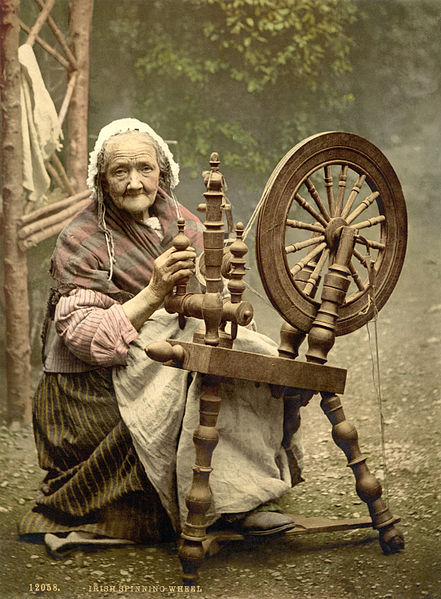
A spinning wheel of curious construction and very neat workmanship was
exhibited on Monday last to the Ladies’ Association in the Court-house of
Ennis. It is made to have eight persons work at it, and, we understand, fully
answers the purpose. The maker is James RO*A*E, who resides in the town of
Gort.