Posted in Posts and podcasts

Three Galway Playwrights

Three Galway Playwrights.
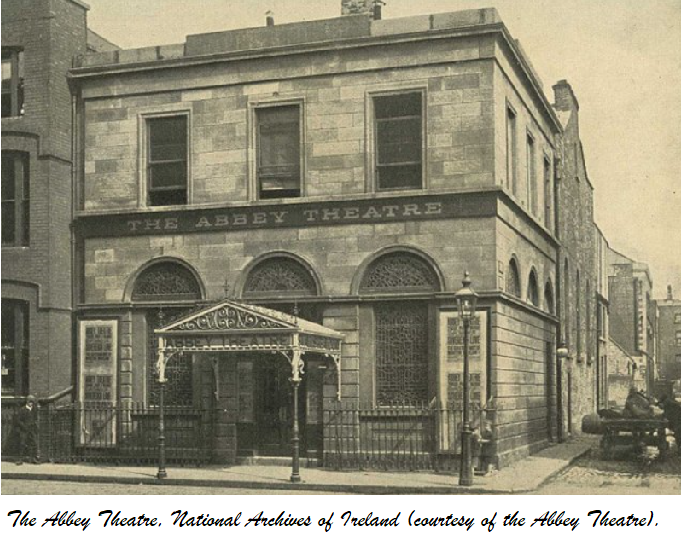
Irish Travel, Official organ of the Irish Tourist Association Vol. XII. No. 4 January, 1937 p. 85
Galway has given three great figures to the Irish literary revival – Lady Gregory, Seamus O’Kelly and Edward Martyn.

Seamus O’Kelly was born in Loughrea in 1881 and educated at St. Brendan’s College there. Later he was a journalist in Skibbereen and Naas, afterwards coming to Dublin, where he wrote some successful plays which were
produced by the Abbey Theatre Company, then in its infancy. O’Kelly is better known by his stories than by his plays. His two best-known novels are
“Waysiders” and” The Lady of Deer Park.” He was connected with the Sinn Fein movement and for some time edited its official organ, “Nationalist.”
He died in Dublin on the 11th November, 1918, the day the Great War ended.

Edward Martyn was also closely connected with the Abbey Theatre, being one of its founders. Born at Masonbrooke, Galway, in 1859, he was educated in Dublin and Oxford. He wrote much, his best known works being “Maeve,” “The Heatherfield,” etc. He was keenly interested in church music and the revival of the Irish language, and was associated with Arthur Griffith in the early days of Sinn Fein. He was President of that organisation from 1904 to 1908. When Sinn Fein became Republican after 1916 Martyn seems to have faded out of the picture. He died in 1923 and left his body for dissection.

Lady Gregory, another founder of the Abbey theatre, was born at Roxborough, Co. Galway. Her best known works are “Gods and Fighting Men,” “A Book of Saints and Wonders,” “Our Irish Theatre,” “Hugh Lane’s Life and Achievement,” “Some Short Plays,” “New Comedies” and “Some Irish Folk-History Plays.”

Other Galway writers of note are John McNevin, author of the “Irish Volunteers”; Dr. James McNevin, the United Irishman, author of “Pieces of Irish History”;, M.D. Bodkin, the novelist; Miss Violet Martin, novelist; Fances Carey, best of the English translators or Dante; and John William Curran, the noted political writer.
Posted in Posts and podcasts

Dongorey – 1914

TUAM HERALD 16th MAY, 1914

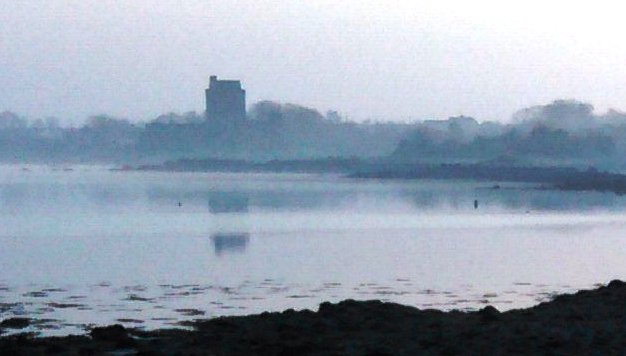
Dunguaire
Photo: Norma Scheibe

The Right Hon. Archer Martyn, Justice of the Count of Appeal of British Columbia, writes as follows on his kinsmen of Tullyra Castle and Dongorey;
In the Record Office, among the grants pursuant to Privy Seal, there is one dated at Westminster, February 21, 1615, to Oliver Martyn, of Kinvarra, gentleman, of the Castle of Kinvarra, and the parcels of Kinvarra, Ballybranegan and Knocknechollin, containing 1 quarter, etc, in the Barony of Kiltaraght (Kiltartan) in the county of Galway, to hold of the Earl of Clanricard, by the like tenure as by inquisition taken at Loghreogh (Loughrea), 16th September, 1607.
And on the same day there was also granted to the said Oliver the privilege of holding a Saturday Market at Kinvarra. This shows (says my well-informed informant) that Richard’s possession of Kinvara Castle, that is Dunguaire, was confirmed as early as 1615 and doubtless he must have purchased it from its O’Heyne proprietor at an early date, because there was then no question of forfeiture, nor any marriage between the families, that I have ever heard suggested. Foster’s Irish Chieftains, pp 188, 432, gives some particulars of Doonguara, and says that Richard Martyn (several times mayor of Galway) got Dunguara Castle, near Kinvarra, from the chief of the sept of O’Hynes and that his first residence in the county was that place, and that he later was granted Tullyra (Tulira) by King Charles. He was succeeded by his son Oliver, the Jacobite M.P.
In the indenture of Connaught, given in full in O’Flaherty’s “West Connaught,” p.323 the exact reference to Oene Montagh O’Heine, of Downgorye, otherwise O’Heine – that is Eoghan Mantach (tootless). Three years after the said composition, Dunguaire was in the possession of Hughe Boye O’Heine, son and heir of said Owen, on 23rd July, 1588, XXX of Elizabeth, as is shown by the grant on p.405 of “Hy Fiachrach.”
Then we learn from the Civil Survey of 1641 (“Hy Fiachrach” p.405) that in that year there was no Heyne living in Dunguaire, though a long list of Kiltartan O’Heynes is given, with their residences, which shows that Dunguaire had already passed from them.
The exact reference in the 1617 grant is as follows:
“Grant to Oliver Martyn of Kinvarra, gent. In Killaraght (Kiltartan) barony the castle of Kinvarra, and the parcels of Kinvarra, Ballybranegan, and Knockechollen, containing 1 quarter eleven-twelfths of Crossoby Clowassy;
1 quarter, Lecarrowoughteraghmong, Scribagh, and Downan;
half quarter Killinkyeny;
1 quarter, half of Cahirseraley quarter;
one-fourth of the half of quarter of Sessinnegarby, Townincallagh half card.
Fannaby half card;
Mabery Kighobirr half card to hold Saturday market at Kinvarra, and a court of free powder, and the usual tools; rent 10s Irish;
To hold according to an inquisition taken at Loughreagh, 16th September, 1617.
In Joyce’s “Names of Places,” vol.ii, pp 194-6, the following note on Guaire Aidhe, and a p.195 says;
“Half a mile east of Kinvarra, on the seashore, stands an ancient circular fort, one of those so common in most parts of Ireland, and this is all that remains of the hospitable palace of Durlas. Moreover it has lost the old name and is now known by the equivalent name of Dun Guaire, or, as it is anglicised, Dongorey, Guara’s fortress. A modern castle, built by the O’Heynes – modern as compared with the earthen circumvallation – stands in the middle of the ford and occupies the very site of the house of Guara the Hospitable.
Dalton, in his “Statistical Survey of Galway” (1824?7) says(p.466) the castle of Kinvarra is in good preservation.
Joyce, in “Irish names of Places”. p.522, speaking of the origin of Kinvarra, says;
“The highest point reached by the tide in a river was sometimes designated by the term Ceann-mara i.e. the head of the sea; from a spot of this kind on the River Roughty, the town of Kenmare, in Kerry, received its name; and Kinvarra, in Galway, originated in the same way, for the Four Masters call it Ceannmhara.

Posted in Posts and podcasts

The Kinvarra Prosecution – 1901

Tuam Herald, 28th September, 1901 p.2

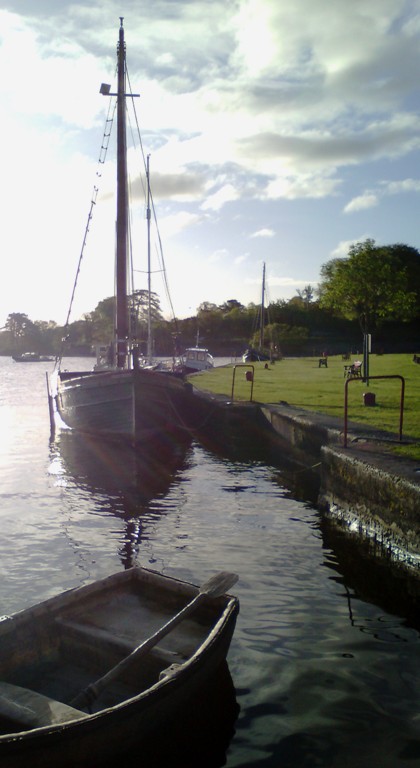
Kinvara Quay Photo: EO'D
Kinvara Quay
Photo: EO’D

We understand that as a result of the police prosecution of Bartley Hynes for putting his name in Irish on his cart Mr Edward Martyn has ordered his name to be put in Irish on all his carts and so has Lady Gregory. It is said that the cards in question will be sent at an early date to Kinvarra. We shall see if the English-speaking police of that quarter take any steps to prosecute Lady Gregory and Mr Edward Martyn for what they summoned Bartley Hynes. The end of the matter is that Irish police must learn Irish and if they do they will understand that Irish characters are “legible.”