Posted in Posts and podcasts

Stormy weather – Galway – the bay of Kinvarra – 1771

Finns Leinster Journal 13th February, 1771 p.1
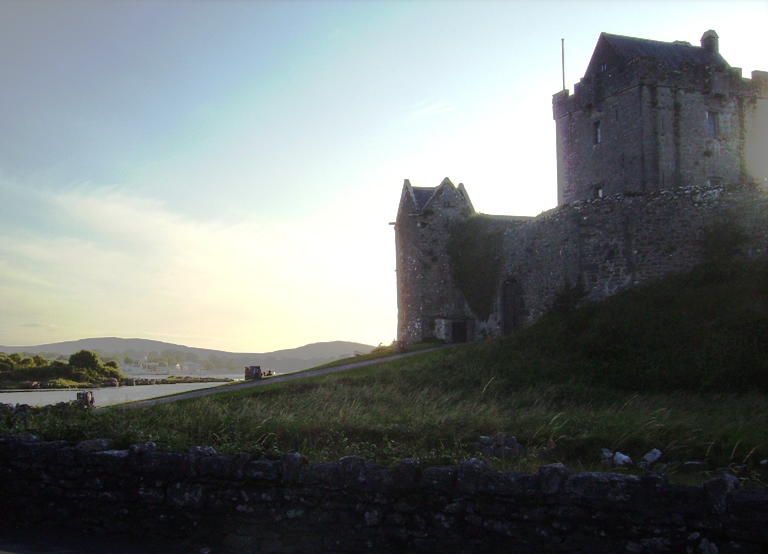
A fine evening Dunguaire, Kinvara Photo: EO'D
A fine evening
Dunguaire, Kinvara
Photo: EO’D

Galway, Feb 4.
Last Wednesday and Thursday were so prodigious a storm that the spring tides on those days swelled so high as to overflow the Quay and parts adjacent. In several houses in the neighbourhood, the water was above three feet high; but on Thursday a circumstance happened which much surprised all that observed it, as the like was never perceived here before. Whilst it was flowing, the tide, as if by some violent emotion, was twice within the space of an hour, suddenly raised above its usual height, and as suddenly subsided, which made many think there had been an earthquake.

A sloop, said to be from Limerick, bound for Rotterdam with butter, has been for some days past in the Bay of Kinvarra, opposite this coast, her name or the master’s name not intimated; but it is said she has lost her rudder and is otherwise damaged by the tempestuous weather.
Posted in Posts and podcasts

1st of November 1775 – the earth moved in Kinvara – and Aughinish – and Corranrue…

https://widgetworld3.wordpress.com/podcasts/

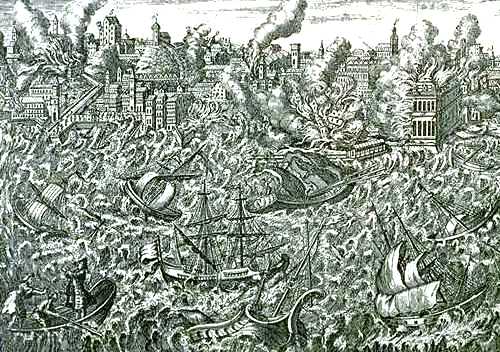
Lisbon, Portugal, during the great earthquake of 1 November 1755. This copper engraving, made that year, shows the city in ruins and in flames. Tsunamis rush upon the shore, destroying the wharfs. The engraving is also noteworthy in showing highly disturbed water in the harbor, which sank many ships. Passengers in the left foreground show signs of panic. Original in: Museu da Cidade, Lisbon. Reproduced in:  The Lisbon Earthquake.  British Historical Society of Portugal, 1990
Lisbon, Portugal, during the great earthquake of 1 November 1755. This copper engraving, made that year, shows the city in ruins and in flames. Tsunamis rush upon the shore, destroying the wharfs. The engraving is also noteworthy in showing highly disturbed water in the harbor, which sank many ships. Passengers in the left foreground show signs of panic. Original in: Museu da Cidade, Lisbon. Reproduced in: The Lisbon Earthquake. British Historical Society of Portugal, 1990 Wikipedia.org
It is reported, I know not on what authority, that, on the 1st of November, 1755, the day of the great earthquake at Lisbon, a castle, on the western boundary of the parish of Kinvarra, which had formerly belonged to the O’Heynes,’ was destroyed, and a portion of it swallowed up.
(Thomas L. Cooke’s rambles 1842/43)

The 1755 tsunami is also thought to have separated the small island of Aughinish, on the southern shores of Galway Bay from Co. Clare. The castle of Corranrue (Norman) was also damaged.