Posted in Posts and podcasts

Local Spirit(s) – Kinvara, Duras, Ballinderreen – 1920

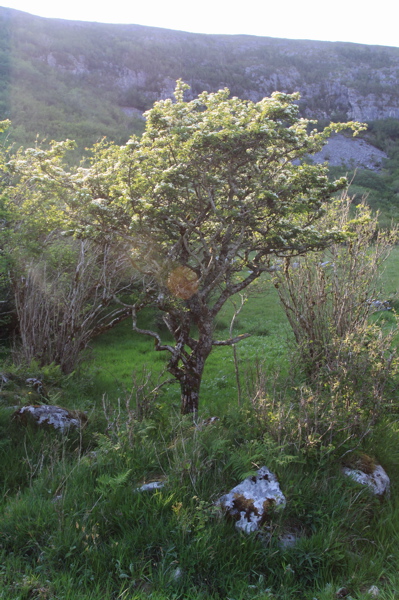
The Burren Photo; Norma Scheibe
The Burren
Photo; Norma Scheibe
Visions and beliefs in the west of Ireland, collected and arranged by Lady Gregory: with two essays and notes by W. B. Yeats.
Second series, G.P. Putnam’s Sons, New York and London
The Knickerbocker Press 1920
https://widgetworld3.wordpress.com/podcasts/
A FAIRY FORT

A woman I know had business one time in Ballyvaughan, and when she was on the road beyond Kinvara a man came to her out of a fort and he asked her to go in and to please a child that was crying. So she went in and she pleased the child, and she saw in a corner an old man that never stopped from crying. And when she went out again she asked the man that brought her in, why was the old man roaring and crying. The man pointed to a milch cow in the meadow and he said, “Before the day is over he will be in the place of that cow, and it will be brought into the forth to give milk to the child.” And she can tell herself that was true, for in the evening when she was coming back from Ballyvaughan, she saw in that field a cow dead, and being cut in pieces, and all the poor people bringing away bits of it, that was the old man that had been put in its place. There is poison in that meat, but no poison ever comes off the fire, but you must mind to throw away the top of the pot.

A GATHERING OF SPIRITS
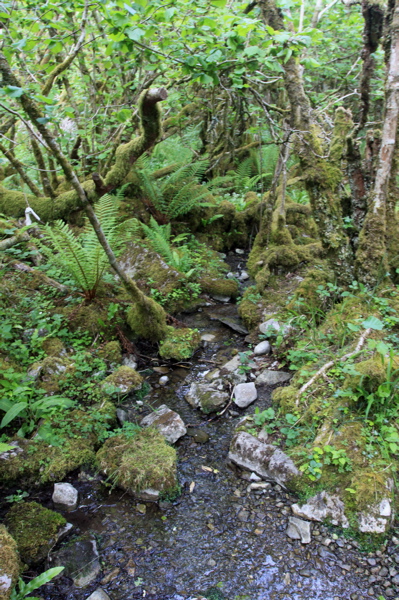
Stream near St. Colman's The Burren Photo: Norma Scheibe
Stream near St. Colman’s
The Burren
Photo: Norma Scheibe

There’s a bad bit of road near Kinvara Chapel, just when you get within sight of the sea. I know a man has to pass there, and he wouldn’t go on the driver’s side of the car, for it’s to the right side those things are to be seen. Sure there was a boy lost his life falling off a car there last Friday week. And I knew him, a quiet boy, and married to a widow woman; she wanted the help of a man, and he was young. What would ail him to fall off the side of an ass-car and to be killed?

It’s by the big tree outside Raheen (where you take the turn to Kinvara) that the most things are seen. There was a boy living in Gort that was out before daylight with a load of hay in a cart, and he sitting on top of it. He was found lying dead just beside the tree, where he fell from the top of the cart, and the horse was standing there stock-still. There was a shower of rain fell while he was lying there, and I passed the road two hours later, and saw where the dust was dry where his body had been lying.

And it was only yesterday I heard a story of that very same place. There was a man coming from Galway with a ton weight of a load on his cart, and when he came to that tree the linching of his wheel came out, and the cart fell down. And presently a little man, about two and a half feet in height, came out from the wall. He lifted up the cart, and held it up till he had the linching put up again. And he never said a word but went away as he came, and the man came in to Gort.
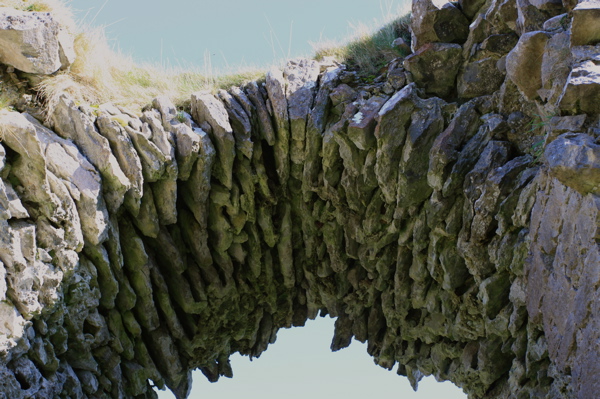
The Old Castle, Kinvara Photo: Norma Scheibe
The Old Castle, Kinvara
Photo: Norma Scheibe
THE SHEE
I heard a churning one time in the hill up by the road beyond. I was coming back from Kinvara, and I heard it plain, no mistake about it. I was sorry after I didn’t call down and ask for a drink. Johnny M— did so, and got it. If you wish for a drink and they put it out for you, it’s no harm to take it, but if you refuse it, some harm might happen to you. Johnny H——— often told that he heard churning in that spot, but I wouldn’t believe the sun rising from him, he had so many lies. But after that, I said, “Well, Johnny H——– has told the truth for once.”

THE MONSTER
There is a monster of some sort down by Duras, it’s called the ghost of Fiddeen. Some say it’s only heard every seven years. Some say it was a flannel seller used to live there that had a short fardel. We heard it here one night, like a calf roaring.

THE BANSHEE
There is a boy I knew near Ballinderreen, told me that he was going along the road one night and he saw a dog. It had claws like a cur, and a body like a person, and he couldn’t see what its head was like. But it was moaning like a soul in pain, and presently it vanished, and there came most beautiful music, and a woman came out and he thought at first it was the Banshee, and she wearing a red petticoat. And a striped jacket she had on, and a white band about her waist. And to hear more beautiful singing and music he never did, but to know or to understand what she was expressing, he couldn’t do it. And at last they came to a place by the roadside where there were some bushes. And she went in there and disappeared under them, and the most beautiful lights came shining where she went in. And when he got home, he himself fainted, and his mother put her beads over him, and blessed him and said prayers. So he got quiet at last.
Posted in Posts and podcasts

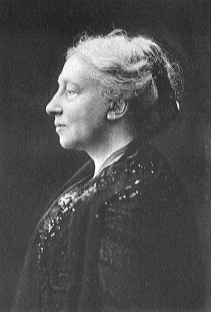
Our Irish Theatre – Augusta Lady Gregory

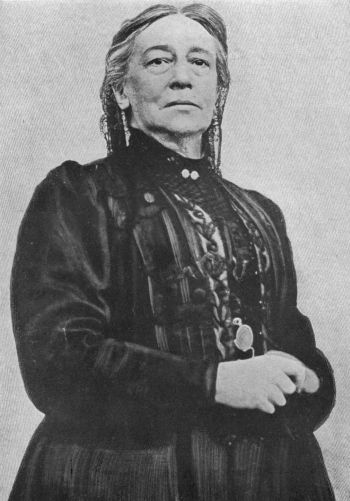
Augusta Lady Gregory Project Gutenberg Wikipedia.org
Augusta Lady Gregory
Project Gutenberg
Wikipedia.org
Our Irish Theatre: A chapter in Autobiography by Lady Gregory. New York: The Knickerbocker Press. G. Putnam’s Sons, New York, London. 1913. pp. 4-7

Later in the year I was staying for a few days with old Count de Basterot, at Duras, that is beyond Kinvara and beside the sea. He had been my husband’s warm friend, and always in the summer time we used to go and spend at least one long day with him,–we two at first, and then later I went with my son and the boy and girl friends of his childhood. They liked to go out in a hooker and see the seals showing their heads, or to paddle delicately among the jellyfish on the beach. It was a pleasant place to pass an idle day. The garden was full of flowers. Lavender and carnations grew best, and there were roses also and apple trees, and many plums ripened on the walls. This seemed strange, because outside the sheltered garden there were only stone-strewn fields and rocks and bare rock-built hills in sight, and the bay of Galway, over which fierce storms blow from the Atlantic. The Count remembered [Page 4]  when on Garlic Sunday men used to ride races, naked, on unsaddled horses out into the sea; but that wild custom had long been done away with by decree of the priests. Later still, when Harrow and Oxford took my son away and I had long spaces of time alone, I would sometimes go to Duras to spend a few days.Lady_gregory plY
I always liked to talk and to listen to the Count. He could tell me about French books and French and Italian history and politics, for he lived but for the summer months in Ireland and for the rest of the year in Paris or in Rome. Mr. Arthur Symons has written of him and his talks of race,–to which he attributed all good or bad habits and politics–as they took long drives on the Campagna. M. Paul Bourget came more than once to stay in this Burren district, upon which he bestowed a witty name, “Le Royaume de Pierre.” It was to M. Bourget that on his way to the modest little house and small estate, the Count’s old steward and servant introduced the Atlantic, when on the road from the railway station at Gort its waters first come in sight: Voila la mer qui baigne l’Amérique et les terres de Monsieur le Comte. For he–the steward–had been taken by his master [Page 5]  on visits to kinsmen in France and Italy–their names are recorded in that sad, pompous, black-bordered document I received one day signed by those who have l’honneur de vous faire part de la perte douloureuse qu’ils viennent d’éprouver en la personne de Florimond Alfred Jacques, Comte de Basterot, Chevalier de l’ordre du Saint Sépulcre, leur cousin germain et cousin [who died at Duras (Irlande) September 15, 1904]; la Marquise de la Tour Maubourg, le Vicomte et la Vicomtesse de Bussy, la Baronne d’Acker de Montgaston, le Marquis et la Marquise de Courcival, le Comte et la Comtesse Gromis de Trana, la Countesse Irène d’Entreves, and so on, and so on. I do not know whether the bearers of these high-sounding names keep him in their memory–it may well be that they do, for he was a friend not easily forgotten–but I know there is many a prayer still said on the roads between Kinvara and Burren and Curranroe and Ballinderreen for him who “never was without a bag of money to give in charity, and always had a heart for the poor.”

Augusta Lady Gregory

On one of those days at Duras in 1898, Mr. Edward Martyn, my neighbour, came to see the Count, bringing with him Mr. Yeats, whom I did [Page 6]  not then know very well, though I cared for his work very much and had already, through his directions, been gathering folk-lore. They had lunch with us, but it was a wet day, and we could not go out. After a while I thought the Count wanted to talk to Mr. Martyn alone; so I took Mr. Yeats to the office where the steward used to come to talk,–less about business I think than of the Land War or the state of the country, or the last year’s deaths and marriages from Kinvara to the headland of Aughanish. We sat there through that wet afternoon, and though I had never been at all interested in theatres, our talk turned on plays. Mr. Martyn had written two, The Heather Field and Maeve. They had been offered to London managers, and now he thought of trying to have them produced in Germany where there seemed to be more room for new drama than in England. I said it was a pity we had no Irish theatre where such plays could be given. Mr. Yeats said that had always been a dream of his, but he had of late thought it an impossible one, for it could not at first pay its way, and there was no money to be found for such a thing in Ireland.
We went on talking about it, and things seemed [Page 7]  to grow possible as we talked, and before the end of the afternoon we had made our plan. We said we would collect money, or rather ask to have a certain sum of money guaranteed. We would then take a Dublin theatre and give a performance of Mr. Martyn’s Heather Field and one of Mr. Yeats’s own plays, The Countess Cathleen. I offered the first guarantee of £25.