Posted in Posts and podcasts

Dongorey – 1914

TUAM HERALD 16th MAY, 1914
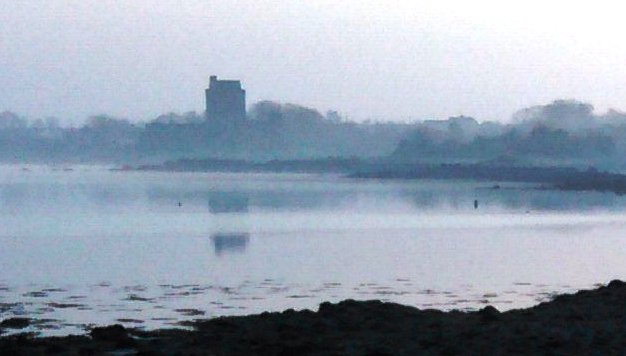
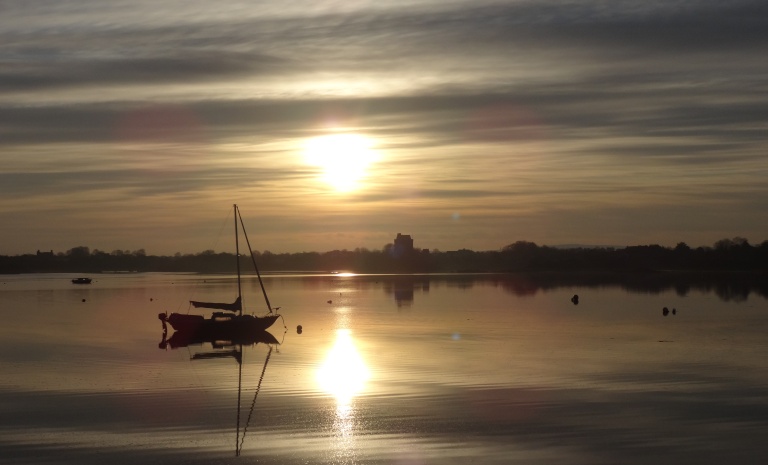
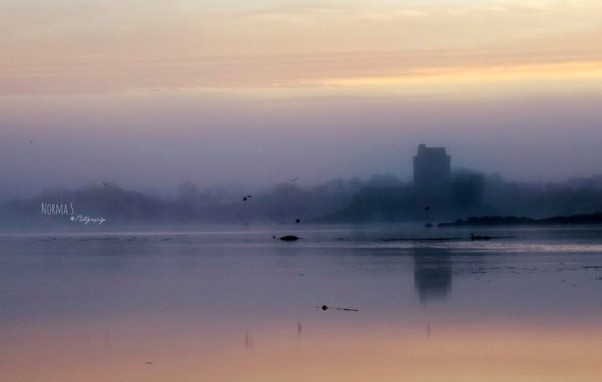
Dunguaire
Photo: Norma Scheibe

The Right Hon. Archer Martyn, Justice of the Count of Appeal of British Columbia, writes as follows on his kinsmen of Tullyra Castle and Dongorey;
In the Record Office, among the grants pursuant to Privy Seal, there is one dated at Westminster, February 21, 1615, to Oliver Martyn, of Kinvarra, gentleman, of the Castle of Kinvarra, and the parcels of Kinvarra, Ballybranegan and Knocknechollin, containing 1 quarter, etc, in the Barony of Kiltaraght (Kiltartan) in the county of Galway, to hold of the Earl of Clanricard, by the like tenure as by inquisition taken at Loghreogh (Loughrea), 16th September, 1607.
And on the same day there was also granted to the said Oliver the privilege of holding a Saturday Market at Kinvarra. This shows (says my well-informed informant) that Richard’s possession of Kinvara Castle, that is Dunguaire, was confirmed as early as 1615 and doubtless he must have purchased it from its O’Heyne proprietor at an early date, because there was then no question of forfeiture, nor any marriage between the families, that I have ever heard suggested. Foster’s Irish Chieftains, pp 188, 432, gives some particulars of Doonguara, and says that Richard Martyn (several times mayor of Galway) got Dunguara Castle, near Kinvarra, from the chief of the sept of O’Hynes and that his first residence in the county was that place, and that he later was granted Tullyra (Tulira) by King Charles. He was succeeded by his son Oliver, the Jacobite M.P.
In the indenture of Connaught, given in full in O’Flaherty’s “West Connaught,” p.323 the exact reference to Oene Montagh O’Heine, of Downgorye, otherwise O’Heine – that is Eoghan Mantach (tootless). Three years after the said composition, Dunguaire was in the possession of Hughe Boye O’Heine, son and heir of said Owen, on 23rd July, 1588, XXX of Elizabeth, as is shown by the grant on p.405 of “Hy Fiachrach.”
Then we learn from the Civil Survey of 1641 (“Hy Fiachrach” p.405) that in that year there was no Heyne living in Dunguaire, though a long list of Kiltartan O’Heynes is given, with their residences, which shows that Dunguaire had already passed from them.
The exact reference in the 1617 grant is as follows:
“Grant to Oliver Martyn of Kinvarra, gent. In Killaraght (Kiltartan) barony the castle of Kinvarra, and the parcels of Kinvarra, Ballybranegan, and Knockechollen, containing 1 quarter eleven-twelfths of Crossoby Clowassy;
1 quarter, Lecarrowoughteraghmong, Scribagh, and Downan;
half quarter Killinkyeny;
1 quarter, half of Cahirseraley quarter;
one-fourth of the half of quarter of Sessinnegarby, Townincallagh half card.
Fannaby half card;
Mabery Kighobirr half card to hold Saturday market at Kinvarra, and a court of free powder, and the usual tools; rent 10s Irish;
To hold according to an inquisition taken at Loughreagh, 16th September, 1617.
In Joyce’s “Names of Places,” vol.ii, pp 194-6, the following note on Guaire Aidhe, and a p.195 says;
“Half a mile east of Kinvarra, on the seashore, stands an ancient circular fort, one of those so common in most parts of Ireland, and this is all that remains of the hospitable palace of Durlas. Moreover it has lost the old name and is now known by the equivalent name of Dun Guaire, or, as it is anglicised, Dongorey, Guara’s fortress. A modern castle, built by the O’Heynes – modern as compared with the earthen circumvallation – stands in the middle of the ford and occupies the very site of the house of Guara the Hospitable.
Dalton, in his “Statistical Survey of Galway” (1824?7) says(p.466) the castle of Kinvarra is in good preservation.
Joyce, in “Irish names of Places”. p.522, speaking of the origin of Kinvarra, says;
“The highest point reached by the tide in a river was sometimes designated by the term Ceann-mara i.e. the head of the sea; from a spot of this kind on the River Roughty, the town of Kenmare, in Kerry, received its name; and Kinvarra, in Galway, originated in the same way, for the Four Masters call it Ceannmhara.
Posted in Posts and podcasts

Midsummer Night

Midsummer’s night was one of the most solemn festivals of the ancient pagan world. It’s also known as the eve of St. John the Baptist.

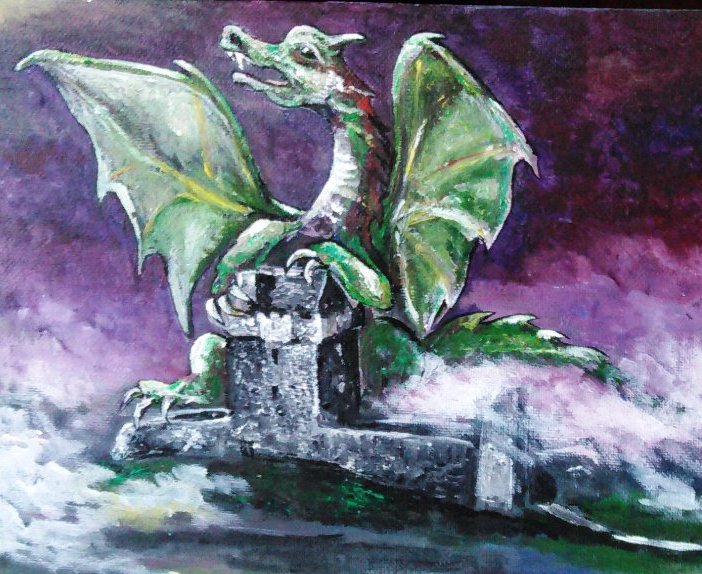
Dunguaire Dragon Acrylic on board EO'D
Dunguaire Dragon
Acrylic on board
EO’D

In pre-Christian times the first fire was lighted on the hill of Howth, on the east coast of Ireland, near Dublin, and the moment the flame appeared through the darkness a great shout went up form the watchers on all the surrounding hill tops, where other fires were quickly kindled. These were viewed by watchers further west, who in turn kindled their own fires and so on, until the flame had ‘travelled’ across the country.
It was also customary to walk three times around the fires, reciting certain prayers to ward off sickness during the coming year.The next morning was considered the proper time to hunt for mushrooms.
Midsummer’s eve is also a favourite fairy season. On this night, they are on the watch to carry off incautious mortals, particularly women and infants who are not protected by a sprig of lusmor (fada over o) or foxglove, or some other safeguard against fairy influence.

Posted in Posts and podcasts

The Flight of the Dishes

A tale from Kinvara, County Galway.
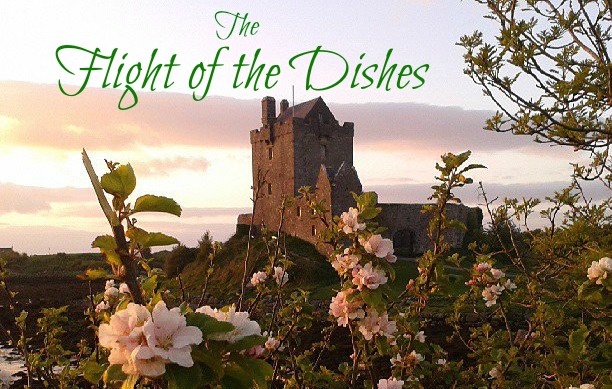
Dunguaire Castle, Kinvara, County Galway. Photo: Norma Scheibe.


(An adaptation©EO’D)

Dunguaire Castle, ‘the Fort of Guaire’ stands on a hill just outside Kinvara, County Galway. Surrounded by water on three sides it commands a fine view of the village, the Burren Mountains and the sparkling waters of Galway Bay. From minute to hour, sun and sky brings change to its walls and to the angles of its battlements. Dunguaire itself rests as constant as the mountains beyond.
It’s a fitting seat for a King, and no less than five Kings of Connaught made their seat here. The castle got its name in memory of the most famous one of all – Guaire. His reign was a time of plenty for the region. He served and protected all in his kingdom and he did right by them. He took from his tenants only what they could spare and ensured no person was left in need. He sheltered those who suffered loss or hardship, he made fair judgment in times of crisis, and he treated nobleman and tenant with the same dignity and respect due all humanity. For that, he was much-loved. It was said he gave so generously that the ‘dint’ of giving caused his right arm to grow longer than his left.

It was a fitting seat for a king. Photo: Norma Scheibe
It was a fitting seat for a king.
Photo: Norma Scheibe

Each time he sat down to eat he said grace. It was a simple entreaty and in keeping with his reputation as a benevolent ruler.
“May the great God look down on us as we break bread together.” he would say.
“And if any in my kingdom are more in need than I, then I pray they have this bounteous food to sustain them; and welcome.”

Those prayers were answered when, one fine day, his dishes took flight…

(more on theburrenandbeyond.com)

Posted in Posts and podcasts

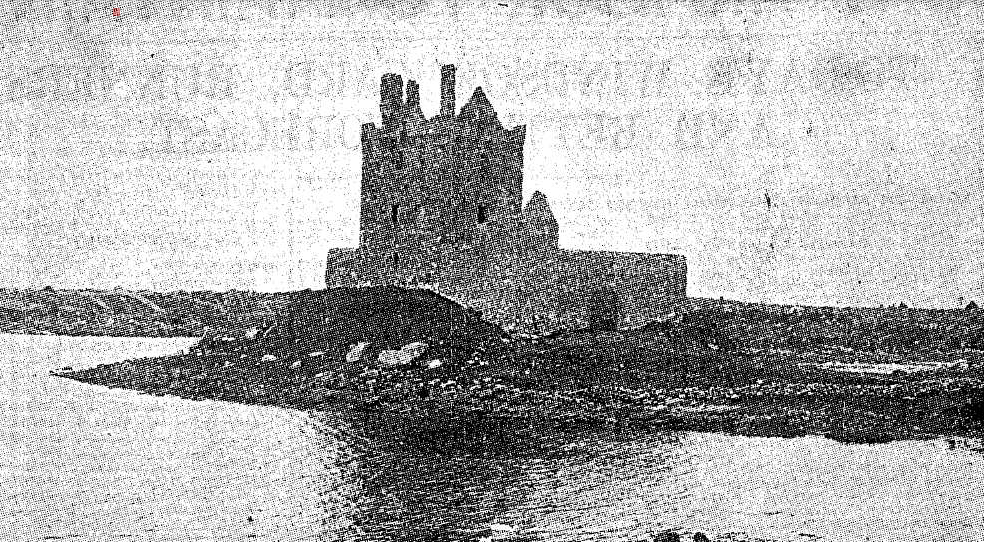
An ancient Stronghold – 1937

Old Dunguaire 1937

Dungory Castle, (Dunguaire) on the shores of Kinvarra Bay, Co Galway.
(Cashman)
Irish Examiner 16th December, 1937

Posted in Posts and podcasts

Dunguaire Castle – barracks, bullets and battles

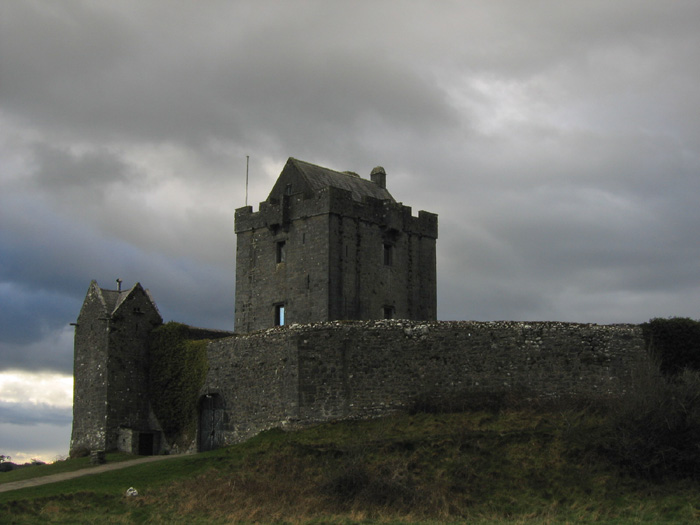
Dunguaire Castle Creative Commons Photo: Postdlf
Dunguaire Castle
Creative Commons Photo: Postdlf

https://widgetworld3.wordpress.com/podcasts/

In 1842/1843 Tomas L Cooke rambled around Kinvara, Co. Galway and published accounts of his travels in the Galway Vindicator. Dunguaire Castle was one of the sites he visited, which he describes as…

a square building in the fashion of Queen Elizabeth’s reign, and of several stories in height, standing some distance outside the town upon a small elevated peninsula, surrounded by the sea, with the exception of one low and narrow isthmus, that connects it with the main land. A strong and high wall built along the verge of the declivity encloses the court-yard, or bawn. The outer gateway is large, and has an embattled wall with embrazures overhead. It is flanked on the right by a small quadrangular bastion, or tower, which commands it and the outward wall on two sides. In the sides of the tower, just mentioned, there are set in masonry some large stones, perforated with round holes of five or six inches in diameter, apparently intended for exposing the muzzles of small ordnance.

These defences were sorely tested. In Mr Cooke’s words...

The Castle of Kinvarra was, until very recently, used as a Barrack by a military detachment quartered here. The walls circumscribing the bawn, have, in former days been shattered in two of the angles, apparently by the fire of artillery from a sod battery thrown up about two or three hundred yards off, in the direction of Tubbermacduach. The platform of this ancient battery is still visible, and on it are placed at intervals some very large rocks, which, in all probability, served as shelter to the gunners against the fire of matchlocks or other small arms from the castle. It is not very likely that the besieged were altogether inactive or without using fire-arms, during the investment of the place…

Dunguaire Castle – built to last the test of time – and conflict.