The Australia Star 27th July 1895 p8
Continual Duels- Anecdotes of.
In the recently. published “Autobiography of Sir William Gregory,” edited by Lady Gregory, there are a number of interesting particulars concerning social and political life in Ireland at the close of the last century and the beginning of this. The narrator begins with some details about his great grandfather, Robert Gregory, an excellent type of the nabob, who amassed a huge fortune in India and then returned to England.
Sir William says:—
My great-grandfather, on his return from India, had purchased an estate in Essex, another in Cheshire, a house in Bernerstreet, London, then a fashionable quarter, and a property in Ireland of over £7000 a year. Before his death he had sold the Essex and Cheshire estates, but he reserved that of Galway. From the accounts I have heard of him, he was a most kind and polished old gentleman, living in very great state, and considering, as old Indians used to do, that a huge retinue of servants was necessary for existence. I have heard my grandmother speak of the procession of carriages in which he and his suite travelled from London to Coole, but -what particularly struck her were the number of servants who came to the door, and waited at dinner in black silk stockings, black breaches, and gold garters. He was particularly courteous to young ladies, who had good reason to remember their visits to Coole with pleasure, and it was his habit to take them at their departure to a drawer, in which were precious stones, and let them fish out one of them without looking, taking the chance of what it might turn out to be. One fortunate maiden was mentioned to me— though I have forgotten the name— who had the luck to pick up a very valuable ruby.
He died at the age of 83, September 1, 1810, with all his faculties unimpaired, and his hair scarcely tinged with grey.
The grandfather of Sir William Gregory was Under-Secretary for Ireland, a position, he held for 18 years. It is characteristic of all governments in Ireland that officials are not only paid, but housed after a splendid fashion. Some of the great officials have two official residences, one in Dublin Castle and the other in Phoenix Park, the beautiful stretch of grounds just outside Dublin. It was in the Under-Secretary’s Lodge in Phoenix Park that Sir William was born in 1817.
Much of the interest of this volume is due to the glimpses it gives of Irish life as it used to be among the Irish nobility and the Irish gentry. It is not an agreeable picture. The hiccough sounds through it all. For it is impossible otherwise to account for the recklessness and the ferocity which characterised some of their doings, especially in the matter of duelling. Though the bravery may be admired, there is something extremely odious in the swagger with which these gentlemen got up from their cups to destroy each other’s lives.
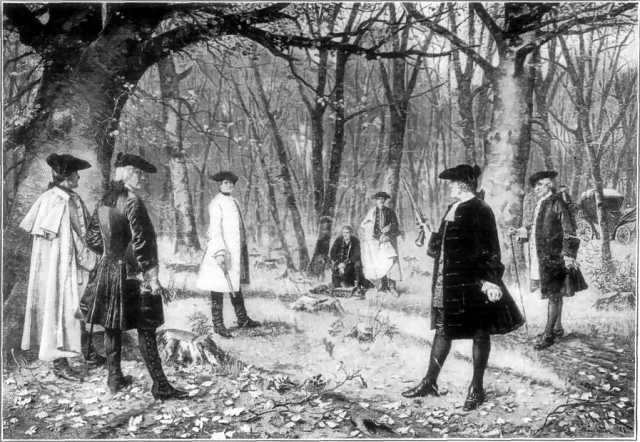
The duel was dying out in its pristine ferocity in the days of Sir William Gregory’s youth— though it had not altogether disappeared from the land. There are plenty of illustrations of this in some of the excellent stories which Sir William Gregory tells. Thus his grandfather, one day, while dressing, had suddenly to take a prominent-part in a duel :
A duel had been arranged between Sir Valentine Blake and Robert Burke, of St. Clerens, two Galway men, and the spot selected was close to my grandfather’s gate.
He was, engaged at his important shaving operation, when he heard first one, and then, after an interval, a second double shot, which he knew to be from a pistol. He did not hesitate a moment, but ran downstairs, bare legged as he was. An orderly’s horse was at the door; he sprang on it and galloped to his gate-house. As he neared the gate he heard, close at hand, a third double shot, and just outside he saw a gathering of spectators round the seconds, who were discussing the subject of making a fourth shot effective. Just as he got to the ring a huge fellow rode In and shouted out: —
“Gentlemen, this is all child’s play. Let’s finish the business properly. Let each second advance his man two paces, and I’ll engage they don’t miss.”
“Who are you, sir?” cried my grandfather, dashing his horse forward. “Who are you, sir, to give such bloody counsel?”
“Who am I indeed!” said the other man, looking at the strange figure in a grey dressing-gown and bare legs.
“I’ll have you to know, sir, I’m Mr. Hickman, the clerk of the peace for the County of Clare!”
“Then, Mr. Hickman,” said my grand father, very quietly, ” I arrest you and the principals and seconds of this duel, in the King’s name, and I’ll have you all taken up before 12 o’clock.’
After which he rode home in his bare legs, chatting very pleasantly to Sir Phillip, who had been on the ground acting professionally as surgeon for the belligerents.
An even more remarkable duel was described to Sir William Gregory by the late Marquis of Clanricarde, in his way a type of the old Irish gentleman :—
“One day, at Portumna, he pointed out to me a field on the other side of the Shannon, about half a mile from the bridge which connects Galway with Tipperary. We had been talking of William Macdonagh, the well-known steeplechase rider, who was a kind of squireen and lived in the neighbourhood. He had recently shot himself through the head in a pistol gallery in Leicester square, where Dunkellin and I went an hour afterward to practice, and there he was, lying stark and stiff behind a screen.
‘I remember,’ said Lord Clonricarde, ‘seeing the poor fellow fight his well-known duel in that field. He had a difference with some Tipperary gentleman, and it was decided that the duel should take place with pistols on the Tipperary side of the river. The decision as to the side of the river where the affair should come off was a matter of life and death, for the Tipperary man well knew that if he was victorious on the Galway side, he would be torn to pieces by the Galway mob, while the Galway man knew that if he killed his antagonist on the Tipperary side, his chance of escape from the men of Tipperary would be small indeed. On the morning of the duel there were at least two thousand persons present, all Tipperary men, as the Galway peasants did not dare to cross the bridge.’ Lord Clanricarde went over from Portumna, and Macdonagh rode his horse to the scene of action, and gave it to a man to hold close at hand. A regular lane was made, lined by spectators on each side. When the signal was given both fired, and Macdonagh not only shot his antagonist dead, but also one of the peasantry who, in his eagerness to sea the sport, had pushed forward and received the ball in his head.
Macdonagh got to his horse and made for the bridge of Portumna. After taking one or two fences gallantly on the way, he found his retreat cut off and the Tipperary men in occupation of the bridge. Without a moment’s hesitation he put his horse at the Shannon, amid the execrations of his baffled pursuers, and he reached the other bank in safety.”
Sir William Gregory was the hero of one of the most historic contests in Irish history— the fight for the Dublin seat at a by-election in 1842. He says :”The Dublin people welcomed me very heartily, and an agreement was come to that I was to pay £4000 down, that the balance was to be made up somehow, and that I was to have nothing to do with bribery. The election ultimately cost about £9000; where the balance came from I know not, but among the vouchers in possession of my committee was one which was afterwards placed in my hands: ‘For 1500 freemen, gratification, at £3 per head, £4500.”
O’Connell took part in the election, and was especially vehement against Gregory for having listened in silence at one of his meetings to the cry “To hell with the Pope.” Gregory indignantly denied the charge— so indignantly as to vex the souls of the “fifteen hundred freemen voting solid at three pounds per head”:—
“I am afraid there were some good grounds for O’Connell’s statement that the offensive words were shouted, though my conscience was clear enough. I was much rebuked for the violence of my disclaimer, and the Rev. Tresham Gregg, in a speech next day to the Protestant freeman, when alluding to these allegations, said, ‘No, my friends, we must not cry, ” To hell with the Pope;” we must cry, “To heaven with the Pope.”
It will give some idea of the religious rancour which prevailed in those days among the lower-classes of Protestants, that one of the first petitions I was requested to present was a supplication to the House of Commons to pass a measure to prevent the Roman Catholics from using bells at their chapels, which, as being summonses to idol worship, greatly distressed the ears of the petitioners.”