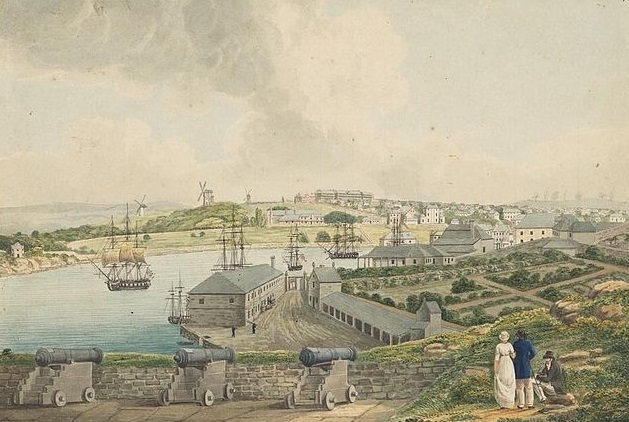
View of Sydney Cove from Dawes Point Source An Historical account of the Colony of New South Wales Author Lycett, Joseph, ca. 1775-1828
Last month was witnessed in Sydney the inauguration of a branch of the Cumann na mBan. The meeting, held for the purpose in the rooms of the I.N.A., Station House, was a very enthusiastic and successful one. After the aims and objects of the association were explained, it was decided by the ladies to place themselves under the patronage of Ethna Carberry, and that the branch be known as An Craob Ethna Carberry (the Ethna Carberry branch). The following ladies were elected office-bearers;
President – Miss B. O’Grady
Vice-Presidents – Miss M. Ryan and Miss Sheehan
Secretary – Miss Amy Ryan
Treasurer – Miss May Maloney
Committee; Mrs Cheetham, Miss Madeline Sheehy, Miss Mary Organ and Miss Kathleen Weber.
The names of Mrs. J. Murphy and Miss Darcy have since been added to the committee.
When the ban has been lifted from the holding of meetings, the Cumann na mBan will meet in the I.N.A. rooms (sixth floor), Station House, at 8 p.m. sharp on Wednesdays and special attention will be given the Irish language, industry, literature, &c. Information as to membership can be had from the secretary Miss A. Ryan, I.N.A., sixth floor, Station House.
Special cable despatch to The Sun from the London Times Services;
Whereas by our special proclamation dated July 3, 1918, in pursuance and by virtue of the criminal law and procedure of Ireland, Act of 1887, we declared from the date thereof certain associations in Ireland known by the names of Sinn Fein organization, Sinn Fein clubs, Irish Volunteers, Cumann na mBan and Gaelic League to be dangerous, and whereas the association known by the name of Dail Eireann appears to us to be a dangerous association and to have been after the date of said special proclamation employed for all purposes of the associations known by the names of Sinn Fein organization, Sinn Fein clubs, Irish Volunteers and Cumann na mBan, now we the Lord Lieutenant-General and General-Governor of Ireland, by and with the advice of the Privy Council in Ireland, by virtue of the criminal law and procedure of Ireland Act of 1887, and of every power and authority in this behalf, do hereby, by this our order prohibit and suppress within the several districts specified and named in the schedule, and association known by the name of Dail Eireann.
The Central News, London, has received from a lady who acted as a Red Cross nurse the following graphic story of the part played by women in the recent revolt in Dublin.
The Irish rebellion is remarkable for one fact not so far recognised in England, namely the very prominent part taken in it by Irish women and girls.
On Easter Sunday, which was the day appointed for the Irish Volunteer manoeuvres, and for which all the men were mobilised, the women in the movement were also mobilised, and ordered to bring rations for a certain period. It was only at the last moment, and for sufficiently dramatic reasons, that the mobilisation of both men and women was cancelled. These Irish women, who did their work with a cool and reckless courage unsurpassed by any man, were in the firing line from the first to the last day of the rebellion. They were women of all ranks, from titled ladies to shop assistants, and they worked on terms of easy equality, caring nothing, apparently, but for the success of the movement.
Many of the women were snipers and both in the Post Office and in the Imperial Hotel the present writer, who was a Red Cross nurse, saw women on guard with rifles, relieving worn-out Volunteers. Cumann na mBan girls did practically all the dispatch carrying, some of them were killed, but none of them returned unsuccessful. That was a point of honour with them – to succeed or be killed. On one occasion in O’Connell Street, I heard a volunteer captain call for volunteers to take a dispatch to Commandant James Connolly, under heavy machine gun fire. Every man and woman present sprang forward, and he chose a young Dublin woman, a well-known writer, whose relations hold big Crown appointments, and whom I had last seen dancing with an aide-de-camp at a famous Dublin ball.
IN A RAIN OF BULLETS This girl had taken an extraordinarily daring part in the insurrection. She shook hands now with her commander, and stepped coolly out amid a perfect cross-rain of bullets from Trinity College and from the Rotunda side of O’Connell Street. She reached the Post Office in safety, and I saw Count Plunkett’s son, who was the officer on guard, and who has since been shot, come to the front door of the Post Office and wish her good luck as he shook hands with her before she made her reckless dash to take Connolly’s dispatch back to her own headquarters.
This was only one instance, but typical of a hundred that I saw of the part played by women during the fighting work. They did Red Cross work – I saw them going out under the deadliest fire to bring in wounded volunteers – they cooked, catered, and brought in supplies; they took food to men under fire at barricades; they visited every Volunteer’s home to tell his people of his progress. I never imagined that such an organisation of determined fighting women could exist in the British Isles. These women could throw hand grenades, they understood the use of bombs; in fact they seemed to understand as much of the business of warfare as their men.
Sixty girls were released from Kilmainham Prison a few days ago, but others are still imprisoned and arrests are yet taking place.
The Catholic Press 4th December, 1919 p.20. (abridged)
Photo: EO’D
In a supplement of the “Dublin Gazette” the Lord Lieutenant and Privy Council of Ireland, declared that the association known as Dáil Éireann, appears to them to be a dangerous association. It was formed and first employed for all the purposes of the associations known as the Sinn Féin organisation, Sinn Féin clubs, the Irish Volunteers and Cumann na mBan. The order to prohibit and supress it within the 32 counties and six county boroughs of Ireland was signed by the Chief Secretary and General Sir Frederick Shaw, Commander-in-Chief of the forces in Ireland.
Kinvara Branch of Cumann na mBan had eight members, including:
Cumann na mBan clasp
Miss Kate Fogarty
Mary Hynes, Dungora, Kinvara
Miss Aggie Staunton, Clooas, (sic.) Kinvara
Miss Mary Fogarty, Kinvara
Miss P. Regan, Kinvara
Margaret Johnston, Kinvara
The Soldiers of Cumann na mBan
by Brian O’Higgins
All honour to Óglaigh na hÉireann
All praise to the men of our race,
Who, in days of betrayal and slavery,
Saved Eire from shame and disgrace.
But do not forget in your praising,
Of them and the deeds they have done,
Their loyal and true-hearted comrades,
The Soldiers of Cumann na mBan!
Chorus
They stand for the honour of Ireland,
As their sisters in days that are gone,
And they’ll march with their brothers to freedom,
The Soldiers of Cumann na mBan.
No great-hearted daughter of Ireland,
Who died for her sake long ago,
Who stood in the gap of her danger,
Defying the Sassenach foe,
Was ever more gallant or worthy,
Of glory in high sounding rann,
Than the comrades of Óglaigh na hÉireann
The Soldiers of cumman na mBan!
Chorus
O, high beat the hearts of our Mother,
The day she had longed for is nigh,
When the sunlight of joy and of freedom,
Shall glow in the eastern sky;
And none shall be honoured more proudly,
That morning by chieftain and clan,
Than the daughters who served in her danger,
The Soldiers of Cumann na mBan!
Chorus
Brian O’Higgins (1882-1963) penned the lyrics of
The Soldiers of Cumann na mBan in the week immediately prior the 1916 Rising
This song has been arranged and recorded by Joseph Forde.


 The Burren and Beyond