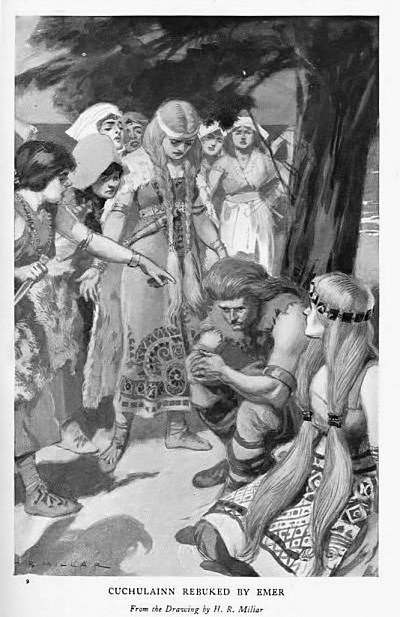
Illustration of Cuchulainn and Emer by H.R.Millar, published in Celtic Myth and Legend by Charles Squire (1905Emer is a name from ancient Celtic mythology. She was the wife of Cu Chulainn, renowned for her beauty, wisdom, wit and the art of needlework. Her father, Forgall Monach, did want want her to marry Cu Chulainn and tried to prevent the match – so, in keeping with the times Cu Chulainn abducted Emer and made her his wife – but only when he proved himself worthy.
The only jealousy of Emer was Fand – a beautiful spirit who seduced Cu Chulainn and tried to coax him away with her. Fand was unsuccessful.
Emer is featured in the Ulster Cycle of Irish Mythology. My mum put a poster of her in our kitchen, just behind my chair. She was amazing … my mum – and Emer.
Mr Andrew Lang, in an article in the “Morning Post” on the evolution of bowling, says that originally the batsmen defended no stumps, but a hole in the ground. The object of the bowler was to get the ball into the hold, whether by a daisy-cropper or a full pitch. The wicketkeeper- or hole-keeper- stumped or rang out the batsmen in the same way, by putting the ball in the hold. Cricket was played thus in the “Late Celtic” or “La Tene” period in Ireland; of about 200 B.C.-220 A.D. In the most ancient Irish epic of mingled prose and verse, which reflects the institutions of the aforesaid “Late Celtic” period we have the score of a match:- Cuchulainn against One Hundred and Fifty Colts of Ulster.
Ulster. b. Cuchulainn……….0
Cuchulainn, not out………….-
The figures of the hero’s score are not given, but if he made a single he could “declare”. In this match we have to reckon with the Celtic tendency to exaggeration. It is improbable that Cuchulainn’s analysis read: “Balls 130, wickets 150, wides 0, no-balls 0.”


 The Burren and Beyond