Posted in Posts and podcasts

Great Meeting in Gort – 1869

Tuam Herald 13th November, 1869 p.1
The Land Question (abridged)


Gort, Sunday Night
This patriotic little town may well take credit to itself for the support which it has this day given to the cause of tenant right in this country. It afforded not only to the people on this side of the extensive county of Galway, but to thousands in the northern districts of the county Clare, an opportunity of expressing their opinions on the present unsatisfactory state of the land laws in Ireland, and of pointing out the mode in which the tenant farmers of the country desire that they should be altered. Some influential gentlemen residing in the town and neighbourhood were anxious that the people should, in the form of resolutions, express their grievances with a view to their redress by a Ministry and by a Parliament which have already manifested an anxious wish to remove those evils which have been a source of misery and discontent to the country.

The notice by which the meeting was called was given only a few days back, and yet the meeting of today was a great success, keeping in view the fact that it was not a county meeting, but was composed mostly of people within a circuit of ten miles of the town. The Athenry and Ennis Junction Railway, however, ran special trains, and brought large numbers of people from longer distances. The train which left Ennis at eleven o’clock arrived in Gort at twelve o’clock bringing people from Ennis, Crusheen and Tubber, and the train from Athenry, which arrived shortly after, carried large number of tenant farmers from that station, from Oranmore, Crughwell (sic.) and Ardrahan. The traffic arrangements were under the direction of Mr. Thomas O’Malley, the manager, and were admirably carried out by Mr William Lawlor, the efficient station master of Gort.

Many of the farmers came in on horseback heading bodies of 400 or 500 people. Ardrahan furnished a contingent of about 400, and the united parishes of Ballymena and Crughwell sent by rail about 300 persons, who were accompanied by the Rev. Francis Arthur, P.P. and the Rev. M O’Flanagan, C.C. This body on entering the unfurled their banner, which had inscribed on it the mottoes, “Fixity of Tenure” and “Tenant Right,” and the Rev. M. Nagle, P.P., Kilbeaconty, accompanied a body of his parishioners, numbering, perhaps, five hundred. The Rev. John Barry, P.P., Behagh, and the Rev. Michael Killeen, C.C., accompanied about 800 from their parish, with banners bearing the words, “Fixity of Tenure” and “Tenant Right.” Numbers also came from Corofin, Ballyvaughan, Kilkeely, New Quay, Feakle, Derrybrian, Loughrea, and Kinvara.


A very large body of tenantry came on horseback from Kinvara, accompanied by their landlord, Isaac B. Daly, and Mrs Daly, who drove in their carriage, and who were loudly cheered. By one o’clock there could not have been less than from 10,000 to 12,000 people in the town, all evidently interested in the cause which brought them together. Previous to the commencement of the proceedings a procession was formed, headed by a number of young girls, some of whom were entirely dressed in green, and these were followed by well-dressed young men carrying green banners, having inscribed on them the words, “God save Ireland,” “fixity of tenure,” “tenant right,” and “Cead mille failthe,” (sic.) and the harp in gold was on several of them. There was scarcely a person in the whole procession, which walked round the market-square, accompanied by music, who was not in some way ornamented with green.

They cheered on passing the houses which by some patriotic device attracted attention. An excellent cast of the face of O’Connell was placed in one of the windows of Forrest’s Hotel, and beneath was a saying of the Liberator’s, “He who commits a crime gives strength to the enemy.” At Glynn’s Hotel, there was a sign on a green ground, and the words “Prosperity to Ireland.” These received respectful attention on the part of the people who, as the hour approached for the commencement of the meeting, assembled in front and around the platform which was erected in the middle of the square, and was so spacious as to accommodate about one hundred and fifty persons. On the motion of Mr. L. S. Mangan, Gort, seconded by Mr. Thomas Boland, the chair was taken amidst loud applause by the Very Rev. T. Shannon, P.P., V.G.

Posted in Posts and podcasts

N.U.I.G – 1845

N.U.I. Galway Wikipedia.org
N.U.I. Galway
Wikipedia.org

The Spectator 24th May, 1845 P9

The Roman Catholic Bishops met in Dublin on Wednesday, and took into consideration the Government bill for academical education.

It is understood that they object to the bill, because it does not place the religion and conduct of the pupils under the control of their religions instructors.  The final decision, as well as the meeting, was adjourned till Friday.

A public meeting for the town and county of Galway was held last week, to petition the Queen in favour of placing in that town (rather than in Cork) the intended Western College for the province of Connaught. The measure was generally approved by those present, both lay and clerical; but some guarantee for the moral and religious charge of the teachers was desiderated. The petition, however, was adopted by a large majority. Belfast and Derry are also con- tending, for the Northern College.

Posted in Posts and podcasts

News in brief – 1912

Wikipedia.org
Wikipedia.org

Northern Star = 11th May 1912 p9
Boycotting and Police (abridged)
There has been no cattle driving in the county since July 1911 but in other reports generally the county in the direction of Athenry, Craughwell, Oranmore, Gort and Kinvara, and bordering on the County Clare, was in a deplorable state. In the great majority of cases no one was to be made amenable notwithstanding all the efforts of the police, and it would seem as if the Executive was completely paralysed in these districts.
In one of the attempted murder cases a labourer working for the Estates Commissioners was fired at and wounded at Woodberry; in another case three shots were fired from behind a wall and a man was hit; in a third a shot was fired through the window of a cottage and the greater part of the charge entered the jaw of an unfortunate man who was sitting inside; in a further a sergeant and a constable were fired at from a wood and the sergeant was wounded; and in a fifth, which occurred near Oranmore, four shots were fired at six men who were passing along the road in a car, and all but one of them were wounded.

Posted in Posts and podcasts

Creating Irish Crime – 1911

Photo: Hopklaver (Medicago lupulina) Creative Commons
Photo: Hopklaver (Medicago lupulina)
Flowering Shamrock
Creative Commons

North Otago Times, 13th April, 1911
CREATING IRISH CRIME

The Connaught Tribune, a leading Nationalist newspaper published at Galway recently printed, on the authority of “a reliable correspondent,” the following extraordinary story of “loyalist” methods in agitating against Home Rule;

Many of the strange and meaningless outbreaks that have recently occurred in County Galway are not the result of any land agitation at all, but the direct outcome of a sinister secret organisation financed by men who are, and have all their lives, been enemies of Ireland, and who are prepared to resort to any desperate mans to prevent this country securing Home Rule.

The statement may appear at first sight very far-fetched (says the correspondent), but I am in possession of information that leads me to believe that a certain despicable class of non-resident landlords are prepared to do all in their power, and have at their disposal unlimited funds, for the purpose of blackening the fair name of this country.

I could lay my hands on over half a dozen men in County Galway who have no visible means of subsistence and who yet always appear to have plenty of money. These men are “in the know” of everything, and it is notorious that they make frequent secret journeys to distant and secret destinations. They are nothing short of “village bums,” and yet they pose as patriots.

But, unless I am very much mistaken, they are the aiders and abettors of the treacherous enemies who are today stabbing us in the back and keeping the progress of our country back half a century by encouraging, if not actually siding in the perpetrating of these outrages that have absolutely no other meaning, and can effect no other purpose whatever except to do untold injury to the country.

Posted in Posts and podcasts

An Irish Ship canal – via Doorus and Island Eddy – 1884

 Island Eddy as it appears on 'A Map of the County of Galway in the Province of Connaught in Ireland' by WIlliam Larkin (London 1818).
Island Eddy as it appears on ‘A Map of the County of Galway in the Province of Connaught in Ireland’ by WIlliam Larkin (London 1818).
FREEMAN’S JOURNAL 18TH OCTOBER, 1884 P6
AN IRISH SHIP CANAL.

The suggestion of constructing a ship canal across Ireland, from Dublin to Galway, or Dublin to the Shannon, has been warmly taken up by eminent and competent men in London. Elaborate plans and surveys have been made at considerable expense, which have been submitted by Captain Eades, the great American engineer. The plans for the Irish Canal have been prepared by Mr. T. A. Walker, Great George-street, Westminster, who recently bored a tunnel under the Severn, the largest undertaking of the kind in the country.

Silently but steadily a staff of engineers have levelled the country between Galway and Dublin Bays, and the plan, although carefully prepared, is largely tentative, its object being to show the practicability of a project of the kind. The proposed canal would be 127 miles in length and would contain upwards of 30 locks. The estimated cost is, of course, ruled by the tonnage of the ships it is intended to accommodate. Thus if for ships of 1,500 tons the cost would be eight millions, for ships of 2,500 twelve millions, and for ships of 5,000 and upwards twenty millions sterling. If built on this scale, and it is considered that anything smaller would be a mistake, the canal would be 200 feet wide on the surface and 100 feet at the bottom.

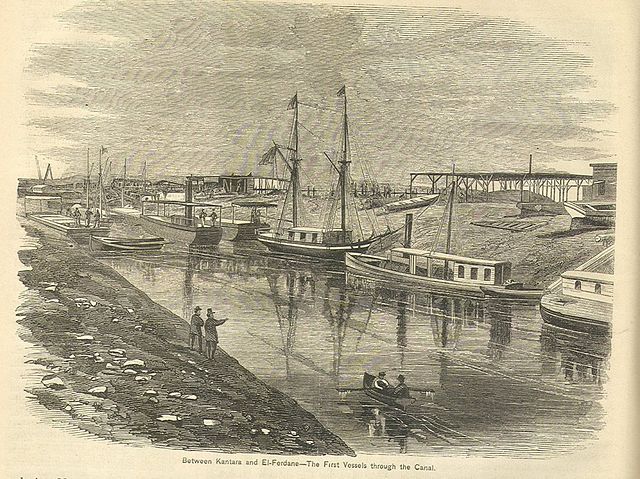
Suez Canal, between Kantara and El-Fedane. The first vessels through the Canal. 19th century image. From "Appleton's Journal of Popular Literature, Science, and Art", 1869.
Suez Canal, between Kantara and El-Fedane. The first vessels through the Canal. 19th century image.
From “Appleton’s Journal of Popular Literature, Science, and Art”, 1869.
In considering these dimensions it must be remembered that the Suez Canal except at its mouth is not 80 feet wide. The depth would be from 30 to 35 feet, and the locks would be fitted with the newest hydraulic apparatus so as to make the process of lockage as simple and expeditious as possible. The passage through the canal would be effected through, a system of towage, although it is somewhat of an open question whether this would be preferable to permitting the steamers to work through.

It is estimated that the passage of a ship from Galway Bay to Kingstown would occupy between 24 and 36 hours. An alternative scheme of a ship railway, in which the ships would be carried in cradles, which, he says, could be constructed for ten millions by his plan, the duration of the passage through the island would, he declared, be reduced to 12 hours.

The proposed course of this great work will be of considerable interest.

The canal starts from Doores Strait (sic.), south of Islandeaddy, in Galway Bay, where the shallowness of the water necessitates the dredging of a channel for a considerable distance out. This proposed canal would give a depth of thirty feet at low water, and would be protected from the silting up of the sand by suitable works. The entrance to the canal would be by a sea lock 600 feet in length, capable of taking ships of 5000 tons. From this lock entrance would be gained to a dock of 29 acres in extent, constructed on an arm of the sea, known as present as Brandy Harbour. The first inland lock would be less than a mile up at Killemaran, (sic.) from whence the canal would pass close to Drumacoo, then turning slightly to the north by Kilcolgan on to Rahasane, and passing about five miles to the south of Athenry, and crossing the Athenry and Ennis Railway at Craughwell, where the fifth lock would be situated. The sixteenth mile of the canal brings it about one mile to the north of Loughrea, from which town there will be a feeder to supply fresh water from the lake which is ten feet above the level of the canal, the latter being 260 feet above sea level. From this point there is; a long straight line of canal without locks until it roaches Eyrecourt, whence an immense aqueduct is to be constructed to carry the canal over the Shannon