Posted in Posts and podcasts

Legends of the County Clare -1855

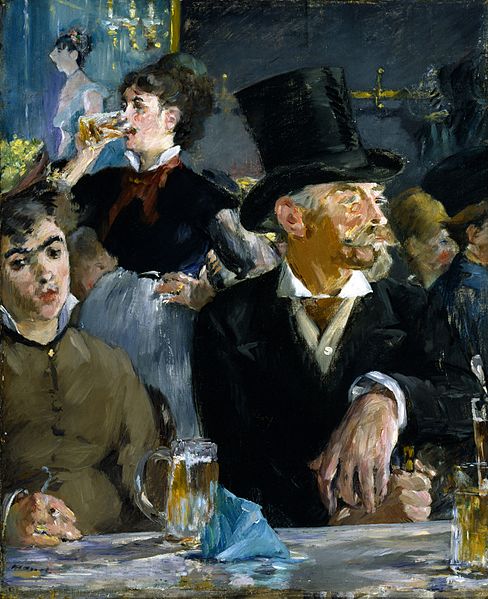
At the Cafe Edouard Manet  (1832–1883) Walters Art Museum
At the Cafe
Edouard Manet (1832–1883)
Walters Art Museum
Freeman’s Journal 20th January 1855 p3
LEGENDS OF THE COUNTY’ CLARE (abridged)

About two miles from the village of Corofin,’in the west of Clare, are the ruins of the Castle of Ballyportree. It is a massive square tower surrounded by a wall, at the corners of which are smaller round towers. The outer wall was also surrounded by a ditch. The castle is so intact the lower part is inhabited by a farmer’s family. In some of the upper rooms massive chimneypieces of grey limestone, of a very modern form, still remain. The horizontal portions of the chimneys are ornamented with a quatrefoil ornament engraved within a circle, but there are no dates or armorial bearings.

From the windows of the castle four others are visible, none of them more than two miles from each other; and a very large cromlech is within a few yards of the castle ditch. The following legend is related to the castle;

When the Danes were building the castle they collected workmen from all quarters, and forced them to labour night and day without stopping for rest or food ; and according as any of them fell down from exhaustion, his body was thrown upon the wall, which was built up over him ! When the castle was finished, its inhabitants tyrannised the whole country, until when the Danes were finally expelled from Ireland.

Ballyportree Castle held out to the last, but at length it was taken after a fierce resistance. Only three of the garrison were found alive, a father and his two sons. The infuriated conquerors were about to kill them also, when one proposed their lives should be spared, and a free passage to their own country given them, on condition that they taught the Irishmen how to brew their famous ale from heather. That secret was eagerly coveted by the Irish, and zealously guarded by the Danes.

At first neither promises nor threats had any effect on the prisoners, but at length the elder warrior consented to tell the secret on condition his sons should first be put to death before his eyes. He said he feared if he returned to his own country, they might cause him to be put to death for betraying the secret. Though somewhat surprised at his request, the Irish chieftains immediately complied with it, and the young men were slain. Then the old warrior exclaimed,
‘ Fools ! I saw that your threats and your promises were beginning to influence my sons; for they were but boys, and might have yielded : but now the secret is safe, your threats or your promises have no effect on me ! ‘
Enraged at their disappointment, the Irish soldiers hewed the stern northman in pieces, and the coveted secret is still unrevealed.

In the South of Scotland a legend, almost word for word the same as the above, is told of an old castle there, with the exception that, instead of Danes, the old warrior and his sons are called Picts.
Posted in Posts and podcasts

True Irish Ghost Stories – 1914

Photo: Waugsberg Wikimedia Commons
Photo: Waugsberg
Wikimedia Commons
Excerpt from True Irish Ghost Stories
compiled by St John Seymour B.D
1914 (abridged)

One night in April 1821, two servants were sitting up to receive a son of the family, Cornelius O’Callaghan, who had travelled in vain for his health, and was returning home to County Clare. One of them, Halloran, said that the heavy rumble of a coach roused them. The other servant, Burke, stood on the top of the long flight of steps with a lamp, and sent Halloran down to open the carriage door. He reached out his hand to do so, saw a skeleton looking out, gave one yell, and fell in a heap. When the badly-scared Burke picked himself up there was no sign or sound of any coach. A little later the invalid arrived, so exhausted that he died suddenly in the early morning.

On the night of December 11, 1876, a servant of the MacNamaras was going his rounds at Ennistymon, a beautiful spot in a wooded glen, with a broad stream falling in a series of cascades. In the dark he heard the rumbling of wheels on the back avenue, and, knowing from the hour and place that no mortal vehicle could be coming, concluded that it was the death coach, and ran on, opening the gates before it. He had just time to open the third gate, and throw himself on his face beside it, when he heard a coach go clanking past. On the following day Admiral Sir Burton Macnamara died in London.

Posted in Posts and podcasts

Fairy Music – 1887

16th century Irish missal - the Bodleian Library
16th century Irish missal – the Bodleian Library
https://widgetworld3.wordpress.com/podcasts/
Ancient Legends, Mystic Charms, and Superstitions of Ireland
Lady Francesca Speranza Wilde (1887)

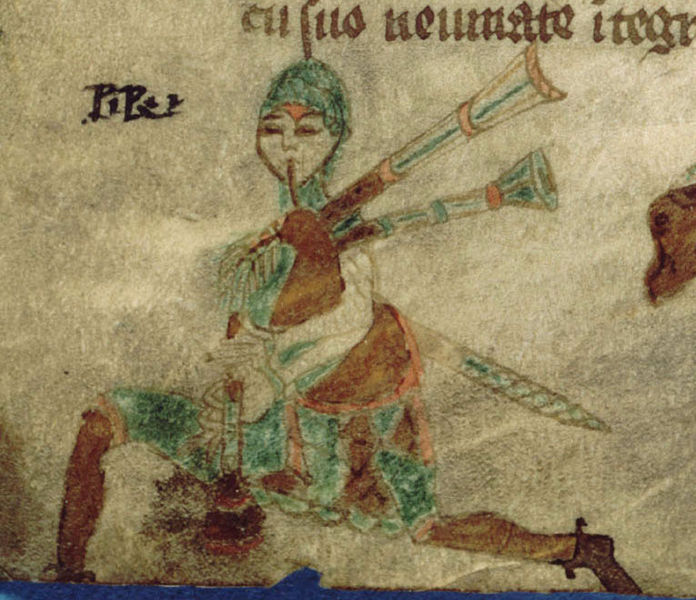
Fairy Music (abridged)
A fairy glance does not kill, but it throws the person into a death-like trance. Their body is carried off to some fairy mansion, while a log of wood, or some ugly, deformed creature is left in its place, clothed with the shadow of the stolen form. Young women, remarkable for beauty, young men, and handsome children, are the chief victims of the fairy stroke. The girls are wedded to fairy chiefs, and the young men to fairy queens; and if the mortal children do not turn out well, they are sent back, and others carried off in their place.

It is sometimes possible, by the spells of a powerful fairy-man, to bring back a living being from Fairy-land. But they are never quite the same after. They have always a spirit-look, especially if they have listened to the fairy music. For the fairy music is soft and low and plaintive, with a fatal charm for mortal ears.

One day a gentleman entered a cabin in the County Clare, and saw a young girl about twenty seated by the fire, chanting a melancholy song, without settled words or music. On inquiry he was told she had once heard the fairy harp, and those who hear it lose all memory of love or hate, and forget all things, and never more have any other sound in their ears save the soft music of the fairy harp, and when the spell is broken, they die.

It is remarkable that the Irish national airs–plaintive, beautiful, and unutterably pathetic–should so perfectly express the spirit of the Céol-Sidhe (the fairy music), as it haunts the fancy of the people and mingles with all their traditions of the spirit world. Wild and capricious as the fairy nature, these delicate harmonies, with their mystic, mournful rhythm, seem to touch the deepest chords of feeling, or to fill the sunshine with laughter, according to the mood of the players.
Above all things, Irish music is the utterance of a Divine sorrow; not stormy or passionate, but like that of an exiled spirit, yearning and wistful, vague and unresting; ever seeking the unattainable, ever shadowed, as it were, with memories of some lost good, or some dim foreboding of a coming fate–emotions that seem to find their truest expression in the sweet, sad, lingering wail of the pathetic minor in a genuine Irish air.

There is a beautiful phrase in one of the ancient manuscripts descriptive of the wonderful power of Irish music over the sensitive human organization: “Wounded men were soothed when they heard it, and slept; and women in travail forgot their pains.”

Posted in Posts and podcasts

The Coast of Clare – 1897

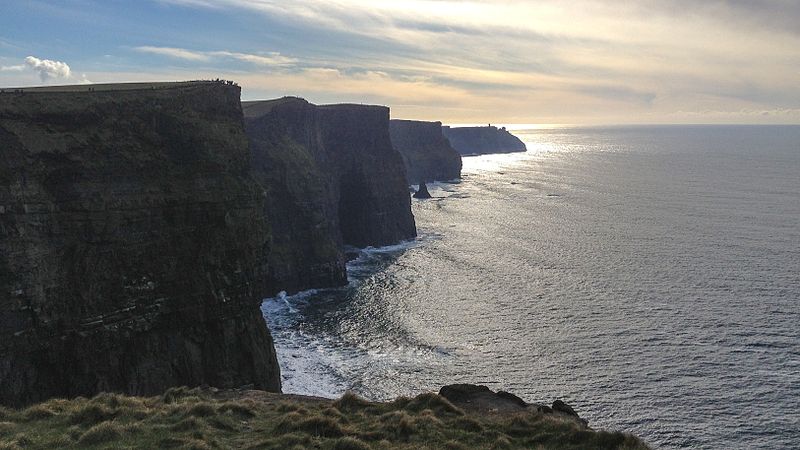
The Cliffs of Moher, Co Clare Photo: Michal Osmenda Wikimedia Commons
The Cliffs of Moher,
Co Clare
Photo: Michal Osmenda
Wikimedia Commons

https://widgetworld3.wordpress.com/podcasts/

THE BURROWA NEWS 1ST JANUARY, 1897

THE COAST OF CLARE

Fancy being brought face to face with the great ocean representing on the map an expanse of water between the Irish and the American shores of no less than five thousand miles.  No intervening territory meets the eye the whole length of this prodigious waterway, no strip of land, no cliffs, not even a bare rock on which a sea bird might perch.  As a Clare boatman once said to a party of tourists;

“Just throw a stone from where you are now and it will fall into another world, barring it didn’t sink in the water.”


The surpassing grandeur of the great Atlantic ‘in breeze, or gale, or storm’ is in itself something to gaze upon.  There behold the mighty sea, almost along the entire shore, rolled back ‘from dusk till dawn, and from dawn till dusk again,’ in masses of foam against huge frowning, raven-coloured rocks.  The din of the conflict scarcely ever ceases, while day and night those sable cliffs valiantly repulse their fierce assailants.  


The cliffs of Moher, lining the coast of Clare for five miles, are in themselves a simple marvel. Moher, an iron-bound barrier, erected by Nature to repel the lashing fury of the ocean, is pronounced on all bands to be the finest pile of rock that guards the margin of our sea girt land. Try and imagine a serried array of boulders rising abruptly at low water mark to an altitude ranging from 600 to, it is said, 1,000 feet, and this is Moher.


These towers of the sea are not so tall as others in Ireland – for instance, in Crohahawn in Achill, or Slieveneague in Donegal.  It is to be remembered, however, that the precipitous cliffs on the Mayo coast repose in their sockets at an angle of about 45 degrees; but the Clare Peaks, sheer perpendicular elevations, stand rooted and immovable against the rage of the tempest, and are more than proof against almost perpetual winds from the west.


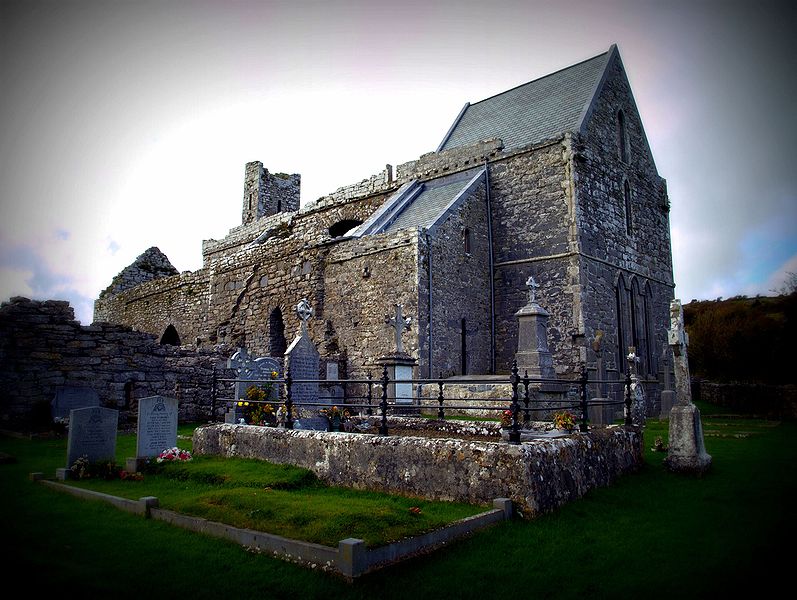
 Corcomroe Abbey The Burren, Co Clare Photo: Shaun Dunphy Creative Commons

Corcomroe Abbey
The Burren, Co Clare
Photo: Shaun Dunphy
Creative Commons

Some notion may be formed of the violence of western hurricanes on the coast of Clare by the fact that trees planted inwards fifty miles from the Cliffs of Moher acquire a bend towards the eastern horizon.  The power of the blasts off sea is enhanced by the indented character of the shore in this portion of Ireland.


Huge recesses of the Atlantic are frequent, and add immensely to the fascinations of the Clare Coast.  From Liscanor (sic) to Doonbeg the ocean forms a spacious bay at Corcomroe and other charming inlets of smaller size.  The fresh invigoration breezes, surcharged with ozone, that play around on all sides of the coast of Clare acknowledges no compeer anywhere.

Posted in Posts and podcasts

Valiant Fishermen from County Clare – 1907

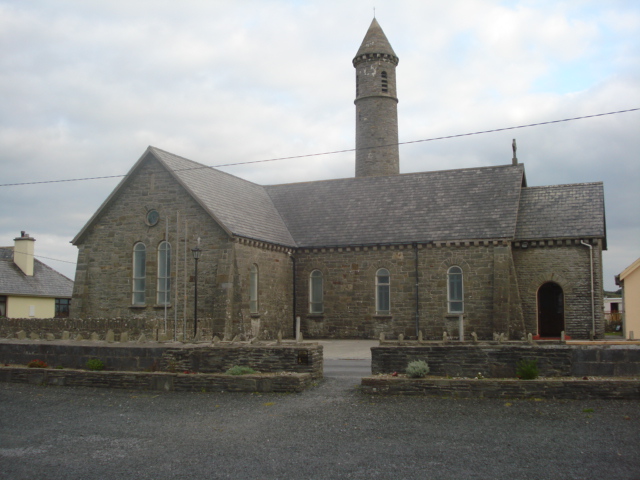
Quilty Church, County Clare Built with funds donated by French people after the rescue of the crew of the Leon XIII. The church porch contains a replica of the Leon XIII in a glass bottle, and the ship's bell stands in front of the altar. Photo: Eddylandzaat Wikipedia.org
Quilty Church, County Clare
Built with funds donated by French people after the rescue of the crew of the Leon XIII. The church porch contains a replica of the Leon XIII in a glass bottle, and the ship’s bell stands in front of the altar.
Photo: Eddylandzaat Wikipedia.org
https://widgetworld3.wordpress.com/podcasts/
THE STARK COUNTY DEMOCRAT, 4TH OF OCTOBER, 1907, WEEKLY EDITION P5
IRISH FISHERMEN WORK VALIANTLY TO SAVE CREW OF FRENCH VESSEL WRECKED BY GALE

London, October 3rd
Throughout yesterday and today the fishermen on the coast of County Clare, Ireland, aided by coast guards and volunteer helpers, worked with the greatest courage and devotion to rescue the crew of the French ship Leon XIII, which went ashore in a gale on Spanish Point.
By nightfall they succeeded in saving thirteen, but nine men are still clinging to the rigging. There is hope, however, that they will be rescued at low tide tonightl

Posted in Posts and podcasts

Adventurous Boys from County Clare – 1853!

Photo: Bjørn Christian Tørrissen Creative Commons
Photo: Bjørn Christian Tørrissen
Creative Commons
WHEELING DAILY INTELLIGENCER 16TH MARCH 1853, P2
https://widgetworld3.wordpress.com/podcasts/
ADVENTUROUS BOYS

On last Saturday, there passed through Galena, by stage, two boys, one of four and the other seven years of age. They left the county of Clare, Ireland, the first of January, for Dubuque (Dublin?) and came the whole way unattended by relatives or particular friends. When they left New York, on their journey westward, they had but $2.50 with which to pay their expenses; but when they arrived at Chicago, the sum had grown to $6.
Weakness and confiding faith are, often, ever a surer protection than strength. Whatever may be the defects in the American character, at the present times, a want of sympathy is not due of them. – Galena Gazette

Posted in Posts and podcasts

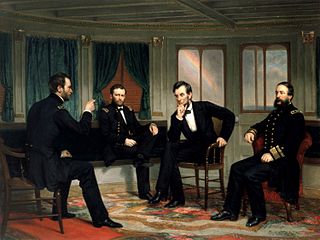
Better late…1913

The Peacemakers Sherman, Grant, Lincoln and Porter, discussing plans for the last weeks of the Civil War, March 1865  Oil on canvas -  c. 1868 by George Peter Alexander Healy (1818-1894) White House Historical Association
The Peacemakers
Sherman, Grant, Lincoln and Porter, discussing plans for the last weeks of the Civil War, March 1865
Oil on canvas – c. 1868 by George Peter Alexander Healy (1818-1894)
White House Historical Association
https://widgetworld3.wordpress.com/podcasts/
THE CITIZEN 5TH AUGUST, 1913 – OUR MAGAZINE PAGE (6)
GOSSIP FROM WASHINGTON

From County Clare, Ireland, recently came $250 to the conscience fund of the treasury. It was the first contribution from Europe in many years and was sent by a civil war veteran, who said that during the conflict he had made “false returns”.