Numerous reports of mines having been seen in Galway Bay and along the west coast have been made during the last week by fisherman, including one proceeding from Connemara to Kinvara with a boat load of turf on Wednesday. It is worth recalling that, during the last war, only two mines drifted into Galway Bay. Both exploded with fatal results, but the stringent precautions now being taken should avert any repetition of such tragedies.
Captain Hamilton, competent Port Authority at Galway told our representative on Friday that a drifting mine had been reported to him about half a mile south-west of the Margaretta Buoy on Thursday night. He immediately reported the matter to the authorities at Renmore Barracks. “I know,” he said, “that there is a mines expert in this area at present and he went to Furbough yesterday where he dismantled a mine that had come ashore. I understand that the expert has gone to Clifden this morning where he is dismantling two more mines that came ashore there.”
Asked if he thought there was a danger of any of those mines coming ashore at Salthill, Captain Hamilton asked “Why not? Of course,” he said. “There are look-out posts all along the west coast who are keeping a constant watch and they report immediately any sign of mines.” Asked if he could give any explanation for the presence of the mines, Captain Hamilton said that in his opinion they broke away from a minefield in the English Channel and the easterly wind which has been blowing from some time, drove them out into the Atlantic and now they are drifting back in again.
Supplement to the Cork Examiner, 18th November, 1899
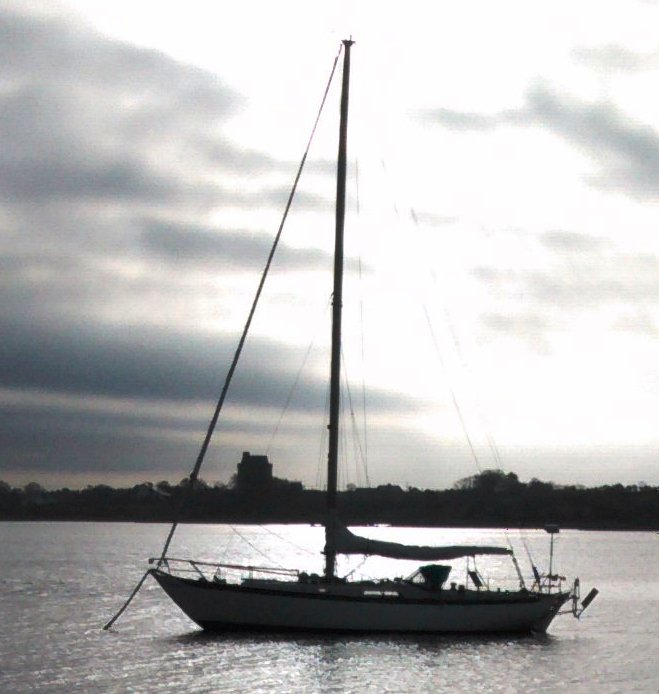
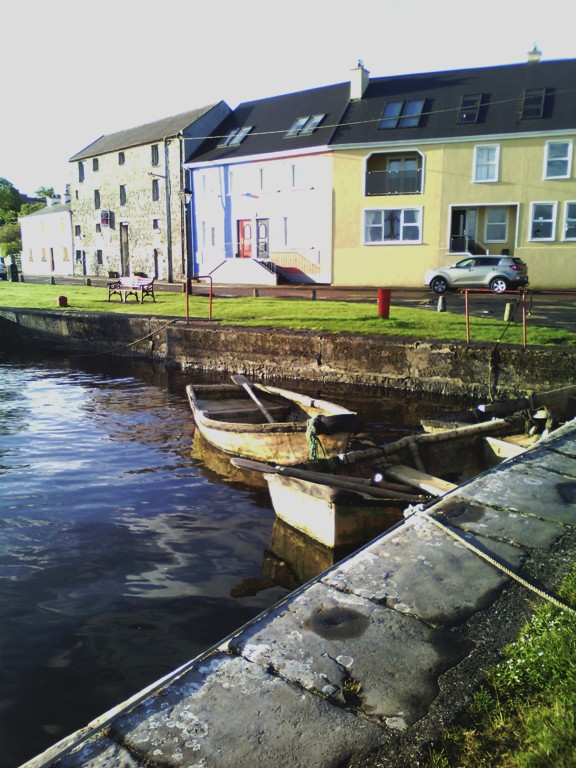
Photo: Norma Scheibe
The finest scenery in Ireland is on the northwest coasts of Connemara, Mayo and Donegal. There are no grander headlands in Europe than these broken, precipitous highland masses towering above the Atlantic.
Galway is the gateway leading into this picturesque region with its invigorating climate. A magnificent sea wall leads to it from Loop Head, at the mouth of the Shannon, with the glorious cliffs of Moher midway. Galway Bay is the outlet for a chain of lakes with which the highlands of Connemara are riddled. The coast is mountainous, with a succession of many coloured precipices and countless islands all the way from Clifden to Achill Head, where the Croaghaun cliffs are nearly 2,200 feet above the sea and thence along Mayo to Slieve League and the rock-bound highlands of Donegal. In picturesque colouring, grandeur, primeval wildness and elemental power there are few coasts that bear comparison with the north-western outstretch of Ireland.
Galway town is quaint and beautiful, and its charm of local colour comes from a strain of Spanish blood. For centuries it was a port commanding a large trade with Spain. Its merchants and sailors were constantly visiting and there were frequent marriages. While it was not Spanish in origin and attracted few settlers from the South, its architecture, gardens, manners and life were coloured by its associations with the more tropical country. The course of modern improvement has not been so rapid as to obliterate these traces of Spanish taste. While the town is not laid out with the regularity of a chess board, there is a central square or garden where the women are on parade on Sunday afternoon, and many of them have olive skins and coal-black eyes and hair. They have the same love of colour which fascinate Spanish women, and are brighter and gayer in dress than the Irish girls of Limerick, Dublin or Cork.
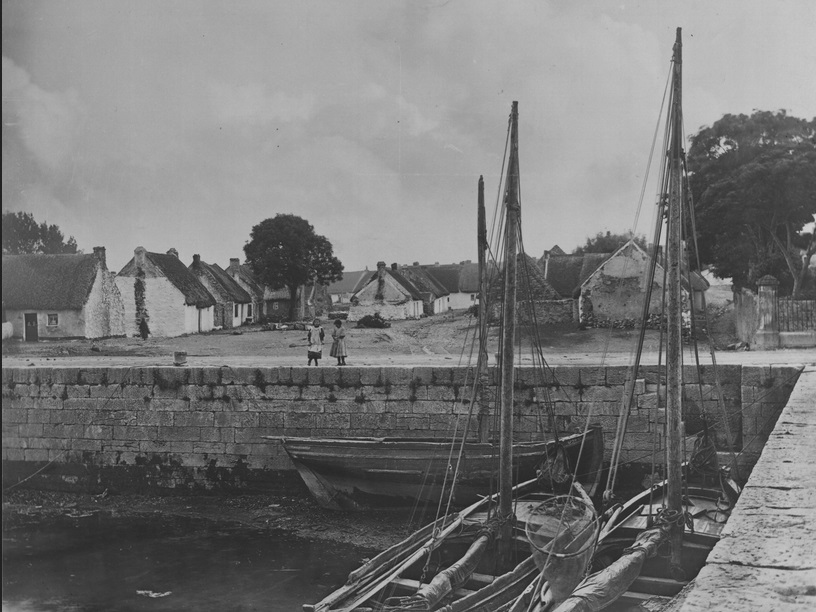
The Claddagh, Galway Photo: Robert John Welch (1859-1936) N.U.I.G. archives Creative Commons
The houses are also painted or kalsomined in pink, blue, yellow and white, so that there is a display of colour even in a quiet street like Prospect Hill – leading into green meadows. Neglected as the old houses with their central courts and wide entries and stairways have been, Galway still contains many of the distinctive features of a Spanish town.
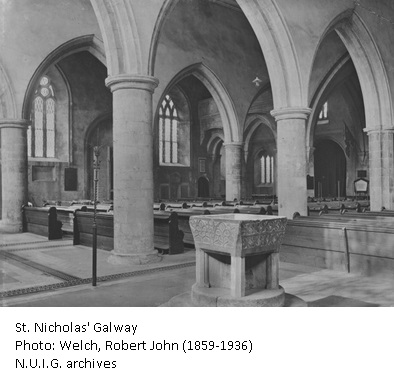
The Lynch mansion even in its present state of dilapidation goes far to support the composite reputation of this Irish Spanish port. This stronghold of a powerful family has degenerated into a chandler’s shop, but the medallions on the side, the decorated doorways and windows, and the grotesque heads near the cornice attest its foreign character; and the Lynch stone on the crumbling wall behind St. Nicholas’s Church perpetuates the grim sense of justice of its most famous tenant. James Lynch Fitzstephen, wine merchant and Mayor, was in Spain about the time America was discovered and invited the son of one of his friends to return with him to Galway for a visit. The guest flirted with the Irish girls, and was finally stabbed one night in the streets by a jealous rival. The murderer was the Mayor’s only son, who confessed his crime in an agony of remorse. The father, encouraged by this violation of hospitality, condemned his guilty son to death, and with his own hand conducted the execution, either from his own castle or opposite the church. The Lynch stone commemorates this act of stern, unbending justice, and with skull and bones rudely sculptured enforces the quaint inscription;
“Remember Deathe Vaniti and al is but Vaniti.”
Although the Castle and the mansions of the Burkes and the Joyces have fallen into ruin, there are Spanish patios, doorways, dripstones and archways, and even Saracenic windows, to be seen in the tangle of crooked streets, if one has the patience to look for them. More obvious than these peculiarities of ancient domestic architecture are the levels of colour and a gaiety of manner and spirits, which remain as unerring signs of Spanish infusion of blood. There are Spanish faces in the back streets, and Spanish voices are heard in the fish markets. Poverty is as real here as in other Irish towns, but its pathos is less moving because an instinctive effort is made either to hide it or take a cheerful view of it. There are flowers in doorways and windows; the cottages have touches of bright colours.
The Claddagh offers as interesting a study of the heredity as Spanish-Irish Galway. This is the strange suburb at the entrance to the harbour, where a tribe of coast fishermen has retained for generations many characteristic traits. These fishing folk disliked strangers, had little to do with Galway, lived by themselves and intermarried, kept out of ordinary courts of law, and allowed a chief, known as the Claddagh King, to settle all their disputes. Their King has been dethroned, and they have relaxed their discipline sufficiently to suffer fishermen not of the tribe to live among them and even to welcome tourists to their thatched cottages. The characteristic dress of the woman, a red gown and blue mantle with a handkerchief wound round their head, is still seen in this fishing colony, and every wife wears the Claddagh ring, with two hands holding a heart. The huddle of huts is one of the strangest and most fantastic spectacles on the Irish coast.
There was a time when a great commercial revival was predicted for Galway. A transatlantic packet line obtained a small contract and sought to take advantage of the shortest sea course between the United Kingdom and Newfoundland and Halifax; and extensive harbour improvements were planned in order to open the port to ships of the largest draught. The packet line lost two ships and abandoned the route and the breakwater has not been built; Galway, with its herring fleet and salmon fisheries has remained a fishing port.
The salmon fisheries have been improved by the construction of fish walks and ladders and by systematic measures for promoting breeding, and there are salmon leaps to be seen from every one of the picturesque bridges. Electric engineers have looked at the swift river pouring a torrent from Lough Corrib into Galway Bay, and suggested that power could be supplied at low-cost for creating a great manufacturing town. One small power house has been erected, and a few flouring mills are in operation.
With the opening of Connemara and Mayo to tourist travel on a large-scale by the construction of light railways, the establishment of coaching routes and the erection of new hotels, Galway’s fortunes are improving without commerce or manufacture. Curiosity shops have multiplied, and the Claddagh ring is prominent in every show-case. Wise men are suggesting that the town can be made more attractive to strangers by reproducing some of the bygone effects of domestic architecture and colour; and it is not unlikely that the paint-pots will be emptied upon the walls of the cottages before a new season sets in, and that garrulous guides will be in readiness to conduct tourists to every neglected ruin in ancient Galway. It is certain that full advantage has not been taken of the picturesque resources of this delightful fishing town, but it is also doubtful whether visitors can ever be detained very long on the edge of Connemara where there is a coast of unrivalled grandeur in reserve for them.
“New York Tribune”
On Friday last while Sergeant Feeney of the Kinvarra station was on patrol duty with a party of his men, he noticed an unusual volume of smoke in the direction of Kinvarra Quay, and at once went in that way. He found that a large boat belonging to a man named McDonagh from Connemara, and which had been moored at the quay was on fire. He and his men immediately jumped on board the boat and on entering the hold found two of the boatmen asleep. Having roused the men the entire party proceeded to extinguish the flames. Were it not for timely arrival of the police, the certainty is that the two men would have been burned to death.
The harbour authorities of Kinvara exact three pence for every load of turf coming in from Connemara. During the turf season over 20 boats come and go every day and this season the cost for a boat load of turf was from 45s to 60s.
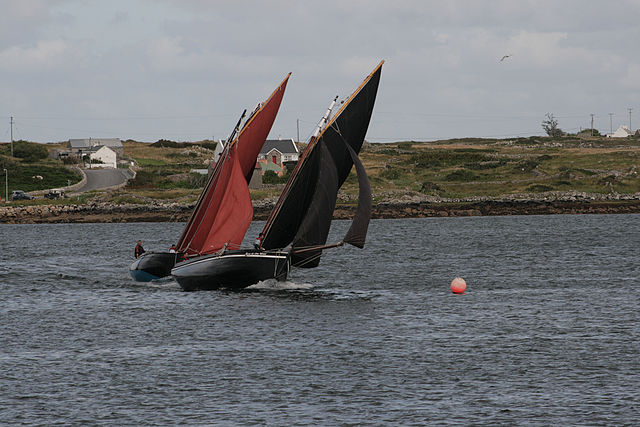
The men who bring the turf from Connemara are fine specimens of Irishmen. Each puckaun contains three men and they are excellent sailors and navigate their crafts in so expert a way that never an accident occurs. The turf is expensive but most necessary. There is no turf in the immediate neighbourhood of Kinvara or within miles of the town, so the people must depend on the supply from Connemara brought in these boats from over the bay.
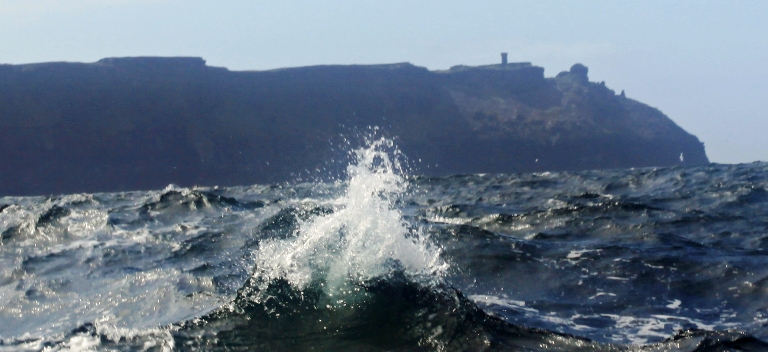
Roundstone, Connemara Photo: Julian MatzCOLONIAL TIMES 11TH JUNE, 1833
Dreadful Wreck of the Oporto Transport.(abridged)
At Clifden, in Galway, in December, a portion of a ship was seen floating near the entrance of Roundstone Bay. By the active exertions of the coast-guard, under the command of Lieutenant Hunter, R. N., it was secured. The following day, the remainder of the wreck was discovered, a few miles distance from the first-named place. Uniforms and several bodies have been washed ashore. A few trunks, with mutilated papers and other articles, found by Captain Busby, R. N, proved her a brig of about 350 tons burden.
The Sydney Gazette and New South Wales Advertiser 16th September, 1820
MERMAID
We extract the following article from The Galway Advertiser:-
Naturalists have hitherto doubted of the existence of mermaids and mermen:
We have it now in our (sic.) to set at rest the doubts of sceptics upon this duplex order of animals, one having been lately discovered basking upon the rocks of Derrygimla, in Errisberg (Connomara), after the ebbing of the tide. It was discovered by a female of the lower order, who was then about four months pregnant; she was suddenly startled by a kind of scream, which was followed by the plunging of an animal, half female and half fish, her lower extremities having the conformation of a dolphin. This woman was so terrified as to miscarry, and has never been able to leave her bed since.
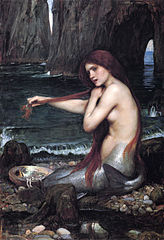
The tide being out, the animal had some difficulty in reaching the water. Thomas Evans, Esq. of Cleggan, a Gentleman well known to many of our readers, just arrived upon the coast in time to witness her last plunges. Having gained the water she disappeared for a few moments, but again appeared perfectly composed. Mr. Evans now had a favourable opportunity of examining this so long-doubted genus; it was about the size of a well grown child of ten years of age; a bosom prominent as a girl of 16; a profusion of long dark brown hair; full dark eyes; hands and arms formed like the human species, with a slight web connecting the upper part of the fingers, which were frequently employed throwing back her flowing locks, and running them through her hair. Her movements in the water seemed principally directed by the finny extremity; for near an hour she remained in apparent tranquillity, in view of upwards of three hundred persons, until a musket was levelled at her, which having flashed in the pan, she immediately dived, and was not afterwards seen. Mr Evans declares she did not appear to him to possess the power of speech for her looks appeared vacant, and there was an evident want of intelligence.
As this is the season of the fishery, we are in hopes some of our fishermen may draw her in their nets, as it is extremely probable, at the time she was first discovered, she was in search of some place to deposit her young. We understand several depositions upon oath as to this animal’s appearance are to be made. We are promised a more minute description which we shall be happy to lay before our readers.

 The Burren and Beyond