Posted in Posts and podcasts

The Stone Window – Kinvara – 1972

Connacht Tribune 8th September, 1972 p.17
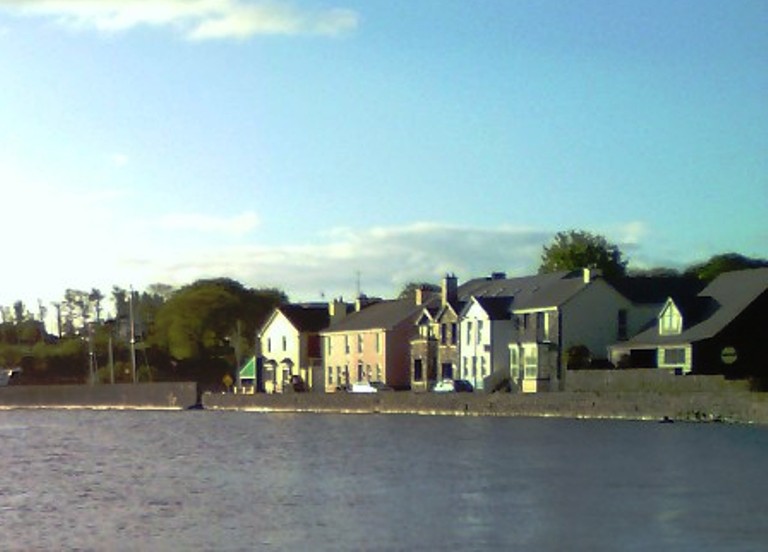
Kinvara Quay Photo: EO'D
Kinvara Quay
Photo: EO’D

Until such time as a professional archaeologist pronounces on the fine stone window and doorway discovered last week at The Quay, Kinvara, there is nothing to dispel the rumours and opinions circulating concerning their origin.
Their discovery was made by workmen demolishing the first of the old buildings at The Quay, the beginning of the £250,000 housing scheme planned for the town by a private company.
The three-foot window is obviously a church window and it stands fifteen feet from the ground, directly above a stone doorway which is nine feet high. On top of the window are inscribed the figures 1782.
The question is; Where did this window come from? Did it come from St Coman’s Church in the centre of the town at the rear of the main cluster of houses? Were the window and doorway part of a clergyman’s residence in the 18th Century? If this residence was once a Protestant clergyman’s home – and there is a local opinion that a Protestant Bishop lived there – were the ornate stone window and doorway incorporated into the original building? Or were they added to the building having been taken from a nearby church?
The intention of the demolition men at present is to leave these monuments in situ. The discovery of the monuments opens up a vista into a forgotten portion of Kinvara heritage. There is a most interesting history attached to The Quay over which has been passed by Galway County Council for the erection of houses.
It would be a great pity if the once hallowed precincts were to disappear without proper recording under the new structures.
Posted in Posts and podcasts

Church -v- State 1933

Anglo Celt 27th May, 1933 p.12 (abridged)

Photo: EO'D
Photo: EO’D

Speaking at Kinvara on Wednesday, after dealing with the Pastoral of 1931
Most Rev Dr O’Doherty said;
There is another evil that is creeping in slowly and the people must be on their guard against it. You may not know that some years ago a dozen young Communists from this country went to Moscow and Berlin to be educated in the methods of Communist propaganda and the Godless methods of Soviet Russia and came back, some of them paid, some of them unpaid, to propagate these methods in Catholic Ireland.

More on Kinvara in the news, archives at theburrenandbeyond.com

Posted in Posts and podcasts

Elysium via Kinvara – 1875

Photo: Norma Scheibe

Freeman’s Journal –  29 May 1875, page 4 

Celtic Voyages.

Ua Corra was a Connaught squire, not one of the jolly, fox hunting, rakish, ‘gentleman’ of more modern times, but a professor of the black art, who did not hesitate to hold direct communication with the devil, and to drag his wife into a partnership in  necromancy. Like the three witches in Macbeth, they had their vessels, and spells, and charms, and pit of Acheron.

And now about the caldron sing, 

Like elves and fairies in a ring, 

Enchanting all that you put in. 

These worthy parents had three sons in due time, who also surrendered themselves to the evil spirit. It was not confined to words. The three brothers at the head of a band of desperadoes, burned the churches and monasteries, and murdered their inmates. While their hands were still red with the blood of their victims, God, in a vision gave them a glimpse of the unspeakable torments of hell, which aroused them to a deep sense of their guilt, and to an earnest wish to repent. They entered the Magh Bile, where after expiating their crimes by a long course of penance, they resolved to make restitution, as far possible, for the ruin they had wrought.  Accordingly they set to work to restore the churches they had demolished.

While engaged on the church of St.Cainin at Ceaun Mara, now Kinvara— a little town pleasantly situated on the Bay of Galway – they witnessed a sunset of unusual magnificence. The bright orb, as it descended into the Atlantic, turned it into a stripe of gleaming gold. The gorgeous sight inspired the idea of an Elysium, and the enthusiastic brothers determined to go out under that distant horizon, float over those golden waters and be near the sun as it sank into the wave.

Having fitted up a bark they set sail from Kinvara and roamed over the mighty waters for many years. In their wanderings they came upon islands teeming with nature’s richest and rarest gifts.

Posted in Posts and podcasts

To sin he was prone….

Detail of stained glass window by Louis Comfort Tiffany in Arlington Street Church, Boston.  It depicts John the Baptist. Photo:John Stephen Dwyer CC=BY=SA=3.0
Detail of stained glass window by Louis Comfort Tiffany in Arlington Street Church, Boston. It depicts John the Baptist.
Photo:John Stephen Dwyer
CC=BY=SA=3.0

https://widgetworld3.wordpress.com/podcasts/
Truthful Tombstone in Kinvara Church

The most remarkable object within the town is the old church and burial place. It is particularly worthy of the antiquary’s especial notice, that the gable-end of the ruinous ecclesiastical edifice, just mentioned, which fronts the neighbouring castle, presents in that direction a round aperture, apparently designed for a clock. In the burial ground, surrounding the ancient house of worship, there are some comical monumental inscriptions to be met with. Amongst them are the following. On one tomb-stone is the pious couplet,
“James O’ Farrell lies under this stone; Pray for him, Christians – to sin he was prone.”
On another stone we find,

” Pray for the soul of Father Patrick Neilan, who
Dyed in ye year 1753,
Who lies under this stone,
He that feared but God alone.”

Of those departed persons, whose names are thus attempted to be perpetuated in doggrel verse at Kinvarra, it may be said with Grey,
” Their names, their years 
spelt by th’ unletter’d muse 
The place of fame and elegy supply.”