Posted in Posts and podcasts

I’m thinking tonight of Kilcolgan

The Schools’ Collection, Volume 0033B, Page 10_051
National Folklore Collection, UCD.
Greta St. George, Ballinderreen NS
No 1
I’m thinking tonight of Kilcolgan
That village far over the sea
To the cottage wherein I was born
My memory it brings back to me
Im thinking tonight of Kilcolgan

No 2
The stile that I often climbed over
The garden where many flowers grew
And mother so patiently waiting
How void was the picture to view

No 3
Kilcolgan I’m often times thinking
If you look as I saw you of yoe’r
For its twenty long years since I left it
And came to Americas shore

No 4
I wonder If there’s any changes
How many the friends I should know
That I used to ramble about with
In the dear happy days long ago.

No 5
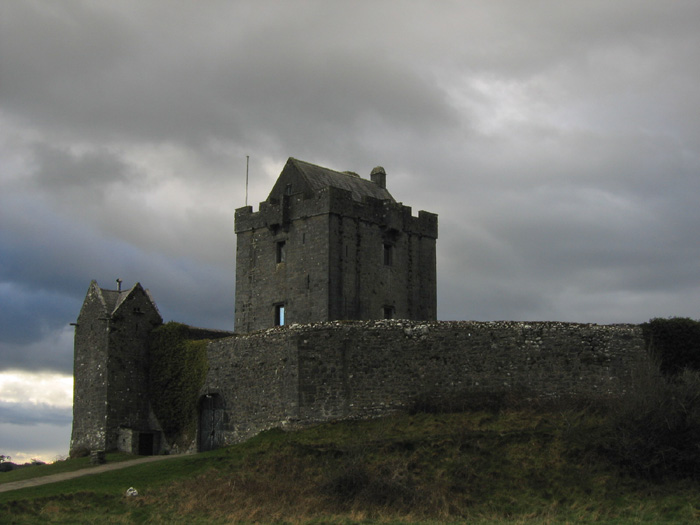
Is Kilcolgan castle still standing
Where I looked on with wonders so great
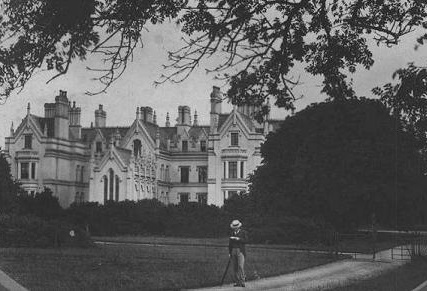
And the house of Tyrone not far distant
Where dwelt the St. Georges in state

No 6
The demaine with acres so many
Got round by a very high wall
The avenue where oft I did wander
With trees so stately and tall

No 7
Does the tide still come upon the river
How often I’ve watched it of yore
Does the boatmen from Old Connemara
Bring over the turf to our shore

No 8
Connemara I ne’er will forget you
Where gaedhlach is spoken go leór
Where fish and potatoes are plenty
And a welcome is always in store.

No 9.
A me will I e’re see you again
Shall I visit the land of my birth
Far dear to my heart is old Ireland
The dear little Isle of the blest

No 10
Shall I e’er see the Kilcolgan I know not
And still cherish hopes that may
And yet cross the stormy Atlantic
And sail into dear Galway bay.

No 11
To visit the home of my childhood
Once more to lay foot on that shore
And hear that glad welcome god save
As I often times heard it before.

No 12
I’ll still keep on hoping and longing
I’ll never give up in despair
But patiently watch and keep waiting
For the ship that will carry me there

This song was written by a man named John Wates
Posted in Posts and podcasts

Lydican Castle – 1922

Newmarket Era 3rd November, 1922 p2.
Lydican Castle, built in Cromwellian days in County Galway was destroyed by fire set by armed men on Saturday. The men kept the family occupying the castle under armed guard in an outhouse during the fire. The Republican forces who came on the scene helped to save some of the furniture in the castle. The fire is also said to have been due to trouble between agriculturalists and the owners of the estate.

Posted in Posts and podcasts

Midsummer Night

Midsummer’s night was one of the most solemn festivals of the ancient pagan world. It’s also known as the eve of St. John the Baptist.

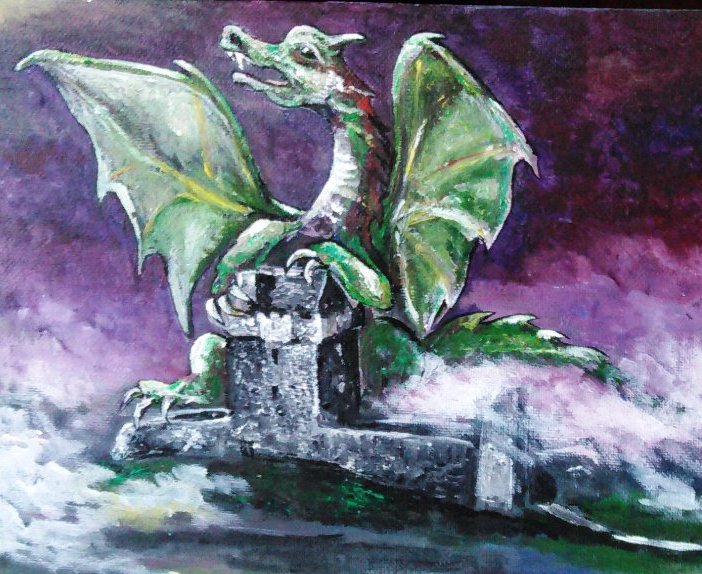
Dunguaire Dragon Acrylic on board EO'D
Dunguaire Dragon
Acrylic on board
EO’D

In pre-Christian times the first fire was lighted on the hill of Howth, on the east coast of Ireland, near Dublin, and the moment the flame appeared through the darkness a great shout went up form the watchers on all the surrounding hill tops, where other fires were quickly kindled. These were viewed by watchers further west, who in turn kindled their own fires and so on, until the flame had ‘travelled’ across the country.
It was also customary to walk three times around the fires, reciting certain prayers to ward off sickness during the coming year.The next morning was considered the proper time to hunt for mushrooms.
Midsummer’s eve is also a favourite fairy season. On this night, they are on the watch to carry off incautious mortals, particularly women and infants who are not protected by a sprig of lusmor (fada over o) or foxglove, or some other safeguard against fairy influence.

Posted in Posts and podcasts

Kilcornan – 1881

http://clarinbridge.galway-ireland.ie
Kilcornan was a 16th century castle of the de Burgo. In the 1830’s the Redington family built a mansion around it and incorporated the old tower in the design. http://clarinbridge.galway-ireland.ie

Irish Examiner 31st December, 1881 p.3
Yesterday the County Galway Hunt was to have its meet at Kilcornan Castle at ten o’clock. Long before that hour horns were sounded in all directions for miles around. As early as nine o’clock no less than five thousand persons had assembled at the entrance gate to the Castle. A pile of stones were placed before the gate, and it was evident by the demeanour of the crowd that the hunt would be stopped at any cost. At ten o’clock Mr. Burton Persse, the master of the hounds, together with several gentlemen and the pack, arrived. The crowd moved in front of the gate.
The master asked what had they against him. A young man stepped forward and said, “No hunting will be allowed until the suspects are released (great cheering). Mr Persse said they could not release them. The young man said they had done their best to bring about coercion. Mr Persse denied that they did. The young man;
“You cannot deny the evidence you gave before the Bessborough Commission.”
Just then fifty soldiers and about seventy policemen, under the command of sub-inspectors and a resident magistrate arrived. The officers had a brief interview with Mr Persse and the young man again came forward and asked,
“Why did you bring police and military?”
Mr.Persse denied having any knowledge of their coming and said that he was always anxious to have the goodwill of the people.

The resident magistrate, addressing the crowd, said if they did no disperse he would give an order to cut them down.
The crowd was about to move when a young man, a stranger to all, rushed and in a loud voice said, “Halt! Death or glory.”
The crowd halted, and two policemen placed him under arrest and threatened to fire. He retorted and said that they would lose their lives or stop the hunt. With a desperate effort he shook off the two policemen, one of them falling over a low wall, and was soon lost in the crowd. All the efforts of the police failed to recapture him.
The huntsmen then rode off in the direction of Oranmore, but were met by another immense crowd, who hooted, groaned, and pelted mud at them. A gentleman was apparently looking for something in his pocket and a report went out that he was searching for his revolver, whereupon sticks and stones were freely flung at him, and he escaped by riding off at full speed. The master was informed if he let the hounds into any of the coverts not one of them would be allowed out alive. A report has just arrived that three gentlemen were more or less injured. In consequence of the opposition to the hunt the following circular has been sent to all the members;
Ballinderry, Dec29th
Sir,
In consequence of the opposition to the hunting on Wednesday at Kilcornan, I am requested by the master of the hounds to call a meeting of the members of the hunt for Saturday next, 31st instant, at the Railway Hotel, Athenry, at two o’clock, where you attendance is particularly requested.
Yours truly,
J. W. Comyn, Hon. Sec.

Posted in Posts and podcasts

Dunguaire Castle – barracks, bullets and battles

Dunguaire Castle Creative Commons Photo: Postdlf
Dunguaire Castle
Creative Commons Photo: Postdlf

https://widgetworld3.wordpress.com/podcasts/

In 1842/1843 Tomas L Cooke rambled around Kinvara, Co. Galway and published accounts of his travels in the Galway Vindicator. Dunguaire Castle was one of the sites he visited, which he describes as…

a square building in the fashion of Queen Elizabeth’s reign, and of several stories in height, standing some distance outside the town upon a small elevated peninsula, surrounded by the sea, with the exception of one low and narrow isthmus, that connects it with the main land. A strong and high wall built along the verge of the declivity encloses the court-yard, or bawn. The outer gateway is large, and has an embattled wall with embrazures overhead. It is flanked on the right by a small quadrangular bastion, or tower, which commands it and the outward wall on two sides. In the sides of the tower, just mentioned, there are set in masonry some large stones, perforated with round holes of five or six inches in diameter, apparently intended for exposing the muzzles of small ordnance.

These defences were sorely tested. In Mr Cooke’s words...

The Castle of Kinvarra was, until very recently, used as a Barrack by a military detachment quartered here. The walls circumscribing the bawn, have, in former days been shattered in two of the angles, apparently by the fire of artillery from a sod battery thrown up about two or three hundred yards off, in the direction of Tubbermacduach. The platform of this ancient battery is still visible, and on it are placed at intervals some very large rocks, which, in all probability, served as shelter to the gunners against the fire of matchlocks or other small arms from the castle. It is not very likely that the besieged were altogether inactive or without using fire-arms, during the investment of the place…

Dunguaire Castle – built to last the test of time – and conflict.