

excerpt – BRIAN OF MUNSTER: THE BOY CHIEFTAIN
(by E.S.Brooks in St Nicholas)
And with this defiance the boy chieftain and ‘the young champions of the tribe of Cas’ went into the woods and fastnesses of County Clare, and for months kept up a fierce guerilla warfare. The Danish tyrants knew neither peace nor rest from his swift and sudden attacks. Much booty of ‘satins and silken cloths, both scarlet and green, pleasing jewels and saddles beautiful and foreign’ did they lose to this active young chieftain, and much tribute of cows and hogs and other possessions did he force from them. So dauntless an outlaw did he become that his name struck terror from Galway Bay to the banks of the Shannon and Lough Derg to the Burren of Clare.
Tag: Brian Boru
Brian Boru’s Harp… and Crown – 1849
https://widgetworld3.wordpress.com/podcasts/
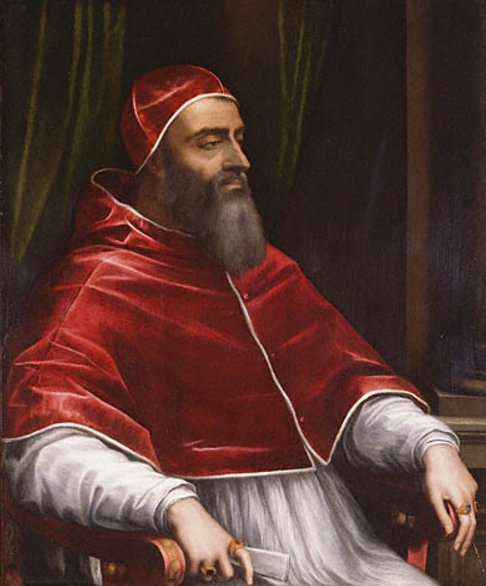
Sebastiano del Piombo – circa 1531
BRIAN BOROIHME’S HARP
It is well known that the great monarch Brian Boroihme (Boru) was killed at the battle of Clontarf A.D. 1014. He left his son Donagh his harp, but Donagh having murdered his brother, Teige, and being deposed by his nephew, retired to Rome, and carried with him the crown, harp and other regalia of his father. These regalia were kept in the Vatican, till Pope Clement sent the harp to Henry VIII, but kept the crown which was of massive gold.
Henry gave the harp to the first Earl of Clanricarde, in whose family it remained until the beginning of the eighteenth century, when it came by a lady of the De Burgh family into that of McMahon of Glenagh in the county of Clare. Following his death it passed into the possession of Consellor (sic.) McNamara of Limerick.
In 1780 it was presented to the Right Hon. William Conyham who deposited it in Trinity College Museum where it now is. It is thirty-two inches high and of good workmanship – the sounding board is of oak, the arms of red sally – the extremity of the uttermost arm in part is capped with silver, well wrought and chiselled. It contains a large crystal set in silver, and under it was another stone now lost.
Tipperary Free Press
 The Burren and Beyond