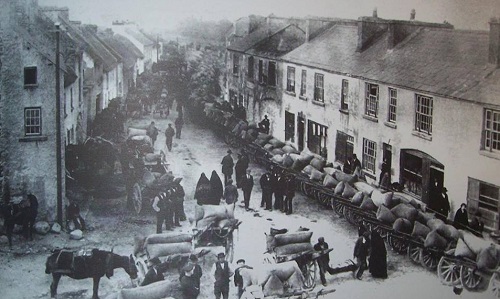
Collected by Mary Leary, Kinvarra, Co. Galway from Patrick O’Leary (age 70) Duchas.ie There is nothing as terrific as a house burning. It is dreaded by every-body. There is scarcely a town or city in Ireland without its share of ruins of burned houses. Galway comes under the rigour of burned houses as well as every other town and city in Ireland because in a town called Kinvara the ruins of a burned draper’s shop are to be seen. This draper’s shop is supposed to be burned by the Black and Tans about the year 1921 when Ireland was infested with them. The burning occurred about eleven o’clock on a dark stormy winter’s night. The Black and Tans entered the shop in a wild fury and went to the kitchen where a range was. They spilled petrol in the fire which immediately burst into flames. The blaze immediately reached the roof overhead, and they followed from the roof to the ceiling and thus the goods caught fire. The occupants of the shop tried to rush to safety and luckily enough they succeeded in escaping from the flames. Their attempts to rescue the contents of the shop were all in vain. All the goods that were in the shop were burned to ashes. Men from the neighbourhood did their best to quench the flames but it was impossible for them to overcome the raging flames. Water was brought in large quantities but the more water was thrown on the flames the wider they spread. Higher and higher they rose until the whole town was illuminated by their lights. The flames could be seen for miles and miles outside the town. Many lives were in danger in the conflagration. A near-by public-house was beginning to take fire when the occupants luckily felt it taking root. They sprang at once for water and neighbours helped them to extinguish the flames. No lives were lost in the burning. The fleeing of the occupants from the house at the beginning saved their lives. The wind blew very strong and this made the flames burn through more swift. On that account there was no possibility of saving the burning house. The ruins of the burned shop are to be seen in Kinvarra to the present day. Never will the terrific burning of the draper’s shop be in oblivion by the people of Kinvarra.
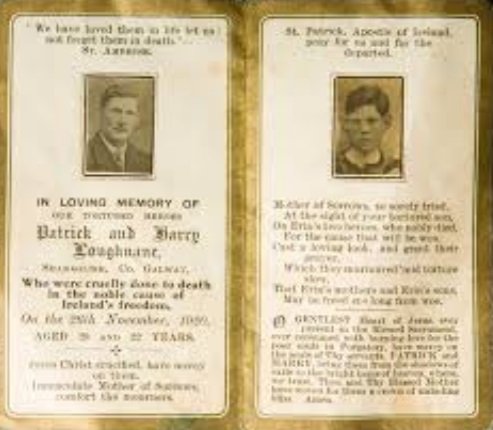
This was composed by a local poet who’s name is unknown. It is about the Loughnane brothers, natives of Shanaglish beyond Gort. They were members of the I.R.A. and they were brutally burned by the English. They were dragged behind two carriers for three miles and they died near Kinvara. Their bodies were then thrown into a pond and were not discovered till ten days afterwards. The Tans that committed this outrage in Nov. 1920 (abridged)
As the winter’s wind blew wild on a cold November’s night, The sad news reached Kinvara of a mournful tragic sight,
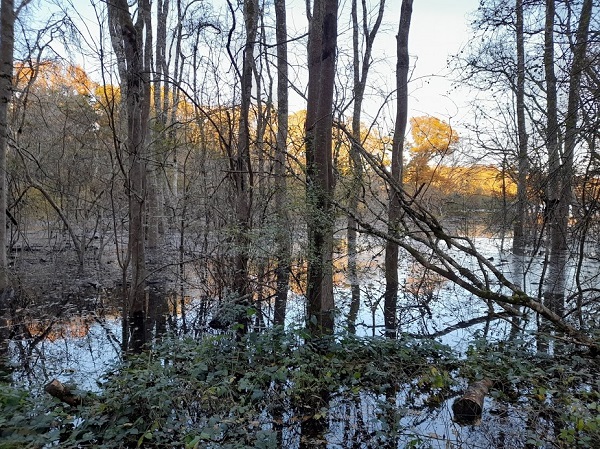
It was the finding of two brothers pale corpses lay side by side, Far from their loving mother these true hearted brothers died, They were taken by our enemies while threshing their mother’s corn, And came back cold corpses to the place where they were born, They were taken in a lorry by a military escort, From their native home Shanaglish Three miles south-west of Gort. II They were dragged behind two carries for three miles and more, Till the blood gushed from their faces and their bodes bruised and sore, They were taken to Drimharsin on a clear November’s day, While the blood gushed from their faces and their roars were head for miles away. “What they suffered God only knows.” III Their bodies were brutally burned as they lay upon the ground, Then left into a pond to prevent them from being found, For ten long days in this desolate grave unblessed by any priest Those martyred brothers Loughnanes by God’s aid was released, To an old house near Kinvara the funeral marched next day, Under a body guard of I.R.A. who took the remains away. IV That day was a sorrowful day for their mother, To see the fresh blood oozing from a wound in Harry’s side, Poor Padraigh’s flesh was torn, o’er his eyes were boiled within, There was nothing left to recognize but a nose and half a chin, His brothers bones lay visible as cold corpses they did lie, Their bodies they were coffined and wrapped in brown and white, And left into the Church of God where they rested that night. V The following day was a mournful sight for the mother of the brave, To see her darling boys going to the bosom of the clay, Those brother nursed with tender care are now beneath the sod, Their spirits are despite their foes today before their God, In the church yard of Shanaglish those two young heroes lie, They gave their blood for Ireland and died for you I, (sic) And gave up all they had on earth and suffered all these pains, To strike for you anther blow and smash the Saxon chains. VI Is there any rebel here amongst you still to repeat those words again, To thread the path of dauntless men who have suffered without fear or disdain, But if you be true to England by obeying her Saxon laws, They you’ll soon forget our men shot down by the cold blooded murderers, the servants of the Crown, Let this ring throughout land and echo over the main, That our gallant Loughnane brothers were not sacrificed in vain.
Irish Independent 4th December, 1934 p.12
Mr. Sean Russell, I.R.A. unveiled a memorial cross, and delivered an oration, near the spot where the mutilated bodies of Patrick and Harry Loughnane (brothers) were found in November, 1920 at Carragaroe, Kinvara.
The brothers were members of the Volunteers, and were taken from home by the Black and Tans; their bodies being discovered in a pond some weeks later. Members of the I.R.A. from many districts, including many old comrades in the Volunteers, paraded to the spot, where they formed a guard of honour, and recited a decade of the Rosary in Irish.
“A Black and Tan on duty in Dublin” by National Library of Ireland Wikimedia Commons –
The Black and Tans fired indiscriminately through the streets of Conakilty Sunday, smashing windows and causing considerable damage. At Moycullen a lorry filled with armed police rounded up the townspeople coming from mass, separated the men from the woman and drove the former into a field. A man, apparently the leader of the police, addressed them. He announced that a local land agent who had been forced to leave town was about to return home and that if a hair of his head was touched, six Republicans would fall in revenge.
After an attack on a police escort at Ardrahan, County Galway the local town hall was burned down by the police.
The Catholic Press 6th January, 1921 p9
IRELAND’S SADDEST TRAGEDY.
Young Mother Shot by uniformed assassins. (abridged)
Mrs. Ellen Quinn, who was shot on November 1 while sitting on the lawn in front of her farmhouse at Kiltartan, Gort, bled to death the same night. She leaves three children, the eldest of whom is not yet four years old. Rev. Father Considine, C.C., Gort, wired Mr. Arthur Griffith, T.C., on November 2:
‘Woman within two months of childbirth,and holding a child in her arms was shot by Galway police here Monday evening. Died few hours afterwards. Have wired Greenwood.”
At the time of the shooting Mr. Quinn, who is a farmer, was away. A messenger, who went for the priest and doctor, broke the painful news to him. Another messenger going to Ardrahan for Dr. Foloy was, it is reported, wounded by a stray bullet. Uniformed men passed into Gort subsequently, firing shots. When the lorry passed the house where the dying woman lay the terror-stricken occupants fled by the back way.
Rev. Father Considine gave a Dublin ‘Freeman’s Journal’ correspondent who called on him a graphic description of Mrs. Quinn ‘s last moments.
“It is too awful, too inhuman, to contemplate.”
These were Father Considine’s opening remarks concerning the tragedy. Pressed to explain what occurred, Father Considine said:
“I have read of Turkish atrocities; I have read of the death of Jean of Arc; I have read of the sufferings of Nurse Cavell, and as I read those things I often felt my blood boil, and I often prayed that the good God might change the minds and the hearts of those cruel monsters. Little did I then dream that I should witness a tragedy, an atrocity more hideous, more revolting, more frightful, more brutal, more cruel than any of those things, and here in our own little peaceful parish of Gort. My God, it is awful!
“About 3 o’clock on Monday, November 1, Malachy Quinn, weeping bitterly, called for me. ‘Father said he, ‘I have just heard that my wife has been shot. Will you run down immediately.’
I procured a motor car, and hurried to the scene. At the gateway there we beheld a large pool of blood. In the yard another pool, and the porch leading to the kitchen was covered with blood.
I entered the room. Oh God! What a sight! There lay the poor woman, the blood oozing out through her clothes. She turned her eyes towards me and said:
‘Oh, Father John, I have been shot.’
‘Shot!’ I exclaimed.
‘Yes,’ she replied.
‘By whom?’ I asked.
‘Police,’ she answered.
‘By police?’ ‘Yes,’ she replied, emphatically.
‘Did you see them?’
‘Yes.’
‘Where?’
‘On a lorry.’
‘How many lorries?’
‘Two.’
‘From which lorry did the shot come?’
‘From the first.’
Photo: Juni Wikimedia Commons
She then became weaker, Father Considine explained, and on rallying exclaimed:
‘Father John, will you do something for me?’
‘I tried to console her,’ he explained, ‘ and administered the Last Sacrament. When I had finished she whispered to me’:
‘Bring me Malachy, bring him to me, I hear him crying. I have something to tell him.”
I did so. What a scene. Then she became weak and fainted off. Gradually she became worse.
I sent word immediately to the Head Constable at Gort. He arrived with police and military. All seemed shocked at the tragedy. I asked him to go in and see the woman. He and his men felt the trial too much, as he answered, ‘I cannot.’
No trace of the bullet could be found.’
Continuing, Father Considine said Mrs. Quiiin was sitting on the lawn with her child when the lorry passed from which the fatal shot was fired. The bullet pierced the stomach, and the child she was holding fell from her arms. She crawled over the wall into the yard, and then crawled to the porch to tell her servant that she was shot.
‘Take in the little children!’ she exclaimed. ‘I’m Done! I’m Done!’
From 3 o’clock to 10.30 she lingered on in pain. Occasionally she would clasp my hand, pull me towards her, and say, ‘I’m done! I’m done!’ At 10.30 her condition became worse, and we knelt by her bedside to recite the Rosary and Prayers for the Dying, She tried to join, but was too weak. At 10.45 the little children began to cry, and with them the crowded house burst into tears. As I read the last prayer of the Ritual she looked around, then closed her eyes and died.
My God! what Turkish atrocity ever equalled this?
‘That morning,’ said Father Considine, ‘I had a note from her asking me to offer Mass for her deceased friends. Little did she dream tnat prayers for the repose of her soul would be asked for today from the altar?”


 The Burren and Beyond