Posted in Posts and podcasts

At Aughinish Point – 1857

Nation 21st November, 1857 p.9 (abridged)
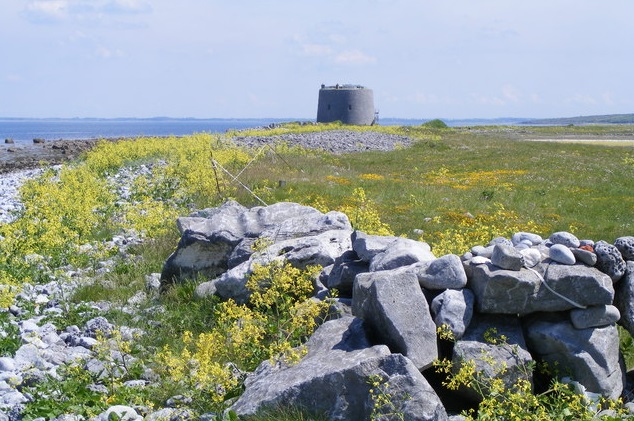
Martello Tower Aughinish Photo: A McCarron Wikimedia Commons
Martello Tower Aughinish
Photo: A McCarron
Wikimedia Commons

At Aughnish Point, a little fishing village in the wilds of Clare, on Monday last, two or three fishermen, with sorrowful faces, might be seen lifting off the strand, where it had been left by the receding tide, the lifeless corpse of a woman. From her long hair and humble garments, the sea water ran in streams over the friendly forms who bore their sad burden to a hut hard by. She whose lifeless form lay stretched upon the fisherman’s cabin floor had sought in death release from sorrow, not from shame. Over her story there hung no mystery, upon her memory no blot or blame. She had truly and faithfully given to society examples of heroism in affliction and fortitude in struggles where man’s endurance failed. Behind this record of its tragic close lies the story of a stainless life.

Twelve years ago, Mary McN. was the wife of an Irish farmer who tilled a little holding of four or five acres, which, with probably the proceeds of the fishing season, sufficed for all his wants. Death struck down her husband and left her single-handed to act a mother’s part with seven children. The black days of the Famine came. She had around her a young family, which, the evidence at the inquest tells us, she had always managed to bring up creditably and respectably. How hard she must have struggled. But now, indeed, the wolf was at the door, yet, she did not, even in that hour, despair. She wrought and wrought and toiled and slaved and never gave up the four acres nor deserted the little home beneath whose roof had passed the bright scenes in the drama of her humble life.

She came through those terrible famine years a victor. The little home still smiled, and still she had the ambition of bringing up her little boys and girls “respectably.” She achieved it all.

But, at last, a more terrible calamity than the Famine came upon her; one before which, all her striving was in vain. One against which, she strove until her honest heart broke in the struggle. The property upon which she was a tenant was sold in the Incumbered Estates Court. An envious eye was cast upon the little farm. In a perfectly “legal” manner Rev Mr J. outbid Mary for the spot which she had held for over twenty years. The spot she had struggled so hard, so bravely, to retain when the grave or the workhouse (to a heart less resolute) seemed inevitable. In vain she pleaded, begged, prayed. She was evicted.

The poor woman long refused to believe the fact. With passionate energy, she exhausted every possible means of retaining the farm. But the law was too strong. She had to quit. With her seven children she was adrift upon the world. The the strong mind gave way; the strained bow broke. For a long time, dejection settled upon her and she would ever keep talking of the humble home where once she had been happy, from which she had been driven forever.

Friends thought Time, the consoler, would calm the poor widow’s grieving; but alas her reason fled. The poor woman wandered about the fields, talking as of old, when they were her care; of the farming labours which she directed; of the hard struggles she fancied were still going on; of the old subjects of anxiety and foresight. She would shout out that she would not be reft of her humble home, that it was still hers.

But sometimes, as if a glimpse of the disastrous truth broke upon her, she would sink in prostration and talk dejectedly about the struggle in which she had been overthrown. Last Monday she was observed to wander to the waterside, pause for a moment, fold her arms, then plunge into the tide.
Take her up tenderly, kind neighbourly hearts; she was an Irish wife and mother, without stain and without reproach.
Posted in Posts and podcasts

Humour from Aughinish – 1907/1920

Sunday Independent 29th December 1907 p2 (abridged)

Behind the wall Photo: EO'D
Behind the wall
Photo: EO’D

Four prizes of half a crown each ar awarded every week for the four best jokes received for this column. Below are two prize-winning entries.

Poet to Editor:    “What do you think of this little poem of mine – ‘She would not smile?’

Editor to Poet:   “I think if you had read the poem to her she might have done”

Winner :Miss Nora McInerney
Aughnish, New Quay, Burrin P.O. County Clare

——————————————
and from the Sunday independent 17th October 1920 p6

Girl to friend: “I found that astronomer rather dull. He used to talk to me about the stars.”

Friend: “I don’t find him dull,” averred the other girl ecstatically.

“He says he talks to the stars about me.”

Winner: Miss Margaret McInerney,
Aughinish, Kinvarra, Co. Galway.

Posted in Posts and podcasts

Aughinish – 1898

Aughinish Tower Wikimedia org
Aughinish Tower
Wikimedia org

Kentucky Irish American 23rd July, 1898 p7

Major Wilson Lynch of Galway has been evicting his unfortunate tenants at Aughinish, on the south side of Galway Bay. He has dispossessed Michael Costello, his wife and many little delicate children. The wife had a doctor’s certificate testifying to the danger of removing her, but out she had to go. Costello has paid over and over again the fee simple purchase money of his dwelling.

Posted in Posts and podcasts

Burren memories – 1890

Photo: Matthew O'Brien Wikipedia.org
Photo: Matthew O’Brien
Wikipedia.org
https://widgetworld3.wordpress.com/podcasts/
THE ADELAIDE ADVERTISER 18TH MARCH, 1890
ST. PATRICK’S DAY – CELTIC DEMONSTRATION

Excerpt from Mr Patrick MacMahon Glynn M.P (President Irish National Federation) address;
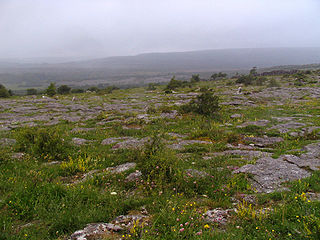
…”Some of you may have, like myself, been born in the West. There by a road which winds along the side of the Burren Mountains is a spring of clear cold water such as the water which fills our day dreams but not our throats, when the mercury is dancing a South Australian hornpipe between 100 degrees and 110 degrees in the shade. It is called Patrick’s Well. Why, I am not sure. I may have been baptised there and don’t remember. Some say that my great namesake once or twice opened his flask by that spring. If he did it is proof that he had a taste for more than spring water, for the sight commands a splendid view of Galway Bay. It was there that I first felt the romance of the sea, as I watched with the wondering eyes of childhood the turf boats glide down between Aughinish and the mainland on the swift ebb of the tide. This is one of the characteristic reaches of a western bay. Outside on the shimmer of the horizon are the wild islands of Arran against whose bold cliffs beat for ever the breaking swell of the Atlantic. It is there that you can feel the glory of Shakespeare’s rebuke of the surges that “Wash both heaven and hell.”

Posted in Posts and podcasts

Travels – Kinvara, Aughinish 1917

Shore and Stone EO'D
Shore and Stone
EO’D

https://widgetworld3.wordpress.com/podcasts/
SEEING THE WORLD
Travel Notes [XX-by the Hon. P.McM.Glynn, K.C. Minister for Home and Territories]
The Register 18 June 1917 p6
Driving round by the flaggy shore to Ballyvaughan and then across a gap in the Burren Mountains towards Kinvara, from which a fine view of the inner part of Galway Bay, the promontory of Aughinish and the swift current of the sea between it and the mainland, is open; along dusty limestone roads; the crumbling walls of deserted houses are seen in many places by the way. Most people of the past seem to have gone to heaven or the United States.
Politics, as they go, are still matters of conversational interest here. The Sinn Fein movement is mentioned by some with sympathy for motive and contempt for methods and organization. The rising came as a surprise, if not a shock to some persons, but there were, or are, scattered sympathisers or objectors to the more drastic of the methods of repression among the middle as well as the working classes. For among those who paid the inevitable penalty of revolt in time of war were some leaders of ripe scholarship and, in other respects, stainless lives; “Poets of the Insurrection” as they were called, whose mistakes of judgment, policy and method are lightly regarded by those of emotional temperament to whom disinterestedness primarily appeals. Discontent now turns on the recent check to Home Rule as expressed in the Government of Ireland Act 1914. There is a feeling that the political system – Union Government – is still the source of any economic maladjustments and that the country will at once flower under the working of autonomy.

Posted in Posts and podcasts

1st of November 1775 – the earth moved in Kinvara – and Aughinish – and Corranrue…

https://widgetworld3.wordpress.com/podcasts/

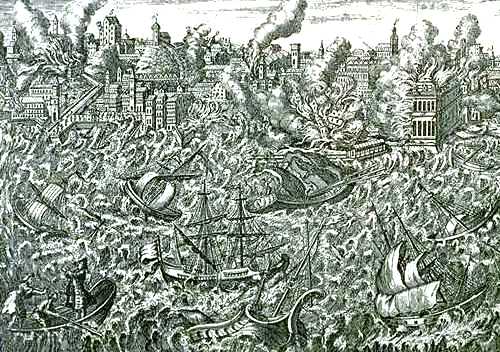
Lisbon, Portugal, during the great earthquake of 1 November 1755. This copper engraving, made that year, shows the city in ruins and in flames. Tsunamis rush upon the shore, destroying the wharfs. The engraving is also noteworthy in showing highly disturbed water in the harbor, which sank many ships. Passengers in the left foreground show signs of panic. Original in: Museu da Cidade, Lisbon. Reproduced in:  The Lisbon Earthquake.  British Historical Society of Portugal, 1990
Lisbon, Portugal, during the great earthquake of 1 November 1755. This copper engraving, made that year, shows the city in ruins and in flames. Tsunamis rush upon the shore, destroying the wharfs. The engraving is also noteworthy in showing highly disturbed water in the harbor, which sank many ships. Passengers in the left foreground show signs of panic. Original in: Museu da Cidade, Lisbon. Reproduced in: The Lisbon Earthquake. British Historical Society of Portugal, 1990 Wikipedia.org
It is reported, I know not on what authority, that, on the 1st of November, 1755, the day of the great earthquake at Lisbon, a castle, on the western boundary of the parish of Kinvarra, which had formerly belonged to the O’Heynes,’ was destroyed, and a portion of it swallowed up.
(Thomas L. Cooke’s rambles 1842/43)

The 1755 tsunami is also thought to have separated the small island of Aughinish, on the southern shores of Galway Bay from Co. Clare. The castle of Corranrue (Norman) was also damaged.