Posted in Posts and podcasts

Seaside places of Clare – 1871

The Irish Times 1st August, 1871 p 3.
Lisdoonvarna Spas and Sea Side Places of Clare, by E. D. Mapother, M.D. Price 1s, Dublin: Fannin and Co., 1871


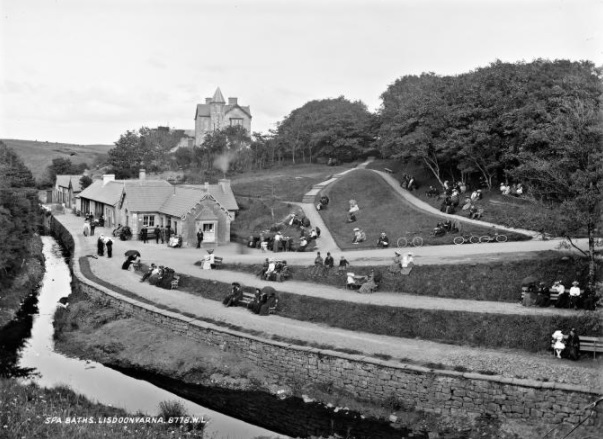
Is there any of our readers who desires a short sojourn amid beautiful scenery, with the briny breezes of the Atlantic for his lungs, and the choice of a great variety of mineral waters for his digestive system? He can effect this purpose conveniently and economically by a visit to the places, the names of which stand at the head of this notice. Leaving the Broadstone station at 8.50 a.m., he can reach Athenry at 1.40, and Gort an hour later. From Gort station, a well-appointed two-horse car will take him to Lisdoonvarna at about 8 p.m., for a 4s fare. The traveller who has no objection to linger on the way will find enough to interest him for a few hours’ in both the former places. At Gort he will be charmed with the beautiful Lough Cooter, the bold outlines of the Burren and Derrybrian mountains, and the fantastic course of the river alternately subterranean, and revealed to view which flows from Lough Cooter into the Bay of Kinvarra, forming the Ladle, the Punchbowl, the Beggarman’s Hole and the Churn on the way. Athenry is celebrated for its extensive and interesting ruins, attesting the ancient importance of the town as the seat of the presidency of Connaught in the days of Elizabeth and her successors, down to Cromwell. From Gort the car takes him along the southern coast of Galway by Kinvarra, New Quay (a pretty bathing place) and Ballyvaghan, the most picturesque view being had from the Corkscrew road which winds upwards from a point three miles beyond Ballyvaghan. The barony of Burren, in which Lisdoonvarna is situated, was described by Cromwell’s General, Ludlow, in terms suggestive of the business which brought him there. He says; “This is a country in which there is not water enough to drown a man, wood enough to hand a man, nor earth enough to bury a man.” There is earth enough, however, to feed some of the best mutton in Ireland, as those who dine at either of the two hostelries of Lisdoonvarna will allow.
The mineral springs are five in number; one of them, called by Dr. Mapother the Double-Arch Iron Spa, is now disused. Of the others, two are sulphur springs, and one of those is the Gowlaun, sufficiently copious to supply baths. A third spring, the Rathbaun, is a chalybeate, and contains as much iron in ten pints as Newbridge Spa contains in seven. The remaining spa is magnesian, but Dr. Mapother says that “it scarcely deserves the name.”
The first medical writer who gave an account of the mineral springs of Lisdoonvarna was the famous Dr. Lucas, M.P. for Dublin, whose statue adorns the City Hall. His analysis was made in 1840 and is quoted seventeen years later by Dr. Rutty, in a work now hard to get, entitled the “Mineral Waters of Ireland.” The barony of Burren, in which Lisdoonvarna is situated is, says Dr. Rutty, “remarkably rocky and dry, the air, wholesome, and the herbage between the rocks which lie very close together very sweet and nourishing, so that the farmers send their cattle in winter thither and it fattens them better than hay would do.”
There can be no doubt about the rocks nor the wholesomeness of the air, nor the sweetness of the pasture; but if Lisdoonvarna was remarkably dry in Rutty’s time the climate must have undergone a considerable change in the hundred and odd years that have elapsed since he wrote. Dr. Mapother’s little book, gives a far more correct and complete account of the mineral springs of the County Clare than any previously published. Dr. Apjohn’s pamphlet is out of print. Dr. Mapother quotes from it, however, the analyses made by that eminent chemist Dr. Apjohn, who wrote in 1853, adds:
“This consideration indicated by science is amply confirmed by experience, for the numerous invalids who visit annually these waters bear the strongest testimony to their curative powers; and the Chalybeate springs of Lisdoonvarna are now recommended with confidence to their patients by the most eminent members of the faculty in the metropolis and other parts of Ireland.” Dr. Mapother seems to rank the principal sulphur spring quite as highly as the chalybeate for its special purpose. His testimony ought to be conclusive on the subject for he is known to have made a careful study of the spas of England and of the United States as well as of his own country. The visitor will be at no lack for splendid coast scenery. The far-famed cliffs of Moher, Galway Bay, on the one hand, and the Shannon on the other, with the islands which fringe the coast, are all within easy reach by car or boat. The cars are well horsed and always to be had, the tariff being 6d per Irish mile, the cheapest travelling, perhaps in the world. Dr. Mapother makes an admirable suggestion which we give in his own words (p page 46)
“The greatest benefit to the poor labourers and artisans would arise from the establishment of an Infirmary at Lisdoonvarna, where the victims of rheumatic gout, a disease more prevalent in Ireland than in any other country, could be lodged, and inexpensively fed. The cost of a plain building, to contain twenty beds, need not exceed £300; and allowing each patient from two to three weeks’ residence, about 200 would be relieved in the season, from May 1st to October 31st. The maintenance and attendance of the patients would cost from £200 to £260 for these six months, and much of it would be readily subscribed by the proprietors, who would profit by the proven value of the spas, by the wealthier visitors, and by public bodies who sent patients there. Such institutions, similarly supported, exist on a large scale at Buxton and many other famous health resorts, which I feel are in no degree superior to that which I have now inadequately described.”
Posted in Posts and podcasts

Frongoch – 1916

The Connacht Tribune, 1st July, 1916 (abridged)

Frongoch
Frongoch postcard

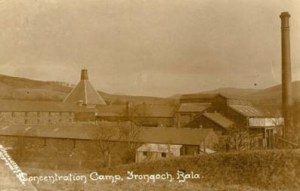
The censor of Frongoch internment camp informs us that Tuesdays and Thursdays are visiting days from 2 to 3 p.m. Prisoners can receive only one visit a month, and applications for permits must be made in writing to the Commandant, allowing sufficient time for reply by post. No admission is granted except on production of the permit. The following have been removed from Stafford to Frongoch;
James Fahy, Doughiska, Galway
Thomas Newell, Castlegar
John Murphy, Athenry
Michael Burke, Doughiska
William Cody, Claregalway
Thomas Silke, Castlegar
Michael Glynn, Lydican
Mr. Joseph O’Flaherty, Loughrea
William Harte, Oranmore
Richard Wilson, Loughrea
Dominic Corbett, Craughwell
Jeremiah Galvin, Slieverue
Christopher Caulfield, Athenry
Martin Walsh, Athenry
Peter McKeown, Athenry
Patrick Kennedy, Athenry
Joseph Cleary, Athenry
Pat Keane, Athenry
Ml Commons, Athenry
Ml Cunniff, Galway
Ml Costello, Galway
Martin Costello, Galway
Pat Costello, Galway
Martin McEvoy, Galway
John Cullinane, Galway
William Higgins, Galway
Michael J. Dunleavy, Galway
Richard Wilson, Galway.

Posted in Posts and podcasts

Padraic Uas O’Fathaigh – 1916 – Gort and South Galway

Connacht Tribune 27th December, 1968 p3. (abridged)

Liam Mellows Wikimedia Commons
Liam Mellows
Wikimedia Commons

Mr Fahy begins his story of Easter Week by recalling the arrest and imprisonment of Liam Mellows in the Autumn of 1915 and his deportation to Reading in April 1916. At that period the Galway County Board of the Irish or Sinn Fein Volunteers, which governed the force, had Mr George Nichols, Galway as chairman; Joseph Howley, Oranmore, treasurer; and Padraic O’Fathaigh, Lurgan, Gort, secretary, with Larry Lardner, Athenry as Brigade Commander. Meetings were held at Athenry and Mellows had his training camp at Ballycahalan. Mr. O’Fathaigh continues his story;

A convention was held in Limerick, at which plans were made for the Easter Sunday Rising. The delegates from Galway were Commandant Larry Gardner, Rev. Fr. Feeney, C.C.; Tresa Bhreathnach, Eamonn O’Corbain and Padraig O’Fathaigh. Mr. Ledden presided at the meeting, and it was arranged that the expected arms from Germany would be taken to Abbeyfeale and there sorted, some to be kept, and the remainder taken by rail to Gort to arm the Volunteers who would muster there on Easter Monday. Handbills about the Gort Monster Meeting were displayed at the Limerick Hall.
“Con” Fogarty would take the arms to Gort. Commandant Colivet would take charge of the Limerick Brigade of the Irish Volunteers at Limerick city. The Clare Battalion, led by Commandant Michael Brennan, would take any Clare barrack they might surprise, but would make no delay in moving to augment the Limerick Volunteers. The Companies of the Galway Brigade would attack the R.I.C. barracks in their area on Easter Sunday.

EASTER SUNDAY 1916
Commandant Larry Lardner was in command, Commandant Liam Mellows having been deported to England. The wily Commandant Mellows, however, succeeded in evading arrest and turned up at Mrs. Walshe’s house in Killeeneen some days before the intended Rising. Liam Mellows ordered that his escape should be kept a secret known only to the Walshe family, Eamonn Corbett and myself.
Liam’s uniform, enclosed in a parcel addressed to Mrs. Walshe, was expected to come via Athenry and its safe delivery was important. Since 1909 I taught Gaelic every Wednesday and Thursday night in Athenry.  My visit to Athenry on Wednesday elicited no surprise. Eamon Corbett was mixed up in rate collecting and travelled extensively. We got the parcel safely; George Fahy at the Railway Hotel and Berty Powell at the Railway Station would have scented out any danger. We took the parcel with all speed to Killeeneen; I thus missed the Irish class for the first time in seven years.

to be continued on theburrenandbeyond.com

Posted in Posts and podcasts

Athenry – 1869

The Brisbane Courier 11th December, 1869 (abridged)

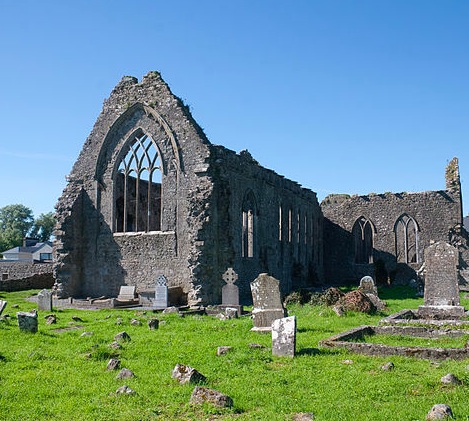
Athenry Priory Photo: Andreas F. Borchert   Wikimedia Commons
Athenry Priory
Photo: Andreas F. Borchert
Wikimedia Commons

The trial of the man for shooting at Captain Lambert near Athenry, on the 12th of July, has ended very unsatisfactorily. The jury were not able to agree and he will have to be tried again. A large sum of money has been subscribed for the defence, and one of the jurors, who was understood to have been in favor of a conviction, was pelted by the mob. The window’s of the judges carriage, also, were broken by stones.

On the evening of the day of the attempted murder a young man was found apparently asleep in the train that runs from Galway to Dublin. In reply to the police, he said that he had got into the carriage at Galway, but two fellow passengers corrected him, and insisted it was at Athenry.  Suspicion was aroused, and he was taken into custody.
He was then discovered to be the son of a tenant whom Captain Lambert had ejected, and a recently-discharged pistol was found in his possession. He had left London on the 11th of July, ” for a trip into the country,” as he told his landlady, and the pistol was traced to a shop in Tottenham Court Road, where he had bought it. In addition to this Captain Lambert positively swore that, he was the person who had fired at him, Yet the jury were unable to agree upon a verdict!

He will be tried again on the 14th of October.

Posted in Posts and podcasts

Athenry Handball Contest – 1909

THE TUAM HERALD,

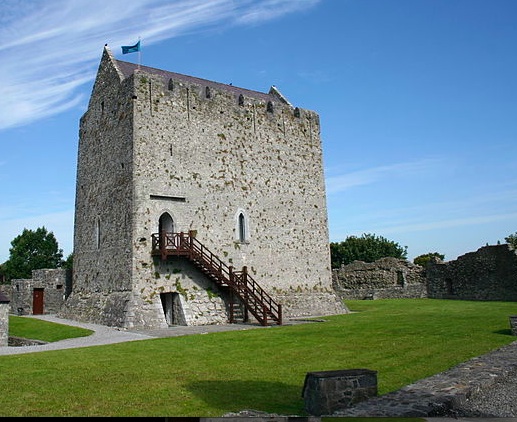
Athenry Castle Photo : Ingo Mehling  Wikimedia Commons
Athenry Castle
Photo : Ingo Mehling
Wikimedia Commons

14th August, 1909

The most interesting handball contest that ever was brought off in the West of Ireland will come off at the great tournament organised by the Athenry Handball Committee on Sunday, August 29th. All the great exponents of this grand old game in the country presently have promised to attend, and some fine games may be expected. The committee have left no stone unturned to make this tournament a success. They are offering three beautiful gold medals to the winners, and three very good silver medals to the runners-up; and the Athenry ball court has undergone a special course of preparation for the event, a large amount of money having been spent upon it.

The rubber is to be the best of five games, and teams to consist of three players each. All entries close with the Hon. Sec, Mr L Lardner, Church Street, Athenry, on Wednesday, August 25th. Entrance fee, 5s, each team. We understand that a team from Tuam will compete at the handball tournament and will be represented by J. Sheehy, M. Flannelly and M. Hession.

Posted in Posts and podcasts

N.U.I.G – 1845

N.U.I. Galway Wikipedia.org
N.U.I. Galway
Wikipedia.org

The Spectator 24th May, 1845 P9

The Roman Catholic Bishops met in Dublin on Wednesday, and took into consideration the Government bill for academical education.

It is understood that they object to the bill, because it does not place the religion and conduct of the pupils under the control of their religions instructors.  The final decision, as well as the meeting, was adjourned till Friday.

A public meeting for the town and county of Galway was held last week, to petition the Queen in favour of placing in that town (rather than in Cork) the intended Western College for the province of Connaught. The measure was generally approved by those present, both lay and clerical; but some guarantee for the moral and religious charge of the teachers was desiderated. The petition, however, was adopted by a large majority. Belfast and Derry are also con- tending, for the Northern College.

Posted in Posts and podcasts

News in brief – 1912

Wikipedia.org
Wikipedia.org

Northern Star = 11th May 1912 p9
Boycotting and Police (abridged)
There has been no cattle driving in the county since July 1911 but in other reports generally the county in the direction of Athenry, Craughwell, Oranmore, Gort and Kinvara, and bordering on the County Clare, was in a deplorable state. In the great majority of cases no one was to be made amenable notwithstanding all the efforts of the police, and it would seem as if the Executive was completely paralysed in these districts.
In one of the attempted murder cases a labourer working for the Estates Commissioners was fired at and wounded at Woodberry; in another case three shots were fired from behind a wall and a man was hit; in a third a shot was fired through the window of a cottage and the greater part of the charge entered the jaw of an unfortunate man who was sitting inside; in a further a sergeant and a constable were fired at from a wood and the sergeant was wounded; and in a fifth, which occurred near Oranmore, four shots were fired at six men who were passing along the road in a car, and all but one of them were wounded.

Posted in Posts and podcasts

An Irish Ship canal – via Doorus and Island Eddy – 1884

 Island Eddy as it appears on 'A Map of the County of Galway in the Province of Connaught in Ireland' by WIlliam Larkin (London 1818).
Island Eddy as it appears on ‘A Map of the County of Galway in the Province of Connaught in Ireland’ by WIlliam Larkin (London 1818).
FREEMAN’S JOURNAL 18TH OCTOBER, 1884 P6
AN IRISH SHIP CANAL.

The suggestion of constructing a ship canal across Ireland, from Dublin to Galway, or Dublin to the Shannon, has been warmly taken up by eminent and competent men in London. Elaborate plans and surveys have been made at considerable expense, which have been submitted by Captain Eades, the great American engineer. The plans for the Irish Canal have been prepared by Mr. T. A. Walker, Great George-street, Westminster, who recently bored a tunnel under the Severn, the largest undertaking of the kind in the country.

Silently but steadily a staff of engineers have levelled the country between Galway and Dublin Bays, and the plan, although carefully prepared, is largely tentative, its object being to show the practicability of a project of the kind. The proposed canal would be 127 miles in length and would contain upwards of 30 locks. The estimated cost is, of course, ruled by the tonnage of the ships it is intended to accommodate. Thus if for ships of 1,500 tons the cost would be eight millions, for ships of 2,500 twelve millions, and for ships of 5,000 and upwards twenty millions sterling. If built on this scale, and it is considered that anything smaller would be a mistake, the canal would be 200 feet wide on the surface and 100 feet at the bottom.

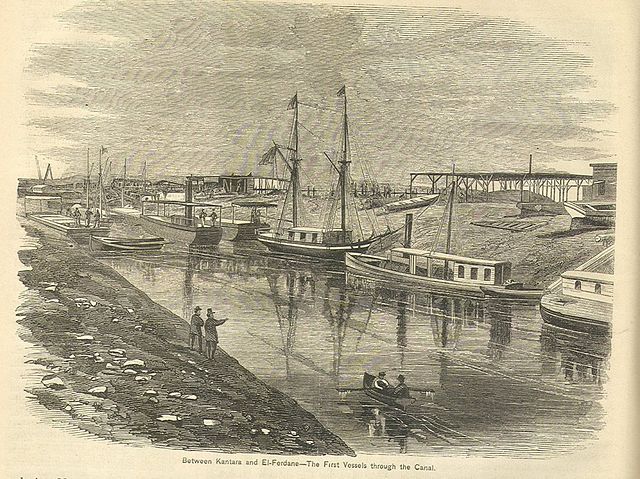
Suez Canal, between Kantara and El-Fedane. The first vessels through the Canal. 19th century image. From "Appleton's Journal of Popular Literature, Science, and Art", 1869.
Suez Canal, between Kantara and El-Fedane. The first vessels through the Canal. 19th century image.
From “Appleton’s Journal of Popular Literature, Science, and Art”, 1869.
In considering these dimensions it must be remembered that the Suez Canal except at its mouth is not 80 feet wide. The depth would be from 30 to 35 feet, and the locks would be fitted with the newest hydraulic apparatus so as to make the process of lockage as simple and expeditious as possible. The passage through the canal would be effected through, a system of towage, although it is somewhat of an open question whether this would be preferable to permitting the steamers to work through.

It is estimated that the passage of a ship from Galway Bay to Kingstown would occupy between 24 and 36 hours. An alternative scheme of a ship railway, in which the ships would be carried in cradles, which, he says, could be constructed for ten millions by his plan, the duration of the passage through the island would, he declared, be reduced to 12 hours.

The proposed course of this great work will be of considerable interest.

The canal starts from Doores Strait (sic.), south of Islandeaddy, in Galway Bay, where the shallowness of the water necessitates the dredging of a channel for a considerable distance out. This proposed canal would give a depth of thirty feet at low water, and would be protected from the silting up of the sand by suitable works. The entrance to the canal would be by a sea lock 600 feet in length, capable of taking ships of 5000 tons. From this lock entrance would be gained to a dock of 29 acres in extent, constructed on an arm of the sea, known as present as Brandy Harbour. The first inland lock would be less than a mile up at Killemaran, (sic.) from whence the canal would pass close to Drumacoo, then turning slightly to the north by Kilcolgan on to Rahasane, and passing about five miles to the south of Athenry, and crossing the Athenry and Ennis Railway at Craughwell, where the fifth lock would be situated. The sixteenth mile of the canal brings it about one mile to the north of Loughrea, from which town there will be a feeder to supply fresh water from the lake which is ten feet above the level of the canal, the latter being 260 feet above sea level. From this point there is; a long straight line of canal without locks until it roaches Eyrecourt, whence an immense aqueduct is to be constructed to carry the canal over the Shannon